
Stock Trading for Beginners: What It Is and How to Start

Stock trading is the activity of buying and selling shares of publicly listed companies to profit from short-term price movements. Traders hold positions for days or weeks, while investors buy and hold for months or years to build wealth through compounding and dividends, so trading has its own instruments, costs, and risks. The shares change hands on regulated exchanges such as the NYSE, NASDAQ, and Euronext, where an order-matching system pairs bids and offers in real time. Prices follow supply and demand from moment to moment, and the gap between the highest bid and the lowest ask is the spread, a built-in cost of every trade.
Stock trading carries meaningful financial risk, and broker disclosures required under EU regulation show that 70% to 80% of retail accounts trading leveraged instruments lose money. Three general risks apply to every instrument: market risk, behavioural risk, and concentration risk. Behavioural risk is the most actionable for a beginner, because it comes from predictable emotional errors such as holding losing positions too long and trading too often. Those errors explain the high loss rates of active traders in research by Brad Barber and Terrance Odean. Concentration risk grows when a trader puts all available capital in a single stock, and diversification and position sizing are the standard defences against it.
Each of the four ways to trade stocks adds risks of its own to these three. Buying shares directly gives ownership without leverage by default, while a stock CFD tracks the price of a share without ownership and is leveraged by default. Options and futures are contracts whose value comes from an underlying stock, and an option that expires worthless costs the buyer the whole premium. A stock ETF spreads the risk across all the companies in an index, and still loses value when the whole market falls.
Regulation decides which of these instruments a trader can use. US law does not permit CFDs for retail traders, while ESMA rules cap leverage on stock CFDs at 5:1 in the EU and give retail clients negative balance protection, and the FCA in the UK and ASIC in Australia apply similar restrictions. Before opening any account, a beginner should confirm that the broker holds a licence from the financial regulator in their own jurisdiction.
Traders choose among six main styles: day trading, swing trading, position trading, scalping, algorithmic trading, and copy trading. Trading frequency also shapes the costs, which fall into commissions, spreads, overnight financing, and platform fees. For active short-term traders, spreads and financing can add up to a substantial cost even when the commission is zero.
A beginner starts by learning the market and the chosen instrument, then opens an account with a regulated broker and funds it with money they can afford to lose. There is no universal minimum to start, because fractional shares from ₦1,350 remove the capital barrier for equity trading. A risk of no more than 1-2% of the account per trade still needs enough capital to absorb several consecutive losses. A demo account comes before the first live trade, because it teaches the platform and the order types with virtual funds, although not the psychology of real money.
The right broker depends first on the instrument. An equity trader compares commissions, the range of exchanges, and research tools, while a CFD trader compares regulation, negative balance protection, and overnight financing costs. For both, regulation in their own jurisdiction is the starting criterion.
What best describes your experience with stock trading?
Choose one and see how your answer compares with other readers.
What is stock trading?
Stock trading is the activity of buying and selling shares of publicly listed companies with the goal of profiting from short-term price movements, as distinct from holding shares passively for long-term growth. It is an active, speculative discipline that requires deliberate decisions about when to enter and exit positions, and traders carry it out through several different instruments depending on their geography, capital, and risk appetite.
A stock represents a fractional ownership stake in a company, and another name for a stock is a share. When a company lists its shares on a public exchange, anyone with a brokerage account can buy and sell those shares. The trader’s objective is to capture price movement by buying when they expect the price to rise, or by using instruments that allow them to profit when the price falls.
What separates stock trading from simply owning shares is the active management involved. A trader monitors the market, selects entry and exit points based on analysis, and manages each position against a defined risk.
Stock trading is a learnable skill with a clear set of tools, rules, and concepts, and a beginner can practise them on a demo account with virtual funds, but trading with real money carries real financial risk.
Stock trading sits within the broader landscape of online trading, which includes forex, commodities, indices, and crypto. In stock markets, risk management, broker selection, and instrument choice follow the same structural principles as in every other form of online trading.
What is the difference between trading stocks and investing in stocks?
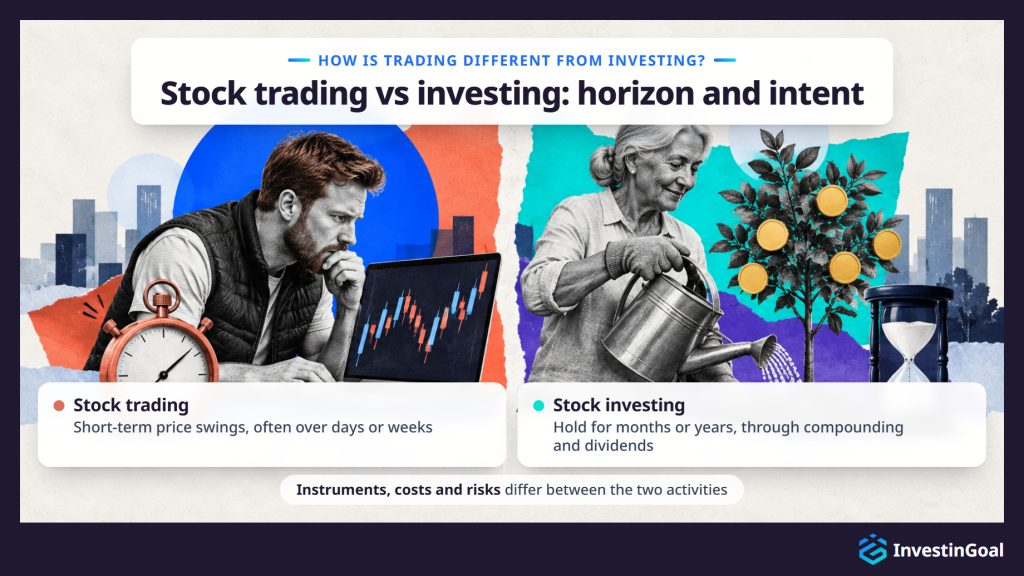
Stock trading differs from stock investing primarily in time horizon and intent. Traders aim to profit from short-term price swings, often holding positions for days or weeks, while investors buy and hold for months or years to build long-term wealth through compounding and dividends. The distinction matters because the instruments, costs, and risk profiles suited to each activity are fundamentally different.
Continue reading
A stock investor typically buys shares in companies they believe will grow in value over the long term. The investor benefits from dividends, the periodic payments some companies distribute to shareholders, and from compounding, where reinvested returns generate their own returns over time. The investor’s primary risk is selecting the wrong company or sector, but time itself tends to smooth short-term volatility.
A stock trader operates on a compressed timeline. Trading frequency is higher, costs accumulate faster, and the margin for error on each position is narrower. Traders rely on active management, making frequent decisions about when to enter and exit, rather than a passive strategy of buying and holding through market cycles.
Understanding which activity you are pursuing is essential, because the tools, the costs, and the psychological demands are different. Trading has instruments, risks, and procedures of its own, and the gap between trading and investing widens further when you factor in how each approach handles drawdowns, tax events, and compounding over multi-year horizons.
How does the stock market work?
The stock market works by connecting buyers and sellers of company shares through regulated exchanges, where an order-matching system pairs bids and offers in real time, and prices adjust continuously based on the balance of supply and demand.
The most recognised exchanges globally are the NYSE (New York Stock Exchange) and NASDAQ (National Association of Securities Dealers Automated Quotations), both in the United States. NASDAQ is the electronic exchange known for listing many of the world’s largest technology companies. Stock exchanges operate in nearly every major economy, including the London Stock Exchange (LSE), the Tokyo Stock Exchange (TSE), and Euronext, which serves multiple EU markets including Paris, Amsterdam, and Lisbon. Each exchange functions as a centralised marketplace. When a trader places an order to buy a stock at a certain price, the exchange’s order-matching system searches for a corresponding sell order at that price. When the system finds a match, the trade executes.
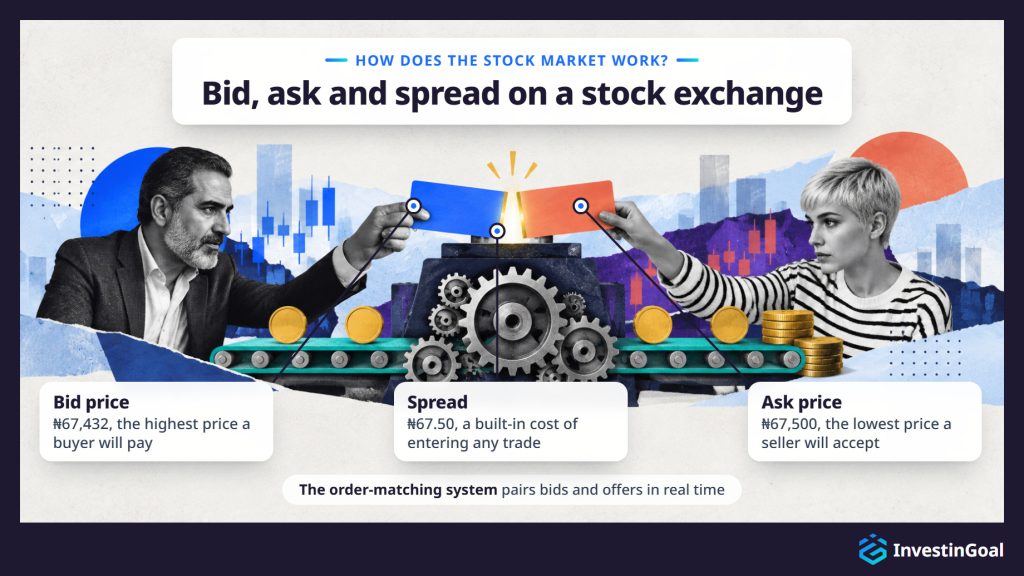
Two prices are always present for any actively traded stock. The bid price is the highest price a buyer is currently willing to pay. The ask price is the lowest price a seller is currently willing to accept. The difference between these two is the spread, and it represents an immediate, built-in cost of entering any trade. If a stock shows a bid of ₦67,432 and an ask of ₦67,500, the spread is ₦67.50, and a buyer who places a market order pays ₦67,500 regardless of the bid.
Exchanges operate on defined trading hours. The NYSE, for example, is open from 9:30 AM to 4:00 PM Eastern Time on weekdays. Outside these hours, most retail traders cannot execute trades on the primary exchange, although some brokers offer limited pre-market and after-hours access with wider spreads and lower liquidity.
Every stock exchange is a regulated exchange, supervised by a government or statutory body that sets rules for listing standards, trade reporting, market conduct, and investor protection. This supervision is what distinguishes a formal stock market from an unregulated over-the-counter (OTC) market, where trades are negotiated directly between parties rather than matched on a centralised exchange. Beyond supervision, the mechanics of how the stock market works include how exchanges list companies, how the market stays liquid, and how trades settle, and all stock trading rests on these mechanics.
How are stock prices determined?
Stock prices are determined moment to moment by supply and demand. When more buyers want a stock than sellers are willing to supply, the price rises. When selling pressure exceeds buying interest, the price falls. Beyond this immediate dynamic, price levels reflect the market’s collective expectation of a company’s future earnings, shaped by reported financials, economic conditions, and investor sentiment.
Continue reading
At the mechanical level, price discovery happens through bid and ask prices. Each time a bid meets an ask, a trade executes and sets a new market price. If a company reports strong quarterly earnings, buyers increase their bids, pushing the bid price higher. If a sector faces regulatory uncertainty, sellers lower their ask price to find buyers, and the stock falls.
Three layers of influence shape stock prices. Company fundamentals form the base, and they include revenue, profit margins, debt levels, and growth trajectory. Economic conditions affect the broader environment, and they include interest rates, inflation, and employment data. Market sentiment is the aggregate psychology of buyers and sellers. It can amplify or override fundamental signals in the short term, creating price volatility that traders seek to exploit.
For a trader, prices move for reasons that are partly measurable and partly driven by collective emotion. Traders interpret these price movements and identify opportunities with two frameworks, technical analysis and fundamental analysis.
What are the risks of trading stocks?
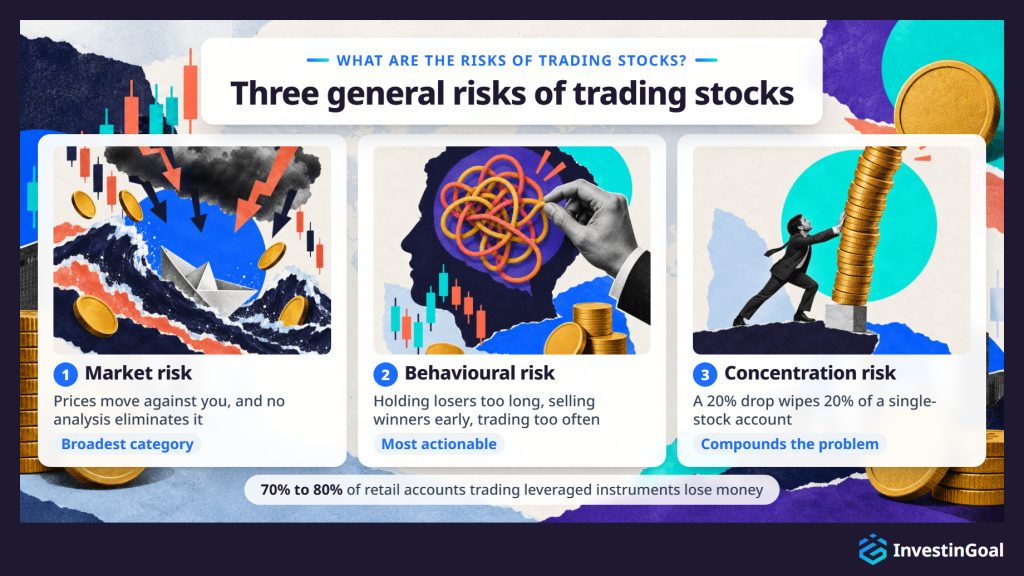
Stock trading carries meaningful financial risk. Broker disclosure data required under EU regulation shows that between 70% and 80% of retail accounts trading leveraged instruments lose money. Behavioural and emotional factors such as panic selling, overtrading, and loss-chasing compound the structural difficulty of consistently outperforming the market on short time horizons. These general risks apply across all trading instruments. Each instrument also carries its own downside profile.
Market risk is the risk that stock prices move against a trader’s position because of earnings surprises, macroeconomic shifts, geopolitical events, or sudden changes in market sentiment, and it is the broadest category. Market risk is inherent to participation in the market, so no analysis method eliminates it entirely.
The more actionable risks for a beginner are behavioural. Brad Barber and Terrance Odean of the University of California led research that analysed over 15 years of individual trading records on the Taiwan Stock Exchange. The research found that the loss rates of active traders are high because beginners tend to make predictable emotional errors: holding losing positions too long in the hope of recovery, selling winning positions too early out of fear, increasing position sizes after losses to “win it back”, and trading too frequently out of impatience or boredom. Each of these behaviours erodes capital faster than the underlying market risk alone.
Concentration risk is the third category, and it compounds the problem. A trader who places all available capital in a single stock faces the possibility of a large, unrecoverable loss if that position moves sharply against them. A 20% drop in one holding wipes 20% of the entire account, while the same drop in one of ten equal holdings affects only 2%. Diversification and position sizing are the standard defences, and a trader needs to learn both skills before deploying significant capital.
Market risk, behavioural risk, and concentration risk apply to every instrument. Each of the four primary instruments for trading stocks also carries risks of its own, which add to or modify these general risks. Position sizing, diversification, and systematic rules that limit exposure to any single behavioural or market-driven loss are the tools experienced traders use to manage the risks of stock trading.
Have you ever lost money on a stock trade?
Choose one and see how your answer compares with other readers.
What are the ways to trade stocks?
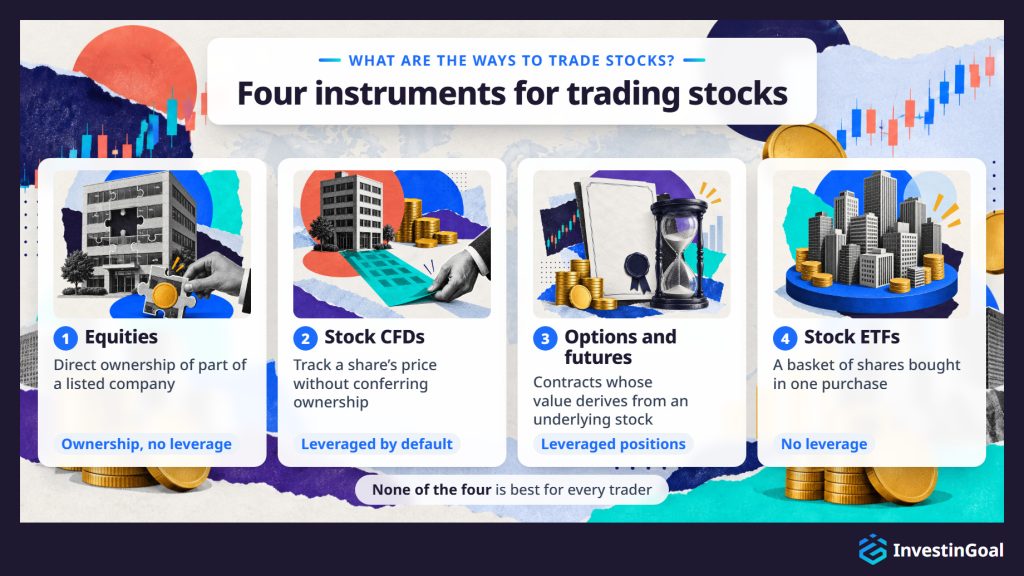
There are four primary ways retail traders access stock markets: buying shares directly, trading stock CFDs, using derivatives such as options and futures, and buying stock ETFs, each offering a different combination of ownership rights, leverage profile, cost structure, and geographic availability.
None of the four instruments is best for every trader, and most beginners won’t know which suits them until they’ve tried a demo account. The right choice depends on what is legally available in the trader’s country, how much capital they have, whether they want actual ownership of shares, and how much leverage exposure they are willing to accept.
Which instrument are you most interested in trading?
Choose one and see how your answer compares with other readers.
1. Equities (stocks / shares)
When a trader buys equities, also called stocks or shares, they acquire direct fractional ownership in a publicly listed company, with a proportional claim on assets and earnings and, for common shareholders, voting rights at company meetings. Equities require no leverage by default, are available to retail traders globally through a standard brokerage account, and carry concentration risk when a trader holds capital in a small number of individual positions rather than diversifying it across many.
Continue reading
When a trader buys equities directly, they own the underlying asset. If the company pays dividends, the shareholder receives them. If the company grows in value, the share price reflects that growth. This direct ownership structure means the trader’s maximum loss on any position is limited to the amount invested, unless they activate a margin account, which introduces borrowed capital and the possibility of losing more than the initial deposit.
There are two main types of shares. Common stock gives the holder voting rights and potential dividends but sits behind creditors and preferred stock holders in the event of liquidation. Preferred stock typically offers a fixed dividend and priority claim on assets but usually does not carry voting rights.
Equities are the foundational instrument for stock trading. They are available in virtually every jurisdiction, regulated by local securities authorities, and accessible to beginners with small amounts of capital through brokers such as Interactive Brokers or Trading 212 that support fractional shares, which allow a trader to buy a portion of a single share rather than a whole one. A trader who wants to buy stocks online selects an instrument, chooses an order type, and executes the trade inside a regulated brokerage account.
2. Stock CFDs (Contract for Difference)
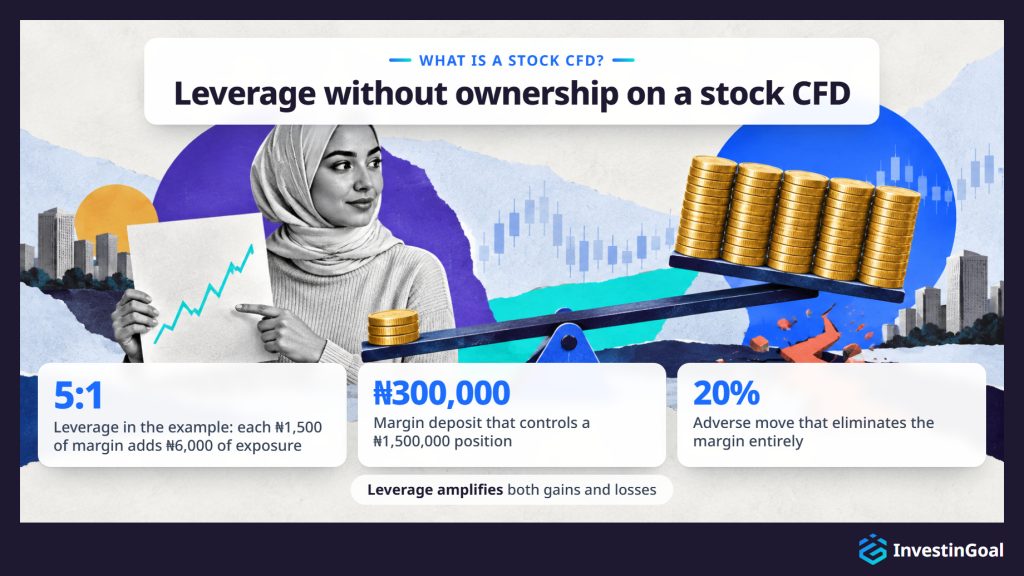
A stock CFD (Contract for Difference) is a derivative instrument that tracks the price of an underlying share without conferring ownership. With a CFD, the trader profits or loses based on the difference between the opening and closing price of the contract, not from holding the asset itself. CFDs are leveraged by default. With 5:1 leverage, for example, a ₦300,000 margin deposit controls a ₦1,500,000 position, meaning a 20% adverse price move eliminates the margin entirely. CFDs are available to retail traders in the EU, the UK, Australia, and most global markets outside the United States, where the law does not permit them. CFD positions held overnight incur an overnight financing charge, and EU and UK rules require regulated brokers to disclose that between 65% and 80% of retail CFD accounts lose money. Regulated CFD brokers such as IG, XTB, and Plus500 are among the platforms through which EU, UK, and Australian retail traders access stock CFDs.
Continue reading
Because a CFD is a derivative instrument, the trader never owns the underlying share. There are no shareholder rights, no dividends received directly (though some brokers adjust for dividend events), and no voting entitlements. The CFD’s value is purely a function of price movement in the underlying stock.
Leverage is the most important feature a beginner must understand. The ESMA 5:1 cap on stock CFDs for EU retail clients means that for every ₦1,500 of the trader’s own capital, the broker extends ₦6,000 of exposure. Leverage amplifies both gains and losses proportionally. A margin call occurs when the position moves far enough against the trader that the margin deposit is no longer sufficient to cover the loss, at which point the broker may close the position automatically.
The US restriction on stock CFDs comes from the law. US securities law does not permit brokers to offer over-the-counter derivative instruments like CFDs to retail clients. Traders based in the United States who want leveraged stock exposure typically use options or leveraged ETFs instead.
For traders outside the US, CFD trading offers a cost-efficient way to take short-term positions on stock price movements with smaller capital outlays, but leverage makes risk management necessary, starting with position sizing relative to account equity.
3. Stock derivatives (options and futures)
Stock derivatives are contracts whose value is derived from the price of an underlying stock, and the main ones are options and futures. They allow traders to take leveraged directional positions without necessarily owning the shares. An option gives the buyer the right, but not the obligation, to buy (call) or sell (put) a stock at a set price before a set expiry date. A futures contract is a standardised obligation to buy or sell at a set price on a specific future date. Options lose value as the expiry date approaches regardless of price direction, an effect called time decay, and they can expire completely worthless. Futures carry margin obligations and, in some contracts, potential delivery requirements.
Continue reading
The right without the obligation is what distinguishes options from futures. A trader who buys a call option pays a premium upfront for the right to purchase the underlying stock at the agreed strike price. If the stock rises above that price before expiry, the option gains value. If it does not, the option expires worthless, and the trader’s maximum loss is the premium paid. Losing the entire premium at expiry is the primary risk a beginner must understand.
Time decay compounds the risk of losing the premium. An option’s value includes a time component that erodes as the expiry date approaches, even if the stock price is moving in the right direction. Time decay means an option trader must be right about both the direction and the timing of the move, which is structurally harder than simply being right about direction.
Futures contracts trade on exchanges as standardised contracts and create a binding obligation for both buyer and seller. Margin requirements govern futures positions, and because the obligation is mutual, losses can exceed the initial margin deposit. Some contracts also involve physical delivery of the underlying asset at expiry, though most stock-related futures are cash-settled, meaning the profit or loss is paid in cash at expiry rather than through delivery of the underlying shares.
Options and futures are more prominent among US retail traders, partly because CFDs are not available in that market. Stock options in particular have become the primary leveraged instrument for US-based beginners. Premium-defined risk on long positions and broad support from brokers such as Charles Schwab and Interactive Brokers make options more accessible than futures for smaller accounts.
4. Stock ETFs (exchange-traded funds)
A stock ETF (exchange-traded fund) is an investment fund that holds the shares in a stock index, such as the S&P 500, and trades on a stock exchange like an individual share. Stock ETFs require no leverage, give the trader shares of the fund rather than shares of the companies, carry an annual fund fee of typically 0.03% to 0.20% for broad-market funds, and are available to retail traders in virtually every jurisdiction through a standard brokerage account.
Continue reading
When a trader buys a stock ETF, the fund owns the underlying shares and the trader owns shares of the fund. The fund collects the dividends of its companies and either pays them out to the trader (a distributing ETF) or reinvests them (an accumulating ETF). The trader can lose at most the amount invested, as with equities bought directly, unless the trader buys on margin.
A stock ETF spreads the trader’s capital across dozens or thousands of companies, so it reduces the concentration risk of a portfolio built on a few individual shares. Market risk remains, because the price of a stock ETF follows its index, and a broad-market fall lowers the value of every company in the fund at the same time.
Stock ETFs trade at the price the market offers at any time the exchange is open, so a trader buys and sells them with the same order types as shares. A stock ETF suits long-term investing more than short-term trading, because one purchase spreads money across a whole index at a low annual cost. Stock ETFs belong to the wider family of exchange-traded funds, which also contains leveraged and inverse ETFs that use derivatives to multiply or reverse the daily return of an index. A leveraged ETF carries the costs and the risks of leverage, even though it trades like an ordinary share.
Is stock trading regulated?
Yes, stock trading is regulated in every major market, with oversight bodies setting rules on which products brokers can offer to retail traders, what leverage limits apply, and what protections traders receive. In Nigeria, the Securities and Exchange Commission of Nigeria (SEC Nigeria) supervises brokers and securities markets. In the United States, the SEC (Securities and Exchange Commission) is the federal agency that oversees securities markets, and the CFTC (Commodity Futures Trading Commission) regulates derivatives markets. US law does not permit CFDs for retail traders. In the EU, the 5:1 cap on leverage for stock CFDs sold to retail clients comes from the measures that ESMA (European Securities and Markets Authority) adopted in 2018 and that the national regulators of each country now apply. Investment services in the EU follow MiFID II, the Markets in Financial Instruments Directive, the EU-wide regulatory framework for investment firms. In the UK, the FCA (Financial Conduct Authority) is the financial services regulator and applies similar restrictions, and ASIC (Australian Securities and Investments Commission) does the same in Australia.
Regulation matters for a beginner because it determines which instruments are legally available, what protections exist if a broker fails, and what leverage limits prevent excessive risk. A trader in the EU benefits from negative balance protection under ESMA rules, meaning they cannot lose more than their account balance on a CFD trade. A trader in the US has no access to CFDs at all but trades equities and options under SEC oversight with separate protections.
Before opening any account, a beginner should confirm that the broker they are considering holds a licence from the financial regulator in their own jurisdiction. An unlicensed or offshore broker may offer higher leverage or fewer restrictions, but it also offers no recourse if it mishandles client funds. Each major regulator enforces capital adequacy, segregation of client funds, and dispute resolution standards, and this layered system of trading regulation protects retail accounts.
What are the main stock trading styles?
The main stock trading styles are day trading, swing trading, position trading, scalping, algorithmic trading, and copy trading, each suited to different instruments, capital levels, and amounts of available time. The styles differ in time horizon, trading frequency, and the type of analysis traders use. Two primary analysis methodologies cut across all styles: technical analysis (using price charts and indicators to identify entry and exit points) and fundamental analysis (using company financials and economic data to assess value).
- Day trading involves opening and closing all positions within the same trading day. Day traders hold no positions overnight, which eliminates overnight financing costs but requires constant attention during market hours. Day traders typically use technical analysis on short time frames and favour liquid stocks or CFDs.
- Swing trading holds positions for several days to a few weeks, aiming to capture a defined price move or “swing”. This style suits traders who cannot monitor the market continuously and who are comfortable holding positions overnight. Swing traders use a mix of technical and fundamental analysis.
- Position trading operates on a longer horizon, holding positions for weeks or months based on larger trends or fundamental changes in a company or sector. It resembles investing in time horizon but differs in intent. The position trader is still actively managing exit criteria rather than holding indefinitely.
- Scalping targets very small profits from many trades over seconds or minutes. It requires fast execution, tight spreads, and high discipline, and is unsuited to beginners.
- Algorithmic trading uses pre-programmed rules or software to execute trades automatically based on defined criteria. It removes emotional decision-making but requires technical skill to design and maintain the system.
- Copy trading allows a beginner to automatically replicate the trades of another trader in real time, on platforms such as eToro. It lowers the knowledge barrier to entry but introduces dependency on another person’s decisions and does not build the trader’s own analytical skills.
The choice of instrument depends on the trading style. Day traders and scalpers need low-spread, high-liquidity instruments such as CFDs or highly traded equities. Swing and position traders may prefer direct equities or options. The capital requirement also varies. Scalping demands enough capital to make very small percentage gains meaningful, while swing trading can be effective with moderate account sizes. Each trader chooses among the types of trading styles based on how much time they can dedicate to the screen each day, how much capital they have, and whether they prefer the rapid feedback of short-duration trades or the patience required by multi-week positions. In practice, many traders start with one style and shift to another as they learn what suits their temperament and schedule.
Which trading style appeals to you most?
Choose one and see how your answer compares with other readers.
What are the costs when trading stocks?
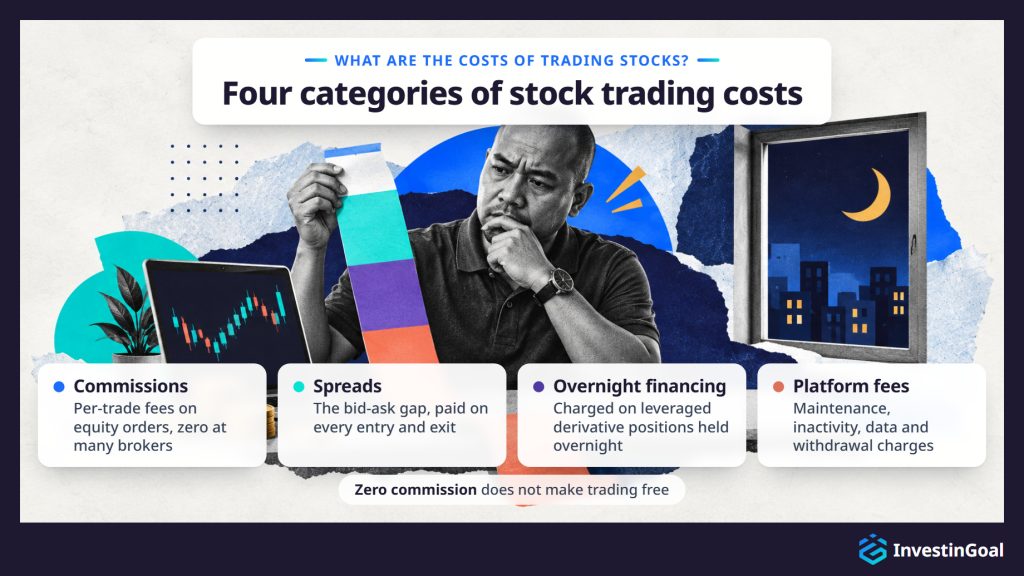
The main costs when trading stocks fall into four categories: commissions on equity trades, spreads on CFDs and leveraged ETFs, overnight financing charges on positions held beyond the trading day, and platform or account fees. The relative weight of each depends on the instrument chosen and how frequently the trader opens and closes positions. For active short-term traders, cumulative spread and financing costs can be substantial even when headline commission rates are zero.
- Commissions are the most visible cost for equity traders. Many zero-commission brokers have eliminated per-trade fees for standard equity orders, among them Robinhood in the US and Trading 212 in the EU and UK. Zero commission does not make trading free, because zero-commission brokers earn their revenue in other ways. Robinhood in the US earns revenue through payment for order flow (PFOF), the practice of routing customer orders to market makers in exchange for compensation. The EU bans payment for order flow under article 39a of MiFIR, in force since 28 March 2024, and the exemption Germany had kept ended on 30 June 2026. Trading 212 says it takes no payment from third parties and earns mainly from currency conversion fees and its CFD business. Traders who use brokers that still charge commissions should evaluate the per-trade or per-share rate against their expected trading frequency.
- Spreads are the primary cost for CFD and leveraged ETF traders. The spread is the difference between the bid and ask price, and the trader pays it on every trade entry and exit. Tighter spreads mean lower costs per trade. For instruments with wider spreads, such as less liquid stocks or leveraged ETFs, the cost of frequent trading compounds quickly.
- Overnight financing is a charge that brokers apply to CFD positions and leveraged ETF holdings that remain open past the end of the trading day, and it is sometimes called the swap rate. This cost reflects the interest on the leveraged portion of the position and can accumulate significantly on trades held for days or weeks. A ₦1,500,000 CFD position held for 30 days at a typical overnight rate might cost ₦30,822 to ₦33,288 in financing charges alone, reducing or eliminating a small gain. It is one of the reasons CFDs and leveraged ETFs are designed for short-term use.
- Platform fees include account maintenance charges, inactivity fees, data subscription costs, and withdrawal fees. These vary widely across brokers and can be meaningful for traders with small accounts or low trading frequency.
Direct equity trading is cheapest for infrequent traders using zero-commission brokers, while CFD and leveraged ETF trading carries lower per-trade entry costs but higher cumulative costs over time because of spreads and financing. Cost transparency affects net trading performance, which makes the full breakdown of stock trading fees a key criterion when comparing brokers.
How do you start trading stocks?
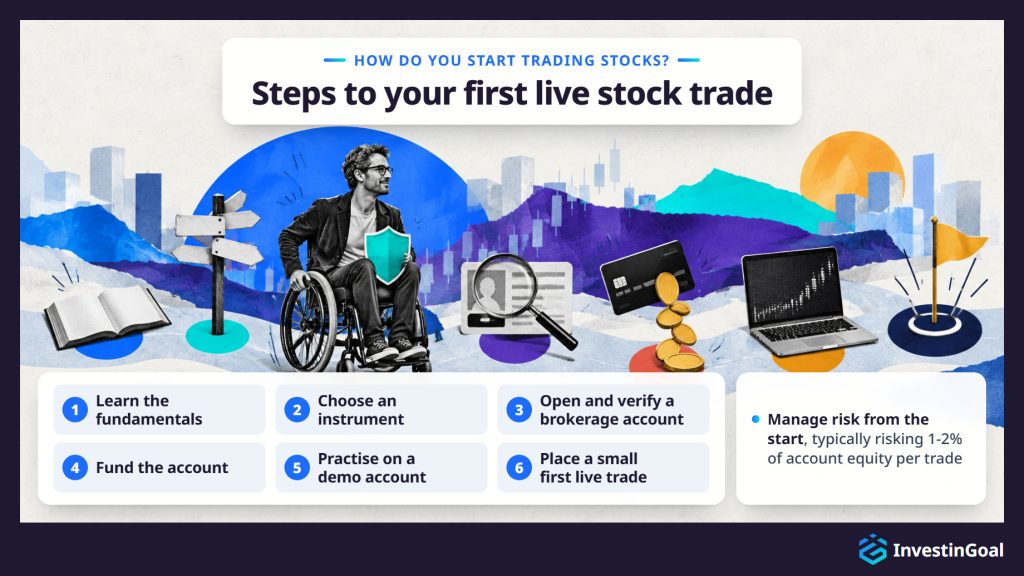
To start trading stocks, first build foundational knowledge of the market, the instrument you plan to use, and its specific risk profile, then open a regulated brokerage account suited to that instrument, fund it appropriately, practise on a demo account, and place your first real trade only when you can execute the mechanics with confidence.
- Learn the fundamentals. Before opening any account, a beginner should understand what stocks are, how the market works, what instruments are available, and what the risks are. When a beginner sets out to learn stock trading, three skills matter most: price chart reading, order type mechanics (market, limit, stop-loss), and basic company financial assessment. These three skills decide whether the beginner executes a first trade competently or blindly.
- Choose an instrument. Based on your location, capital, and risk tolerance, decide whether you will trade equities directly, use CFDs, or start with another instrument. This choice determines which type of broker you need.
- Open and verify a brokerage account. Select a broker regulated in your jurisdiction. The account opening process includes KYC account verification (identity and address documentation), which is a legal requirement for all regulated brokers. Most brokers require a government-issued ID, proof of address, and a tax identification number before they approve the account for live trading. Once you submit these documents, it typically takes between one and three business days to open a stock trading account.
- Fund the account. Deposit an amount you can afford to lose entirely. Account funding methods vary by broker but typically include bank transfer, credit or debit card, and e-wallets.
- Practise on a demo account. Use the broker’s demo or paper trading environment to familiarise yourself with the platform, practise placing orders, and test your approach without risking real money.
- Select your first instrument and place a trade. When you are confident with the platform mechanics, choose a stock or instrument based on your analysis, define your entry price, stop-loss, and target, and execute your first live trade at a small position size. The first positions should be in instruments you can monitor and understand, so when you choose stocks, filter them by liquidity, volatility, and sector familiarity instead of following social media tips or recent price spikes.
- Manage risk from the start. Set a maximum risk per trade, typically 1-2% of account equity, and do not increase position sizes until your process is consistently disciplined.
A beginner learns the instrument first, the broker second, and the stock last, because the instrument decides how much leverage a trade carries. On a stock CFD with 5:1 leverage, every price move has five times the effect on the trader’s own capital.
 Filippo UcchinoCo-Founder, CEO and Editor-in-Chief of InvestinGoal
How much money do you need to start trading stocks?
There is no universal minimum to start stock trading. Many equity brokers accept accounts with no minimum deposit and support fractional shares from as little as ₦1,350, while minimum deposits for CFD accounts range from €0 at XTB to about €100 at Plus500 (£100 in the UK), depending on the country and the payment method. However, a technically accessible minimum differs from a practically adequate starting capital, and sound position sizing generally requires enough capital to absorb several consecutive losses without wiping the account.
Continue reading
A trader who opens an account with ₦67,500 and places a single trade is technically trading, but they have no room for error. One bad trade can eliminate the account.
Responsible management of risk per trade means that no single trade risks more than 1-2% of the account. That rule requires enough capital for 1-2% to be a meaningful position size in the instrument being traded.
For equity trading, brokers offering fractional shares have removed the minimum capital barrier almost entirely. For CFD trading, the regulatory minimum and the broker’s own account minimum set the floor, but a practically adequate starting capital is higher. A beginner should deposit only capital they can afford to lose and should never trade with money needed for essential expenses.
Is demo (paper) trading a good way to practise stock trading?
Yes, demo trading is the recommended first step for every beginner, because it allows full practice of a broker’s platform, order execution, and position management using virtual funds before any real capital is at risk. Its key limitation is that demo trading removes the emotional and psychological pressure of real financial stakes, so a trader has to develop the discipline to manage real losses through controlled live trading at low position sizes.
Continue reading
A demo account mirrors the live trading environment: real-time prices, the same order types, the same interface. It is the correct place to become familiar with the platform, to practise entering market and limit orders, to understand how stop-losses execute, and to build fluency with the broker’s tools. Most regulated brokers offer some form of demo environment, and there is no cost to using one.
Demo trading teaches mechanics but not psychology. A trade placed with virtual funds does not trigger the fear, greed, or impatience that the same trade triggers with real capital. The emotional stakes missing from demo trading are the stakes that cause most beginner losses.
The recommended sequence is to trade in demo until the mechanics are automatic, then move to a live account with the smallest practical position sizes. This controlled entry introduces real financial consequence at a scale where mistakes are educational rather than destructive.
How do you choose the right broker to trade stocks?
The right broker for stock trading depends primarily on which instrument you intend to use. Equity traders should prioritise regulated platforms with low commissions, a broad stock selection across multiple exchanges, and strong research tools, while CFD traders should prioritise ESMA or FCA regulation, leverage limits with negative balance protection, and transparent overnight financing costs. Beyond instrument fit, all traders should verify that the broker is regulated in their jurisdiction and that the account minimum, platform usability, and account type match their experience level and trading style.
Regulation is the non-negotiable starting criterion. An equity broker such as Fidelity or Degiro must be licensed by the securities authority in the trader’s country. A CFD broker such as IG or Plus500 operating in the EU must be authorised under MiFID II. Checking a broker’s regulatory status before opening an account protects the trader’s funds and ensures access to dispute resolution mechanisms.
For equity traders, key evaluation criteria include commissions (per trade or per share), the range of exchanges and markets accessible through the account, the quality of research and charting tools, and whether the platform supports fractional shares for smaller accounts. Brokers also differ in geographic availability, because not all of them serve all countries and the available products may differ by jurisdiction.
For CFD traders, the spread on the instruments they intend to trade is the primary cost metric, followed by overnight financing rates and any account maintenance fees. Negative balance protection is mandatory under EU and UK regulation but not universal elsewhere, and it prevents a trader from owing more than their deposit.
Both equity and CFD traders should test the broker’s platform on a demo account before committing real capital. Platform usability directly affects execution quality, particularly the speed and clarity of order entry, charting, and position management.
Regulated platforms differ substantially in the range of exchanges they connect to. The instruments a platform supports also separate equity-only stock trading platforms from those that serve multi-asset CFD trading. Traders who prioritise mobile execution over desktop charting should evaluate stock trading apps separately, because app-native platforms often simplify order entry at the cost of advanced analytical tools. For traders at the earliest stage, the best platforms for beginner stock traders tend to combine low account minimums, guided onboarding, and integrated educational content that more advanced platforms omit.