Crypto Trading For Beginners: What It Is and How to Start


Crypto trading is the act of buying and selling cryptocurrencies to profit from price movements over short or medium time periods. It takes place on crypto exchanges, which match buy and sell orders 24 hours a day, 7 days a week, and every trade runs on a trading pair such as BTC/USD or ETH/BTC. Crypto trading differs from crypto investing in time horizon and intent, because a trader opens and closes positions within hours, days, or weeks, while an investor holds for months or years. It also differs from forex and stock trading, because the crypto market never closes, Bitcoin routinely moves 5–10% in a day, and the regulatory framework for crypto is thinner and less consistent across jurisdictions.
Crypto trading uses three main instruments. Spot trading means buying the actual cryptocurrency, a CFD mirrors its price through a regulated broker and adds leverage, and futures and options are derivatives designed primarily for experienced participants. Spot trading is the most straightforward start for a beginner, because the trader directly owns the cryptocurrency. Trading on any of the three carries four categories of cost: trading fees, spreads, withdrawal fees, and deposit fees. Trading fees and spreads have the largest cumulative impact, because they apply to every transaction.
Before the first trade, a beginner needs a verified account on a regulated exchange, a deposit method, a secure device, familiarity with the chosen instrument, and capital they can afford to lose entirely. With those in place, the beginner chooses among four main strategies: day trading, swing trading, position trading, and dollar-cost averaging (DCA). The four strategies differ in time horizon, activity level, and risk profile, and a beginner who is uncertain starts with DCA or swing trading. A position trader holds a cryptocurrency for weeks or months, and the most widely practised form of position trading in crypto is HODLing, which means holding through market downturns.
Every strategy carries the risks of crypto trading, which is among the riskiest financial activities available to retail participants. Bitcoin fell approximately 84% from its December 2017 peak to its December 2018 low, Terra/LUNA collapsed from around $80 to near zero in May 2022, and the failures of the Mt. Gox and FTX exchanges kept users waiting years for partial repayments. A beginner can lose the entire trading capital through liquidation, a market crash, a scam, or a rug pull, and leverage makes that loss faster. For that reason, ESMA’s 2018 measures cap leverage on crypto CFDs at 2:1 for retail clients in the EU, and the FCA banned crypto CFDs for retail consumers in the UK in January 2021.
A beginner manages those risks with four rules: limit each position to 1–2% of trading capital, set a stop-loss order at entry, avoid leverage entirely, and never allocate more to cryptocurrency than they can afford to lose in full. Keeping cryptocurrency safe takes three more steps: two-factor authentication (2FA) on the exchange account, small balances on the exchange, and a personal wallet where the trader controls the private key.
A beginner chooses a crypto exchange on five criteria: regulatory status, fee structure, supported assets, security track record, and deposit methods. Regulatory status comes first for a beginner, followed by a simple interface and a low minimum deposit and trade size. The first trade on the chosen exchange takes five steps, from creating and verifying the account to executing the order, and a market order is the simplest order type for it. Alongside the exchange, beginners use a charting platform such as TradingView, a market data feed such as CoinGecko or CoinMarketCap, and a portfolio tracker.
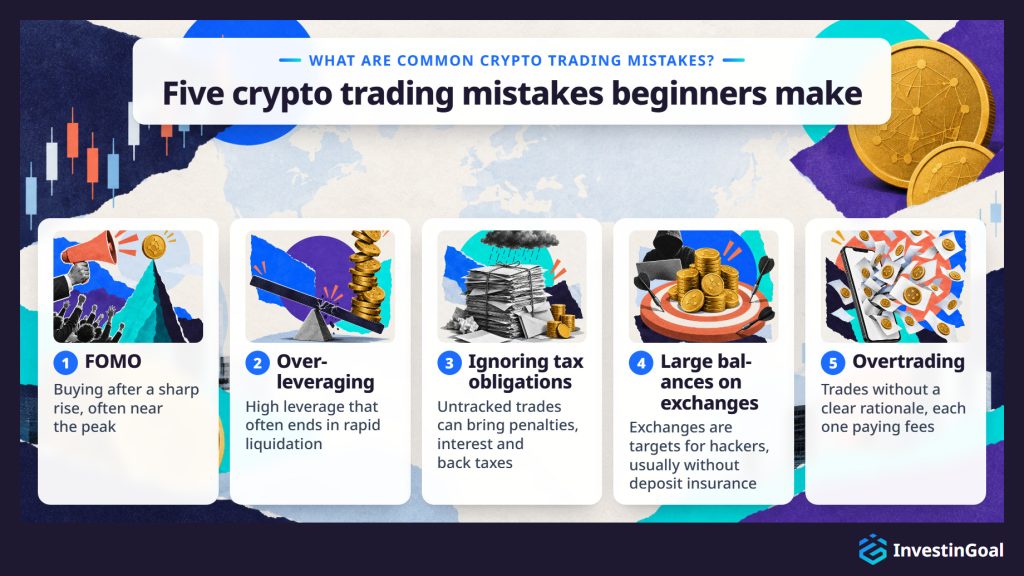
Beginners who start trading most often make five mistakes: FOMO-driven entries, overleveraging, ignoring tax obligations, leaving large balances on exchanges, and overtrading without a defined strategy. Each of these mistakes comes from trading without a plan or from not following one, and a beginner who counters them with the risk management rules is far more likely to survive the learning curve.
What is your main goal with crypto?
Choose one and see how your answer compares with other readers.
What is crypto trading?
Crypto trading is the act of buying and selling cryptocurrencies to profit from price movements over short or medium time periods. It usually happens on crypto exchanges, where traders swap cryptocurrencies such as Bitcoin, Ethereum, and Solana against fiat currencies (like USD or EUR) or against other cryptocurrencies. Crypto exchanges operate 24 hours a day, 7 days a week, so crypto trading has no market close, no weekends off, and no holidays.
The assets traded are cryptocurrencies, often shortened to crypto. Cryptocurrencies are digital tokens recorded on a blockchain rather than traditional financial instruments. The purpose is to profit from price changes, not to use the cryptocurrency for payments or technology. The time horizon is shorter than in long-term investing. A crypto trader may hold a position for minutes, hours, days, or weeks, but the intent is always to act on price movement instead of waiting for long-term appreciation. Crypto trading follows the same core logic as online trading in any other financial market, but it applies that logic to a unique asset class with its own platforms and rules. Every trade happens through a trading pair, such as BTC/USD or ETH/BTC, which defines what the trader buys and what the trader sells. Each trade also involves costs: trading fees, spreads, withdrawal fees, and potentially network fees on the blockchain itself.
Crypto trading differs from crypto investing in how long a position stays open and in how actively the trader or investor manages it. An investor buys a cryptocurrency and holds it for months or years, accepting short-term volatility as part of a longer thesis. A trader actively manages positions, makes frequent decisions about entries and exits, and is directly exposed to short-term volatility as both the source of opportunity and the primary source of risk. For a beginner, the distinction matters because trading demands more time, more decisions, and more exposure to rapid loss than holding.
Beginners need to understand how exchanges, order types, fees, and risk management work before placing their first trade, because crypto prices can move 5–10% in a single day and smaller cryptocurrencies can swing far more.
What is cryptocurrency and how does it work?
Cryptocurrency is a digital asset that exists on a decentralised blockchain network, which means that no central authority controls it, whether a bank, a government, or an institution. Unlike traditional currency, it is created, verified, and recorded by a distributed network of computers, which makes transactions public and permanent.
Continue reading
A blockchain functions as a public ledger. It records every transaction ever made in a chain of blocks that anyone can verify but no single party can alter. The public ledger is what makes decentralisation possible, because there is no central server to hack or shut down and no intermediary has to approve a transfer. When one person sends cryptocurrency to another, the network itself validates the transaction and adds it to the permanent record.
The first cryptocurrency to achieve decentralisation was Bitcoin, which launched in 2009. Bitcoin is also the largest cryptocurrency by market capitalisation. Ethereum followed in 2015 and expanded what blockchain networks could do by enabling programmable contracts on top of the ledger. It is now the largest programmable blockchain network. Today, thousands of cryptocurrencies exist, but Bitcoin and Ethereum remain the two most widely traded and recognised, and they are typically the first cryptocurrencies a beginner encounters on any exchange.
How is crypto trading different from crypto investing?
Crypto trading differs from crypto investing primarily in time horizon and intent. Traders aim to profit from short-term price movements, opening and closing positions within hours, days, or weeks, while investors buy and hold over longer periods expecting long-term appreciation.
Continue reading
Beyond timing, a trader engages in active management, monitoring charts, placing multiple orders, and adjusting positions regularly. An investor follows a passive strategy, typically making fewer decisions after the initial purchase and accepting short-term volatility as part of a longer arc. The emotional demands differ as well. Trading requires rapid decision-making under pressure, while investing requires patience and the discipline to hold through downturns.
The two approaches also carry risk differently. A trader faces risk on every individual position and may accumulate losses quickly through frequent activity. An investor’s risk is concentrated in the asset’s long-term trajectory. Neither approach is inherently safer, but they suit different temperaments, schedules, and capital situations. A beginner whose goal is to buy and hold a cryptocurrency for months or years is closer to investing than to trading, and understanding the distinction between trading and investing early helps avoid choosing the wrong strategy for the wrong goal.
How is crypto trading different from forex and stock trading?
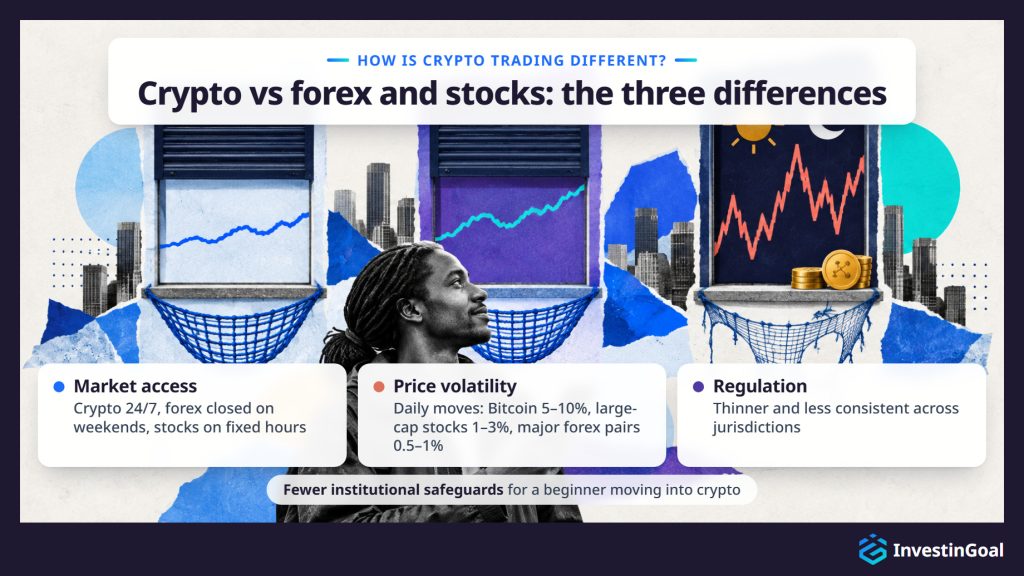
Crypto trading differs from forex and stock trading in three structural ways: crypto markets operate 24/7 with no central exchange, cryptocurrencies are significantly more volatile than most forex pairs or stocks, and the regulatory framework for crypto is thinner and less consistent across jurisdictions.
Continue reading
Market access is the first difference, because the crypto market never closes. The forex market operates roughly 24 hours on weekdays but closes on weekends. The stock market follows fixed exchange hours, typically six to eight hours per day, five days a week. Crypto trading happens continuously, including weekends and holidays, so the price can move significantly while a trader in other markets would be waiting for the next session to open.
Price volatility is the second difference, and research on Bitcoin options shows how wide the gap with traditional assets is. Carol Alexander and Arben Imeraj analysed over seven million Bitcoin option prices in “The Bitcoin VIX and Its Variance Risk Premium”, a study published in The Journal of Alternative Investments. Bitcoin’s one-month implied volatility reached about 180% in March 2020, according to market data from Skew reported by CoinDesk. For US equities, the equivalent measure is the VIX, which typically ranges between 15% and 30% and peaks at only around 80% during extreme events. In a single day, a major forex pair might move 0.5–1% and a large-cap stock 1–3%, while Bitcoin routinely moves 5–10% and smaller cryptocurrencies can swing far more. Crypto volatility creates both opportunity and danger, so risk management is more urgent in crypto than in traditional markets.
Regulation is the third difference, and stock markets answer to established financial authorities such as the SEC (Securities and Exchange Commission) in the United States or the FCA (Financial Conduct Authority) in the United Kingdom. Forex brokers in most major jurisdictions must hold specific licences issued by these or equivalent regulators. By contrast, crypto regulation varies widely. In Nigeria, a crypto exchange needs registration as a virtual asset service provider (VASP) with the Securities and Exchange Commission of Nigeria (SEC Nigeria), under the Investments and Securities Act 2025. As a result, the protections available to a trader on a centralised stock exchange or with a regulated forex broker are not always present on a decentralised crypto platform. A beginner moving from forex or stock markets into crypto enters a market with fewer institutional safeguards. Market access, volatility, and regulation are the three differences in both forex vs crypto trading and stock vs crypto trading.
How does crypto trading work?
Crypto trading works through a digital crypto exchange that matches buy orders from one participant with sell orders from another, executing the transaction at a price both sides agree on. The exchange records the completed trade, and the trader’s account balance updates to reflect the new holding or cash position.
Every trade begins when a trader places an order on the exchange. If the trader wants to buy, their order enters the exchange’s order matching engine, which searches for a corresponding sell order at a compatible price. Every asset on the exchange has a bid/ask spread. The bid is the highest price a buyer is currently willing to pay, and the ask is the lowest price a seller is currently willing to accept. When these two prices meet, the trade executes.
Price discovery happens through the continuous matching of buy and sell orders. As new orders flow into the exchange, the price of the asset adjusts to reflect the latest agreement between buyers and sellers. If more buyers enter the market than sellers, the price rises. If sellers dominate, the price falls.
Once the trade executes, the exchange updates the trader’s account balance instantly. The blockchain also records the cryptocurrency when a spot trader withdraws it to a personal wallet. If the trader keeps the cryptocurrency on the exchange, the record stays in the exchange’s own internal ledger.
In both cases, the trade is complete and the trader holds the new position from that moment.
What are the main instruments to trade cryptocurrency?
The three main instruments to trade cryptocurrency are spot trading, contracts for difference (CFDs), and crypto derivatives such as futures and options. For beginners, spot trading is the most straightforward starting point because the trader directly owns the underlying asset.
Spot trading means buying actual cryptocurrency at the current market price. A trader who buys Bitcoin on a spot exchange owns that Bitcoin and can hold it, transfer it, or sell it whenever they choose. There is no counterparty obligation beyond the initial purchase, and no expiry date on the position.
A CFD is a contract between the trader and a regulated broker, such as eToro or Plus500, that mirrors the price movement of a cryptocurrency without the trader ever owning the underlying asset. eToro’s crypto CFDs are not available to retail clients in the UK. CFDs offer leveraged exposure, meaning a trader can control a larger position with a smaller deposit. Leverage amplifies both gains and losses, which makes CFDs substantially riskier than spot trading for someone without experience.
Futures and options are derivatives that derive their value from the underlying cryptocurrency. Futures oblige the trader to buy or sell at a set price on a future date. Options give the trader the right, but not the obligation, to do so. Both instruments involve leverage and are designed primarily for experienced participants. Futures and options trade on different types of platform from spot exchanges, and a beginner who starts with spot trading avoids the complexity and amplified risk that come with leveraged products.
What are the costs and fees in crypto trading?
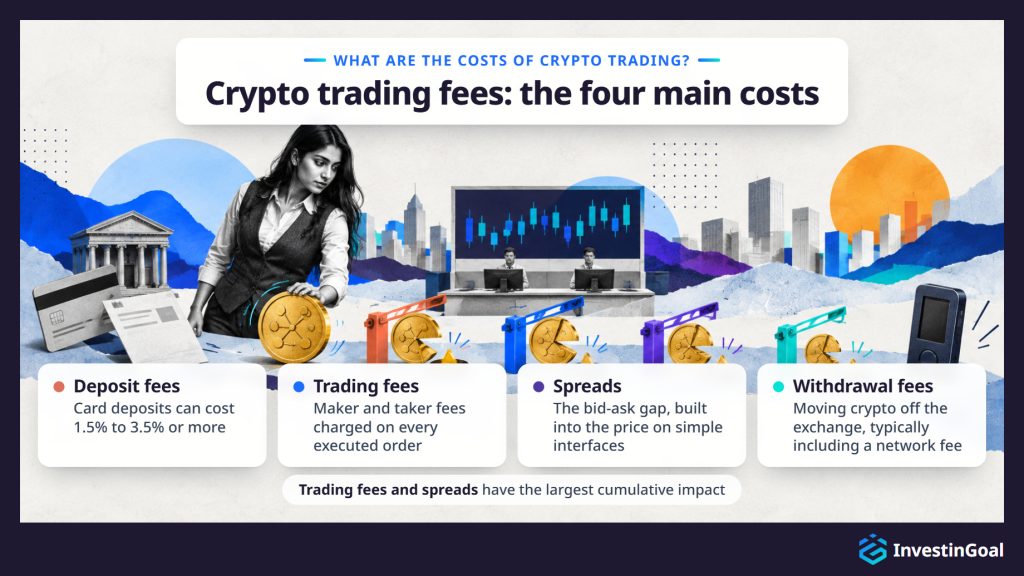
The main costs in crypto trading fall into four categories: trading fees (maker and taker fees charged on every executed order), spreads (the difference between the buy and sell price of an asset), withdrawal fees (charged when moving cryptocurrency off the exchange), and deposit fees (applied by some exchanges or payment providers when funding an account). For beginners, trading fees and spreads have the largest cumulative impact because they apply to every single transaction.
Trading fees follow a maker/taker model on most major exchanges. A maker fee is what the exchange charges when a trader places a limit order that adds liquidity to the order book. A taker fee is what the exchange charges when a trader places a market order that removes liquidity by filling an existing order immediately. Maker fees are typically lower than taker fees because exchanges want to incentivise liquidity. On the major exchanges, these fees are a percentage of the trade, and the percentage decreases as the trader’s trading volume over a 30-day period increases. At the entry level, Kraken Pro charges 0.40% maker and 0.80% taker, Coinbase Advanced charges 0.25% maker and 0.50% taker in the EU and the UK and 0.50% maker and 0.90% taker in the US, and Binance starts at 0.10% for both maker and taker. Binance has not accepted new clients in the EU since 1 July 2026, because it has no MiCA licence. The fee differences compound quickly for active traders. A beginner placing ten trades of ₦150,000 each will pay noticeably less on an exchange with 0.10% fees than on one charging 0.80%.
Spreads are a less visible cost than trading fees. The spread is the gap between the bid (the highest price a buyer is offering) and the ask (the lowest price a seller is accepting). The spread is often wider on an exchange’s simple buy/sell interface than on its advanced trading view. On the simple interface, the exchange builds the spread into the quoted price, so the trader pays more without seeing a separate fee line. A trader can reduce this hidden cost by checking the spread before trading or by using the exchange’s pro or advanced interface.
Withdrawal fees are what the exchange charges when a trader moves cryptocurrency from the exchange to a personal wallet. These fees vary by asset and by exchange, and they typically include a component covering the network fee that the underlying blockchain charges to process the transaction. On the Ethereum blockchain, the network fee is also called the gas fee. Network fees fluctuate with network congestion. A Bitcoin transfer might cost a few dollars under normal conditions, while Ethereum gas fees have historically ranged from under $1 during low-traffic periods to over $50 during peak congestion, though they have dropped significantly since 2024. Some exchanges absorb part of the network fee, and others pass it through in full.
Deposit fees depend on the deposit method. Bank transfers are often free or carry a small flat fee, while debit or credit card deposits can cost 1.5% to 3.5% or more, which makes cards the most expensive way to fund an account. A beginner should check the deposit fee schedule before choosing a deposit method, because a high deposit fee on a small initial amount can erode a meaningful percentage of the starting capital. Each exchange sets its own crypto trading fees, so the total cost of the same trade differs from one exchange to another.
What do you need to start trading crypto?
To start trading crypto, a beginner needs to meet five requirements: a verified account on a regulated exchange, a deposit method (bank transfer or card), a secure device, basic familiarity with the chosen instrument, and trading capital they can afford to lose entirely.
The first requirement is an exchange account, and opening one means choosing an exchange, registering with an email address, and completing KYC verification. KYC stands for Know Your Customer, and it is a legal requirement under Anti-Money Laundering (AML) regulations. KYC verification requires a government-issued ID and, in most cases, a selfie or photo for identity matching. KYC verification can take anywhere from a few minutes to several days depending on the exchange and the trader’s country of residence. A beginner should consider only a regulated exchange with valid licensing, because regulation provides baseline protections that unregulated exchanges do not.
The second requirement is a working deposit method, and most exchanges accept bank transfers and debit or credit cards. Bank transfers typically carry lower fees but take longer to clear. Card deposits are faster but often cost more. The trader should confirm that the chosen exchange supports their preferred deposit method before beginning the registration process.
The third requirement is a secure device, which means a computer or smartphone with up-to-date software, a strong, unique password for the exchange account, and ideally a dedicated email address used only for trading accounts.
The fourth requirement is the instrument choice, because what the trader needs differs from one instrument to another. A spot trader will eventually need a crypto wallet to move cryptocurrency off the exchange for safekeeping. A trader who trades CFDs through a regulated broker needs no wallet, because they never own the underlying asset.
The fifth requirement is trading capital that the beginner can afford to lose entirely. Crypto markets are volatile, so protecting capital starts before the first trade. A beginner confirms all five requirements before placing any order, which makes them the first stage of how to start trading crypto.
How much would you start trading crypto with?
Choose one and see how your answer compares with other readers.
What are the main crypto trading strategies?
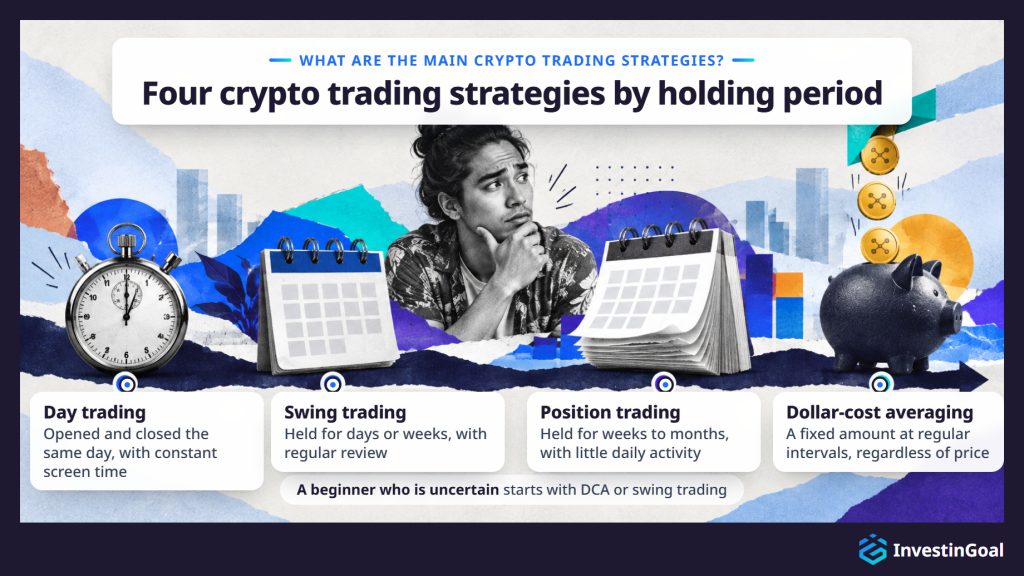
The four main crypto trading strategies a beginner should understand before choosing an approach are day trading, swing trading, position trading, and dollar-cost averaging (DCA). Each strategy differs in time horizon, activity level, and risk profile, so the choice depends on the trader’s schedule and risk tolerance.
Day trading involves opening and closing all positions within the same day, often within hours or even minutes. It demands constant screen time, quick decision-making, and a high tolerance for short-term losses. Day trading does not necessarily need large capital, but it needs a significant time commitment. Day trading suits people who can dedicate several hours per day to active monitoring and are comfortable making rapid decisions under pressure.
Swing trading extends the holding period to days or weeks. The swing trader looks for medium-term price trends rather than minute-to-minute movements. Swing trading requires less screen time than day trading but still demands regular review and adjustment of open positions. The risk profile of swing trading falls between day trading and position trading. Swing positions stay open longer than day trades, so they are exposed to overnight and weekend price swings.
Position trading involves holding positions for weeks to months, aiming to capture sustained directional trends. It requires the least daily activity of the three active strategies and suits traders who prefer a slower, more deliberate approach.
DCA means investing a fixed amount into a cryptocurrency at regular intervals, regardless of price, which makes it closer to investing than to trading. Over time, DCA averages out the purchase price and removes the need to time the market. DCA is the lowest-activity approach, requiring minimal skill and almost no daily attention. It suits beginners who want exposure to cryptocurrency without the pressure of active decision-making.
The right strategy depends on how much time the trader can commit daily, how much volatility they can tolerate emotionally, and how actively they want to manage their capital. A beginner who is uncertain should start with DCA or swing trading before considering the intensity of day trading. A beginner matches the four crypto trading strategies to personal circumstances by comparing their holding period, screen time, and risk profile.
What is position trading and HODLing?
Position trading is a long-horizon strategy where a trader holds a cryptocurrency for weeks or months, aiming to profit from a sustained trend rather than short-term volatility. HODLing is the most widely practised form of position trading in crypto. It means holding through market downturns with conviction in long-term appreciation.
Continue reading
The term HODL originated from a misspelled forum post in 2013 and became shorthand for the philosophy of refusing to sell during price drops. In practice, HODLing is a form of position trading with an extremely long holding period and minimal active monitoring. The position trader may still set broad exit points or adjust their holdings based on major market shifts, while the HODLer typically commits to holding indefinitely.
Position trading and HODLing both require a high degree of volatility tolerance. A position trader holding Bitcoin through a 30% correction must resist the impulse to sell at a loss and trust the longer-term direction of the trend. This psychological pressure differs from the rapid-fire pressure of day trading. Instead of reacting to minute-by-minute moves, the position trader must endure extended periods of unrealised loss.
Position trading and HODLing are best suited to beginners who believe in the long-term trajectory of a specific cryptocurrency and who do not need the capital they have committed for months or years.
How risky is crypto trading for beginners?
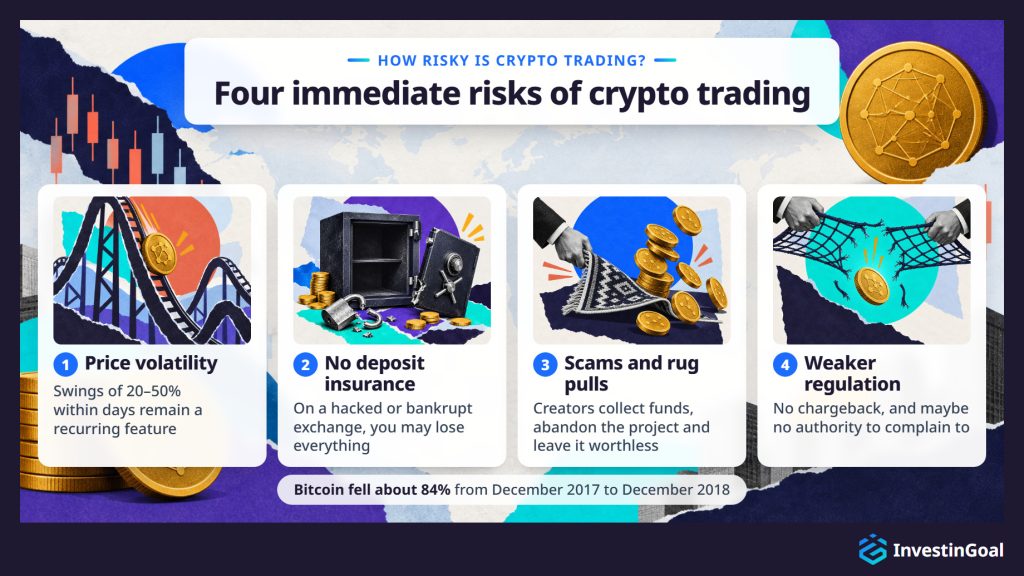
Crypto trading is among the riskiest financial activities available to retail participants. Bitcoin fell approximately 84% from its December 2017 peak to its December 2018 low, during the 2018 crypto winter, Terra/LUNA collapsed from around $80 to near zero in May 2022, and the failure of the FTX exchange in November 2022 triggered another broad market selloff. Swings of 20–50% within days remain a recurring feature of crypto markets, and regulatory protections are substantially thinner than in traditional markets. Blockchain transactions are also irreversible, so no one can recover an error such as a transfer to a wrong address.
Price volatility is the most visible risk, and a cryptocurrency that gains 15% in a week can lose 25% the following week. Smaller cryptocurrencies can collapse by 80% or more in a single event. Moves of this size can erase a beginner’s trading capital before they have time to react or learn from the experience.
The second major risk is the absence of deposit insurance. In Nigeria, the Nigeria Deposit Insurance Corporation (NDIC) protects bank deposits up to a certain threshold, but most crypto exchanges offer no such protection. If the exchange is hacked, goes bankrupt, or freezes withdrawals, the trader may lose everything held on the exchange. Mt. Gox and FTX are the two most significant exchange failures in crypto history. Mt. Gox collapsed in 2014 with approximately 850,000 BTC lost, and FTX filed for bankruptcy in November 2022 with an estimated $8 billion in customer funds unaccounted for. Both failures kept users waiting for years. By March 2025 the Mt. Gox trustee had repaid about 19,500 creditors in bitcoin and bitcoin cash, more than ten years after the collapse. FTX began repaying customers in 2025 at the dollar value of their holdings in November 2022, well below what the same cryptocurrencies were worth by then.
Scam tokens and rug pulls represent a risk category with no direct equivalent in regulated stock markets. A rug pull occurs when the creators of a new cryptocurrency collect funds from buyers and then abandon the project, leaving the cryptocurrency worthless and the buyers with no recourse. Phishing attacks are also widespread. In a phishing attack, fraudulent emails or websites trick traders into revealing their login credentials.
Finally, weaker regulatory protection in crypto means that a beginner may have no authority to complain to if something goes wrong. In Nigeria, a crypto exchange needs registration as a virtual asset service provider (VASP) with the Securities and Exchange Commission of Nigeria (SEC Nigeria), under the Investments and Securities Act 2025, so a beginner who uses a licensed exchange can turn to the authority that supervises the exchange, while a beginner who trades on an unlicensed platform cannot. Blockchain transactions also offer no chargeback mechanism, because they are irreversible. Once a trader sends funds to a wrong or fraudulent address, the funds are gone. Price volatility, the absence of deposit insurance, scams, and weaker regulatory protection are the most immediate crypto risks for a beginner to understand before committing any capital.
What worries you most about crypto trading?
Choose one and see how your answer compares with other readers.
Can you lose all your money trading crypto?
Yes, a beginner can lose their entire trading capital in crypto. Total loss can come from a sequence of leveraged losses that trigger liquidation, a sharp market crash on an undiversified position, sending funds to a scam address, or holding a cryptocurrency that collapses to zero in a rug pull.
Continue reading
Total capital loss is a documented outcome of every major cryptocurrency downturn. During the 2018 crypto winter, Bitcoin dropped approximately 84% from its all-time high, and many smaller cryptocurrencies lost 95% or more of their value. In May 2022, the collapse of Terra/LUNA took its price from roughly $80 to near zero within days, wiping out billions in retail holdings. Months later, the FTX bankruptcy in November 2022 locked customer funds on the exchange with no immediate path to recovery. A trader who had concentrated their capital in any of these situations experienced near-total or total loss.
The risk of total loss also comes from irreversible transactions. If a trader sends funds to a fraudulent wallet address through a phishing link or scam, no bank or authority can reverse the transfer. The funds are permanently gone, because blockchain transactions have no reversal mechanism like a credit card dispute or a bank wire recall. The risk of losing everything applies to beginners more than to experienced participants, because beginners are the most likely to trade without risk controls, concentrate capital in a single position, or fall for scam schemes they have not yet learned to recognise.
Why should beginners avoid leverage when trading crypto?
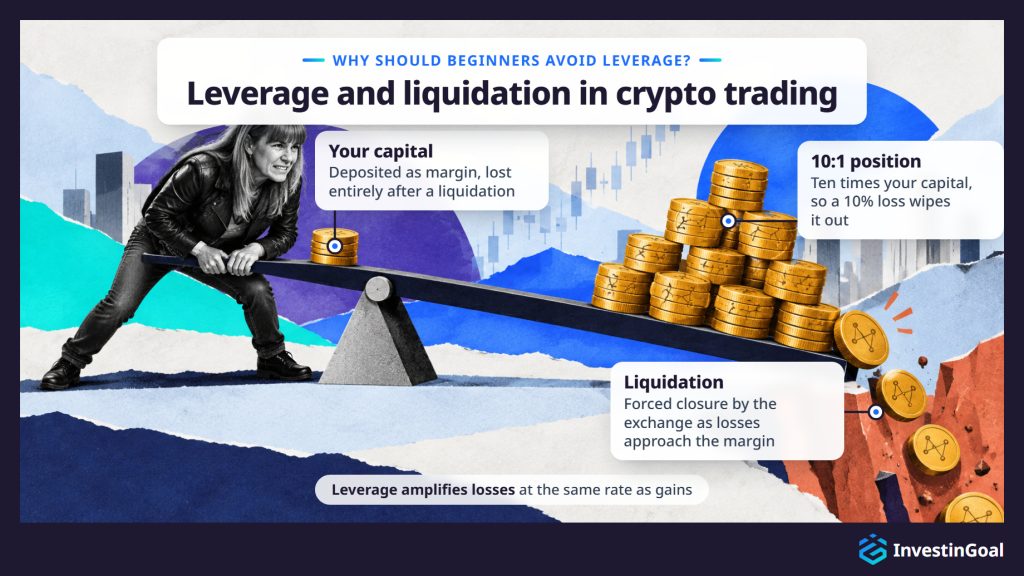
Beginners should avoid leverage in crypto trading because it amplifies losses at the same rate it amplifies gains, and crypto’s native volatility means even a moderate adverse price move can trigger liquidation before any recovery is possible.
Continue reading
A leverage ratio of 10:1 means a trader controls a position ten times larger than their actual capital. A 10% gain on the position doubles the trader’s money, and a 10% loss wipes it out entirely. Crypto prices routinely move 5–10% against a position in a single day, so the exchange can liquidate a leveraged position within hours.
Liquidation is the forced closure of a position by the exchange when the trader’s losses approach or exceed the capital they deposited as margin. After a liquidation, the trader loses the entire margin. A margin call may precede liquidation on some platforms, giving the trader a brief window to add more funds, but in fast-moving crypto markets this window can close before the trader even sees the notification.
The danger of leverage in crypto has led European and British regulators to restrict it for retail clients. ESMA’s 2018 product intervention measures restrict retail clients in the EU to a maximum of 2:1 leverage on cryptocurrency CFDs, the lowest cap across all asset classes. The FCA in the United Kingdom went further and banned the sale of crypto CFDs to retail consumers entirely in January 2021. Both rules treat leverage in crypto trading as too dangerous for inexperienced participants. For a beginner, the starting point is to trade without leverage entirely.
How do you manage risk when trading crypto?
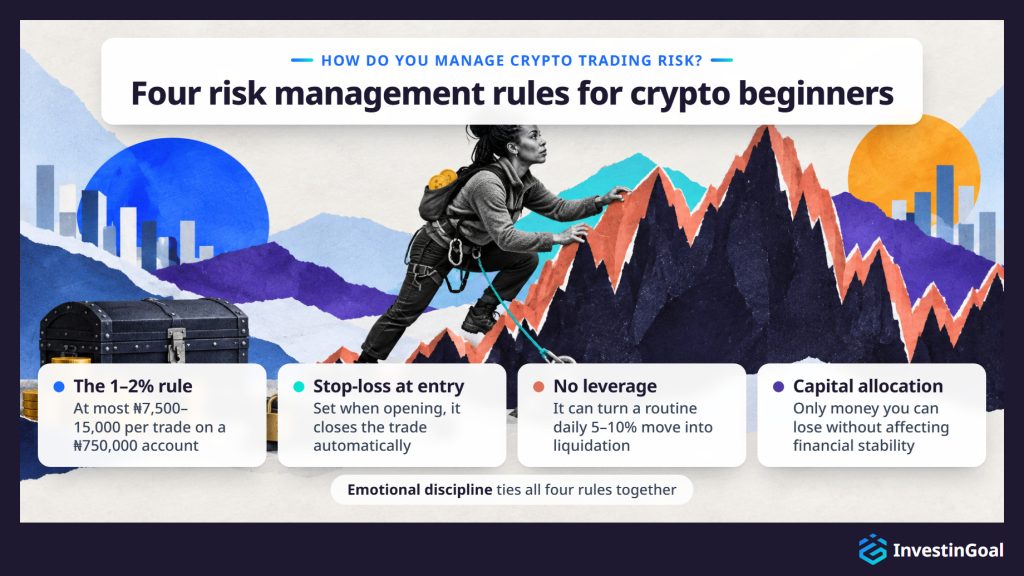
To manage risk in crypto trading, a beginner should apply four rules before placing any trade: limit each position to 1–2% of total trading capital, set a stop-loss order at entry on every position, avoid leverage entirely, and never allocate more to cryptocurrency than they can afford to lose in full.
The 1–2% rule is the foundation of position sizing. It means that no single trade should risk more than 1–2% of the trader’s total account. For example, a trader with ₦750,000 in their account should risk no more than ₦7,500–15,000 on any individual position. If the trade goes wrong, the loss is small enough to absorb without damaging the overall account. The 1–2% rule prevents the most common beginner failure mode: putting too much capital into one trade and suffering a loss large enough to end their trading activity.
A stop-loss order automates the exit. The trader places the stop-loss when opening the position, and it instructs the exchange to close the trade automatically if the price falls to a specific level. The stop-loss takes emotion out of the exit, because the trader decides on the loss at entry instead of in real time.
Avoiding leverage is non-negotiable for beginners, because leverage can turn a routine daily move of 5–10% into a liquidation. The fourth rule is capital allocation, and it applies before any trading begins. The total amount deposited into a trading account should be money the trader can lose entirely without affecting their financial stability. Capital allocation keeps the trader’s maximum drawdown under control when the trader treats it as a firm rule.
Emotional discipline ties all four rules together. A beginner who follows the 1–2% rule and sets stop-losses on every trade will still be tempted to override those rules after a losing streak or a missed opportunity. Diversification further reduces the impact of any one bad trade, because it spreads capital across multiple assets instead of concentrating it in a single cryptocurrency. The four rules are sufficient to protect a beginner’s capital during the first weeks and months of active trading, and every broader approach to risk management in trading builds on them.
How do you keep your cryptocurrency safe?
To keep cryptocurrency safe, a beginner must take three protective steps: enable two-factor authentication (2FA) when opening the exchange account and before the first deposit, avoid leaving large balances on the exchange, and move significant holdings into a personal wallet where the trader controls the private key.
Continue reading
The first step is 2FA, which adds a second layer of security beyond the password, typically a time-based code that an authenticator app such as Google Authenticator generates. Without 2FA, a compromised password is enough to drain an account. With 2FA, an attacker would need access to both the password and the trader’s physical device. 2FA is the single most effective security measure a beginner can enable, because exchange hacks remain a persistent risk across the industry.
The second step is keeping small balances on the exchange, because exchanges are attractive targets for hackers. Exchanges hold large pools of user funds in custodial wallets, which means the exchange controls the private keys on the trader’s behalf. If hackers breach the exchange, they can steal user funds. A beginner should keep only the capital they are actively trading on the exchange and move the rest to a personal wallet.
The third step is using a personal wallet, which can be a hot wallet or a cold wallet. A hot wallet is a software wallet connected to the internet, convenient for frequent access but still vulnerable to online threats. A cold wallet is a hardware device, such as a Ledger or Trezor, that stores private keys offline, providing the highest level of security for long-term holdings. In both cases, the trader holds a non-custodial wallet, meaning they control the private key directly. The trader must store the private key and the associated seed phrase offline and never share them with anyone. The seed phrase is a series of words used to recover the wallet. Losing the seed phrase means losing access to the funds permanently, with no recovery option.
How do you choose a crypto exchange for trading?
You choose a crypto exchange for trading by evaluating it across five criteria: regulatory status in your country, fee structure (maker/taker fees and withdrawal fees), range of supported assets, security track record, and ease of deposit and withdrawal. On these criteria, Coinbase, Kraken, and Binance take different positions, which makes them useful reference points. Regulatory status separates them in the EU, where Binance has not accepted new clients since 1 July 2026 because it has no MiCA licence.
Regulatory status is the first filter, because a regulated exchange has been reviewed and licensed by a financial authority and must comply with rules on fund segregation, anti-money laundering, and user protection. Not every exchange holds a licence in every country, so the trader must check whether the exchange they are considering is authorised to operate in their jurisdiction. In Nigeria, an authorised exchange holds a VASP registration with the SEC Nigeria. A licensed exchange always requires KYC verification, because KYC requirements are a direct consequence of regulation.
Fee structure covers the maker and taker fees applied to each trade and the withdrawal fees. Maker fees apply when a trader adds liquidity to the order book by placing a limit order that is not immediately filled. Taker fees apply when a trader removes liquidity by placing an order that fills immediately. Withdrawal fees cover the cost of moving cryptocurrency off the exchange to a personal wallet. Fee structures vary significantly across exchanges. Coinbase, Kraken, and Binance each use different fee tiers and pricing models, which can meaningfully affect a beginner’s returns over time.
Supported assets determine what the trader can buy and sell. Some exchanges list hundreds of cryptocurrencies, while others focus on a smaller, more curated selection. A beginner does not need access to thousands of cryptocurrencies, but should confirm that the exchange lists the major cryptocurrencies they are interested in.
Security track record reveals how the exchange has handled past threats. An exchange that responded transparently to a breach, compensated users, and upgraded its systems is a different proposition from one that lost user funds without resolution. A beginner should research whether the exchange has suffered major incidents and how it responded.
Finally, deposit methods matter for accessibility. An exchange that only accepts cryptocurrency deposits is not useful to someone who has never owned cryptocurrency. The trader needs an exchange that accepts their local currency through a deposit method they already have, such as a bank transfer or a debit card. The five criteria apply in the same way to every exchange, so a beginner can use them to compare the best crypto exchanges and the best crypto trading apps.
What should beginner crypto traders focus on in a crypto exchange?
Beginner crypto traders should focus on three priorities in an exchange above all others: a strong regulatory status in their country, a simple and intuitive interface, and a low minimum deposit and minimum trade size that allow starting with a small capital base.
Continue reading
Regulatory status matters most because it determines the baseline protections the trader receives. A beginner cannot yet evaluate an exchange’s internal security practices independently, so an exchange regulated by a recognised authority serves as a proxy for trustworthiness. In Nigeria, that authority is the SEC Nigeria. A regulated exchange must follow rules that unregulated exchanges may ignore.
Interface simplicity is the second priority, because an exchange designed for professional traders may offer powerful tools but present an overwhelming experience for someone making their first trade. A clean layout, a clear buy/sell flow, and accessible customer support reduce the chance of costly errors during the learning phase. Interface simplicity also covers fee transparency, which means the beginner should be able to see exactly what each trade will cost before confirming it, without hidden charges or complex discount tiers.
A low minimum deposit and trade size is the third priority, because an exchange with a high minimum deposit or a large minimum trade size excludes beginners who want to start small and learn with low-risk capital. Exchanges that allow deposits of ₦15,000–75,000 and trades of similar size let the beginner gain real experience without committing more money than they are prepared to lose. The three priorities together decide which are the best crypto exchanges for beginners.
How do you make your first crypto trade?
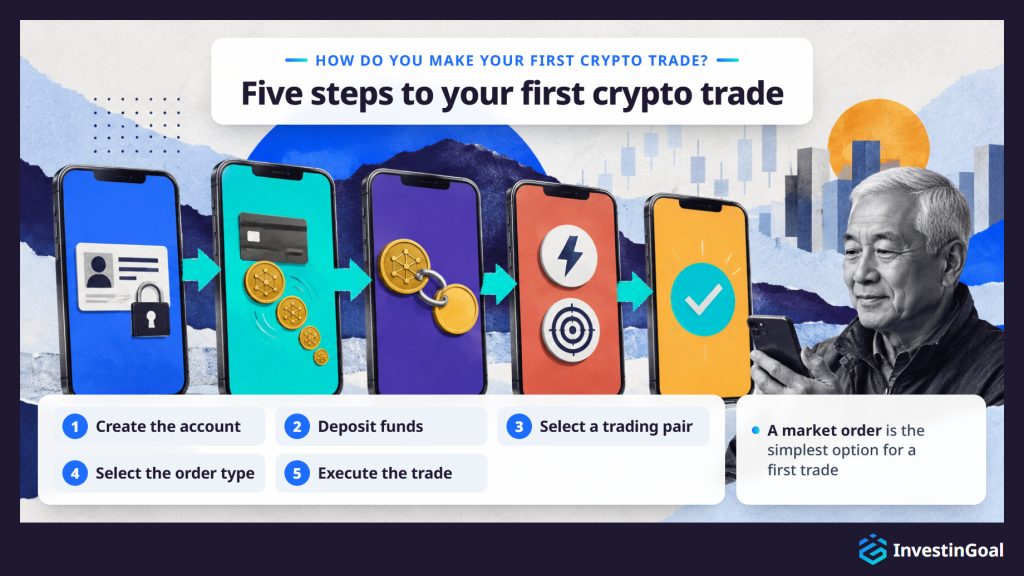
To make a first crypto trade, a beginner follows five steps: create and verify an account on a regulated exchange, deposit funds using a supported deposit method, select the cryptocurrency to buy, choose the appropriate order type, and execute the trade.
- Create the account. Choose a regulated exchange and register with a valid email address. Set a strong, unique password and enable two-factor authentication immediately, before the first deposit. Begin the KYC verification process by submitting a government-issued ID and any additional documentation the exchange requests. Verification time varies from minutes to days depending on the exchange and the volume of applications.
- Deposit funds. Once the exchange has verified the account, navigate to its deposit section and select your preferred deposit method. Bank transfers typically carry lower fees but may take one to three business days. Debit card deposits are usually instant but cost more. Start with a small amount, enough to make a few trades while learning the exchange.
- Select a trading pair. Choose which cryptocurrency to buy. For a first trade, a major cryptocurrency such as Bitcoin or Ethereum is the most practical choice. Bitcoin and Ethereum have high liquidity, are available on every major exchange, and carry less risk of sudden collapse than smaller, less-established cryptocurrencies.
- Select the order type. Decide how you want the trade to execute. A market order fills immediately at the current price. A limit order fills only when the price reaches a level you specify. For a first trade, a market order is the simplest option.
- Execute the trade. Review the order summary, including the amount, the price, and any fees, then confirm. The exchange processes the trade and updates your account balance. A confirmation screen or notification will show the completed transaction. The cryptocurrency is now in your exchange account, and your first trade is done.
What are the main order types in crypto trading?
The three main order types a beginner must understand before placing a trade are the market order (executed immediately at the current available price), the limit order (executed only when the asset reaches a price the trader specifies), and the stop-loss order (which automatically closes the position when the price falls to a defined level, capping the loss).
Continue reading
A market order is the simplest order type, because the trader says “buy now” or “sell now” and the exchange fills the order instantly at the best available execution price. A market order executes quickly and with certainty, but it carries the risk of slippage. If the market is moving fast or liquidity is thin, the final execution price may differ slightly from the price displayed when the trader placed the order.
A limit order gives the trader control over price. The trader sets a price threshold instead of accepting whatever the market currently offers, and the order only fills if the market reaches that level. A limit order eliminates slippage but carries the risk that the order never fills at all if the price does not reach the specified level.
A stop-loss order is a risk management tool. The trader sets a price below their entry point, and if the market falls to that level, the exchange closes the position automatically. The stop-loss limits the downside on any individual trade and removes the need for the trader to watch the screen continuously. For a beginner, placing a stop-loss on every position is one of the most important habits to develop from the first trade onwards.
What trading tools do beginners use in crypto trading?
Beginner crypto traders typically use three categories of tools alongside their exchange: a charting platform to read price history and basic indicators, a real-time market data feed to monitor prices and trading volume across assets, and a portfolio tracker to monitor overall positions and performance in one place.
Continue reading
The most widely used charting platform is TradingView, which provides interactive charts, technical indicators, and the ability to draw trend lines and support/resistance levels. A beginner does not need to master every feature immediately, but learning to read a simple candlestick chart and identify basic price trends is a useful starting point.
For real-time market data, CoinGecko and CoinMarketCap are the two most commonly used market data feeds. Both aggregate prices, trading volumes, and market capitalisation data across thousands of cryptocurrencies and exchanges. A beginner can use either to compare prices across exchanges, check whether a cryptocurrency is gaining or losing momentum, and discover which cryptocurrencies are seeing unusual volume.
A portfolio tracker consolidates all of a trader’s holdings into a single view, regardless of which exchange or wallet holds each asset. A portfolio tracker becomes useful once a beginner starts trading on more than one exchange or holds cryptocurrency in both an exchange account and a personal wallet. The tracker calculates total portfolio value, individual position performance, and overall profit or loss, giving the trader a clear picture of where they stand without logging into multiple accounts.
What are the most common crypto trading mistakes?
The most common crypto trading mistakes beginners make are FOMO-driven entries, overleveraging, ignoring tax obligations, leaving large balances on exchanges, and overtrading without a defined strategy. Each of these mistakes has a direct and measurable cost: in capital, in security, or in compounding losses.
- FOMO stands for fear of missing out, and it drives beginners to buy into a cryptocurrency after it has already risen sharply, typically because social media or news coverage has created excitement around it. Behavioural finance research confirms the pattern. Manpreet Kaur, Jinesh Jain, and Kirti Sood surveyed 473 crypto retail investors for “All are investing in Crypto, I fear of being missed out”, a study published in Quality & Quantity. They found that FOMO, herding behaviour, loss aversion, and overconfidence all significantly influence crypto trading decisions. FOMO in particular acted as a key link between social pressure and actual buying behaviour. The pattern played out when Bitcoin reached its then all-time high near $69,000 in November 2021. Many retail buyers entered at or near the peak and then watched the price decline over 75% to below $16,000 by November 2022. The price has often already peaked by the time the hype reaches a beginner. Buying at the top of a rally and watching the price drop immediately is one of the most common and most discouraging experiences a new trader faces.
- Overleveraging multiplies the damage of FOMO. A beginner who uses high leverage on a FOMO-driven entry is compounding two errors: bad timing and amplified exposure. The result is often rapid liquidation and the loss of the entire margin.
- Ignoring tax obligations is a mistake that does not hurt immediately but creates serious problems later. In Nigeria, gains on cryptocurrency are added to income and taxed at the progressive income tax rates from 1 January 2026. As a result, cryptocurrency trades carry tax obligations that beginners commonly overlook. Failing to track trades and report gains correctly can result in penalties, interest, and back taxes that exceed the original profits.
- Leaving large balances on exchanges creates a security risk. Exchanges are targets for hackers, and in most cases no deposit insurance protects the funds held on an exchange. A beginner who treats the exchange as a long-term storage solution accepts a risk that moving the funds to a personal wallet would reduce.
- Overtrading is the compulsive placing of trades without a clear rationale. It often stems from boredom, the desire to “do something” after a period of flat prices, or the attempt to recover losses quickly. Each unnecessary trade incurs fees and exposes capital to risk without a corresponding edge. Trading without a defined strategy turns the activity into gambling. A defined strategy is a plan for when to enter, when to exit, and how much to risk.
- Emotional discipline is the common thread across all five mistakes. Each of the five mistakes stems from a failure to follow a plan or a failure to have one in the first place. A beginner who recognises these patterns early and counters them with the risk management and position-sizing rules is far more likely to survive the learning curve. A beginner who wants to learn crypto trading beyond the beginner stage follows a structured path that addresses each of these five mistakes.