
ETFs for Beginners: The Ultimate Guide

An ETF (exchange-traded fund) is an investment fund that holds a basket of assets and trades on a stock exchange like an individual share. One purchase of an ETF gives a beginner a slice of hundreds or thousands of securities, and most ETFs follow an index such as the S&P 500, the MSCI World or the FTSE 100. Unlike a mutual fund, an ETF trades throughout the day at market prices, usually costs less and asks for no minimum beyond the price of one share.
ETFs come in five main types: equity, bond, commodity, sector and thematic, and ESG. Most beginners start with a broad-market equity ETF, and in the EU and the UK they also choose between accumulating ETFs, which reinvest dividends, and distributing ETFs, which pay them out as cash.
A broad-market ETF is also the cheapest choice. Broad-market index ETFs charge between 0.03% and 0.20% a year, plus broker commissions and the bid-ask spread, while actively managed funds often charge 0.50% to 1.50%. In 2025, 79% of actively managed US large-cap funds did worse than the S&P 500. Low costs do not remove risk, because the S&P 500 fell 57% in the 2007–2009 financial crisis and 34% in the COVID-19 crash of 2020, so ETFs suit money that can stay invested for many years.
Investing for many years starts with four steps that are the same everywhere: opening an account with a regulated broker, depositing money, selecting an ETF and placing a buy order. The account changes with the country. Beginners in Nigeria use platforms such as Afrinvest, Bamboo or Trove. Investors in Nigeria can buy US-listed ETFs through platforms authorised by the Securities and Exchange Commission of Nigeria (SEC Nigeria).
Among those funds, a beginner chooses a first ETF on five criteria: the index, the expense ratio, the fund size, the replication method and the choice between accumulating and distributing. The platform comes last, and a beginner judges it on four factors: the range of ETFs, the total cost, the regulation and the account type it offers.
What brings you to this guide today?
Choose one and see how your answer compares with other readers.
What is an ETF?
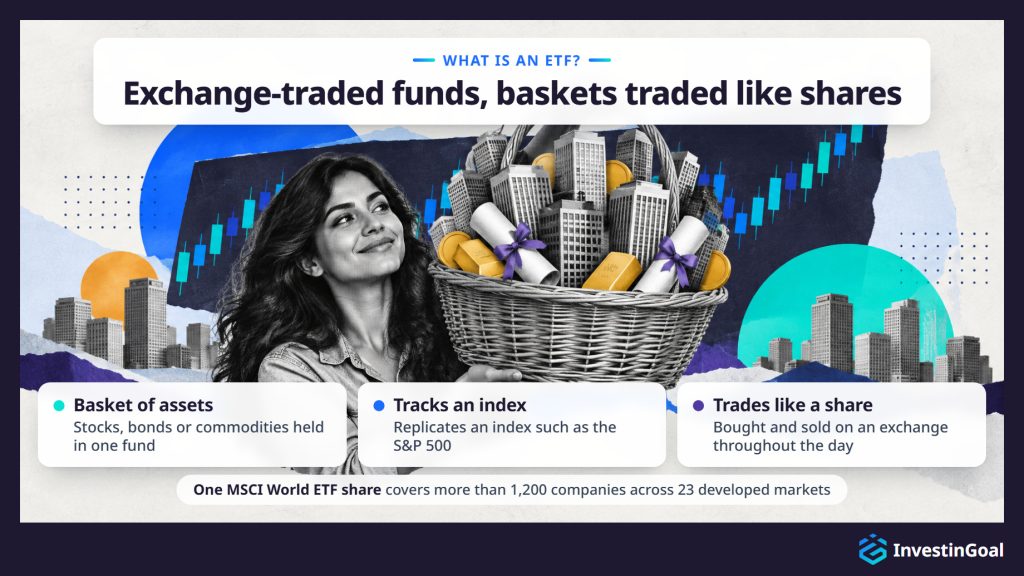
An ETF (exchange-traded fund) is an investment fund that holds a basket of assets, such as stocks, bonds or commodities, and trades on a stock exchange like an individual share. A single ETF purchase gives the investor exposure to dozens or thousands of securities in one transaction, instead of buying company shares one by one.
An ETF provider creates a fund that holds a set of assets chosen to replicate the performance of an index, a list of securities that measures a market, such as the S&P 500 or the MSCI World. The S&P 500 tracks the 500 largest US-listed companies by market capitalisation. The largest providers include iShares, the ETF brand of BlackRock (the world’s largest asset manager), Vanguard (the second largest) and Amundi (the largest in Europe). Investors then buy and sell shares of the fund on a stock exchange, just as they would buy shares of any listed company. The price of each ETF share changes throughout the trading day with supply and demand, but it closely reflects the value of the assets the fund holds.
This structure gives beginners diversification, the spread of money across many securities, with a single purchase. Instead of researching and buying dozens of individual stocks to build a balanced portfolio, an investor can buy one broad-market ETF and immediately own a proportional slice of every company in that index. A single share of a FTSE 100 ETF, for example, gives exposure to the 100 largest companies listed on the London Stock Exchange. A single share of an MSCI World ETF covers more than 1,200 companies across 23 developed markets.
ETFs belong to the broader category of pooled investment funds. Unlike other funds, they trade on a stock exchange, and investors can buy or sell them at any time the market is open, at the price the market offers at that moment. A beginner who wants to invest in ETFs buys them through a broker, in the same way as shares.
How does an ETF track an index?
An ETF tracks an index by holding the same securities in the same proportions as the index it follows, so the fund’s returns closely mirror the index’s performance over time.
Continue reading
This process is called index replication, and it comes in two main forms. Physical replication means the ETF buys and holds all the securities in the index, or a representative sample of them. A physically replicated S&P 500 ETF, for example, holds shares of all 500 companies in the S&P 500, weighted to match the index. When the index provider changes the composition of the index, the ETF adjusts its holdings.
Synthetic replication works differently, because instead of buying the securities, the ETF signs a swap agreement with a counterparty, usually a bank, that agrees to pay the index’s return. Providers use synthetic replication less often for broad-market funds and more often for markets or commodities that are hard to access.
In both cases, the fund calculates its net asset value (NAV), the total value of the assets it holds, at the end of each trading day. The market price of the ETF on the exchange may differ slightly from the NAV during the day, but arbitrage keeps the gap small. The difference between the ETF’s return and the index’s return is called the tracking difference, and for well-managed broad-market ETFs that track major indices like the S&P 500, the FTSE 100 or the MSCI World, it is usually a fraction of a percentage point per year.
Every ETF states its replication method on its factsheet, the summary that the provider publishes for each fund, next to the index the fund tracks and its annual cost. These figures cover the parts of how ETFs work that a beginner needs to know before buying a first fund.
What is the difference between an ETF and a mutual fund?
An ETF differs from a mutual fund mainly in how investors buy and sell it. ETFs trade on a stock exchange throughout the day at changing market prices, while investors can buy and sell mutual fund shares only once a day, at the fund’s closing net asset value. ETFs also tend to have lower expense ratios and no minimum investment beyond the price of a single share.
Continue reading
Intraday trading is the most visible difference, because an ETF order executes in seconds at the current market price. When an investor buys a mutual fund, the fund executes the order after the market closes, at the end-of-day NAV. For long-term investors this difference often does not matter in practice, but it gives ETFs more flexibility for those who want to control the exact price they pay.
Cost is the second difference, because broad-market index ETFs often charge expense ratios between 0.03% and 0.20% per year. According to Morningstar’s US Fund Fee Study 2026, the asset-weighted average expense ratio of active US equity funds was 0.58% in 2025, against 0.09% for broad index funds, and many active funds still charge between 0.50% and 1.50%. Even among index-tracking mutual funds, ETFs tend to have a slight fee advantage because of their structure.
Accessibility is the third difference, because many mutual funds require a minimum first investment, sometimes ₦1,350,000 to ₦4,050,000 or more. ETFs have no such minimum. The entry cost is the price of a single share, which for broad-market ETFs ranges from about ₦13,500 to hundreds of thousands of naira.
Tax efficiency is the fourth difference in the US, because the way ETFs handle redemptions usually produces fewer taxable capital gains distributions than mutual funds. The advantage matters less in Nigeria, where different tax rules apply.
Both products can track the same index, hold the same securities and deliver similar returns. For a beginner, the choice between an ETF and a mutual fund comes down to trading flexibility, cost and the account that holds them. The table below compares the two on trading, typical expense ratio, minimum investment, tax efficiency in the US and price control.
| Dimension | ETF | Mutual Fund |
|---|---|---|
| Trading | Intraday on a stock exchange, at live market prices | Once per day, at end-of-day NAV |
| Typical expense ratio | 0.03%–0.20% (broad-market index) | 0.50%–1.50% (actively managed) |
| Minimum investment | Price of one share (from about ₦13,500 to hundreds of thousands of naira), or less with fractional shares | Often ₦1,350,000–₦4,050,000 |
| Tax efficiency (US) | Generally higher (fewer capital gains distributions) | Generally lower (redemptions can trigger taxable events) |
| Price control | You choose the exact price via market or limit order | You receive the NAV calculated after the market closes |
What are the main types of ETFs beginners can invest in?
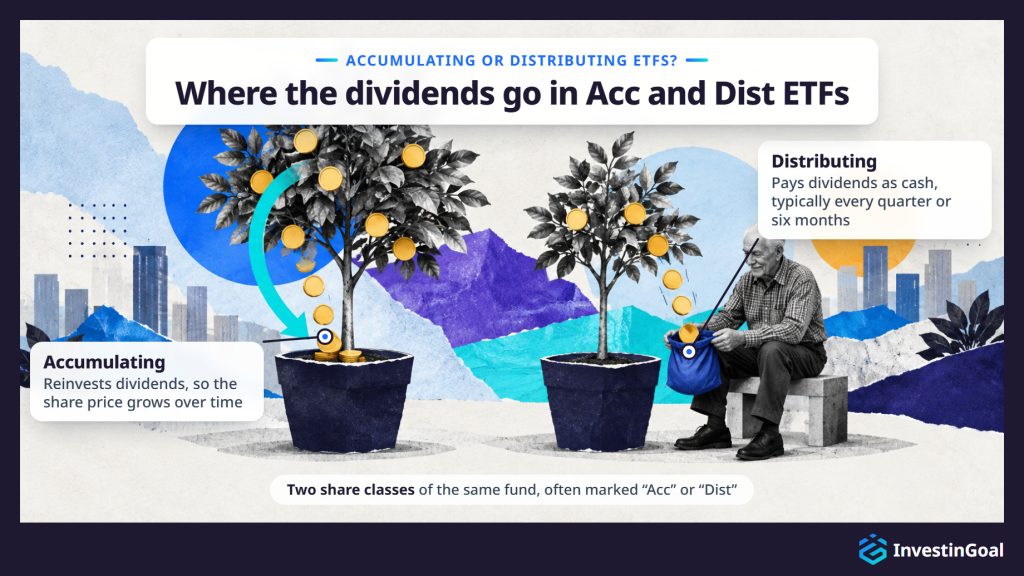
The main types of ETFs beginners can invest in are equity ETFs, bond ETFs, commodity ETFs, sector and thematic ETFs, and ESG ETFs, each giving exposure to a different asset class or investment theme through a single fund.
Equity ETFs are the most widely held category. They track stock market indices and give the investor ownership of a broad basket of company shares. A FTSE 100 equity ETF holds the 100 largest UK-listed companies. An S&P 500 equity ETF holds the 500 largest US-listed companies. An MSCI World equity ETF holds more than 1,200 companies across 23 developed countries. For most new investors, a single broad-market equity ETF is the starting point of their portfolio.
Bond ETFs hold portfolios of fixed-income securities, such as government bonds or corporate bonds. They offer lower expected returns than equity ETFs but also lower volatility, which makes them useful for diversification or for investors with shorter time horizons. An ETF tracking the Bloomberg Global Aggregate Bond Index, for example, holds investment-grade government and corporate bonds from developed and emerging markets.
Commodity ETFs give exposure to physical commodities like gold, silver or oil without requiring the investor to buy and store them. A gold ETF, for instance, tracks the price of gold bullion. Investors often use commodity ETFs as a hedge against inflation or market uncertainty.
Sector and thematic ETFs focus on a specific industry (such as technology, healthcare or clean energy) or a specific investment theme (such as artificial intelligence or cybersecurity). They are more concentrated than broad-market ETFs, so they carry higher sector-specific risk alongside higher potential returns within that sector.
ESG ETFs apply environmental, social and governance screening criteria to their holdings, and they exclude companies that do not meet specific sustainability or ethical thresholds. A FTSE 100 ESG ETF, for example, would hold a filtered part of the standard index based on ESG scores.
Each type serves a different role in a portfolio, and a beginner does not need to hold all of them. Most new investors start with a broad-market equity ETF and add other types of ETFs later. The table below sums up what each type holds, an example index and its risk compared with the broad market.
| ETF type | What it holds | Example index | Risk vs. broad market |
|---|---|---|---|
| Equity ETF | Shares of companies across a stock market index | S&P 500, MSCI World, FTSE 100 | Baseline (is the broad market) |
| Bond ETF | Government and/or corporate bonds | Bloomberg Global Aggregate Bond | Lower volatility, lower expected return |
| Commodity ETF | Physical commodities (gold, silver, oil) | Gold bullion price | Different risk profile, often used as a hedge |
| Sector / Thematic ETF | Companies in one industry or theme | MSCI World Information Technology | Higher (concentrated in one sector) |
| ESG ETF | Companies filtered by sustainability criteria | FTSE 100 ESG Select | Similar to broad market, slightly narrower |
What is the difference between accumulating and distributing ETFs?
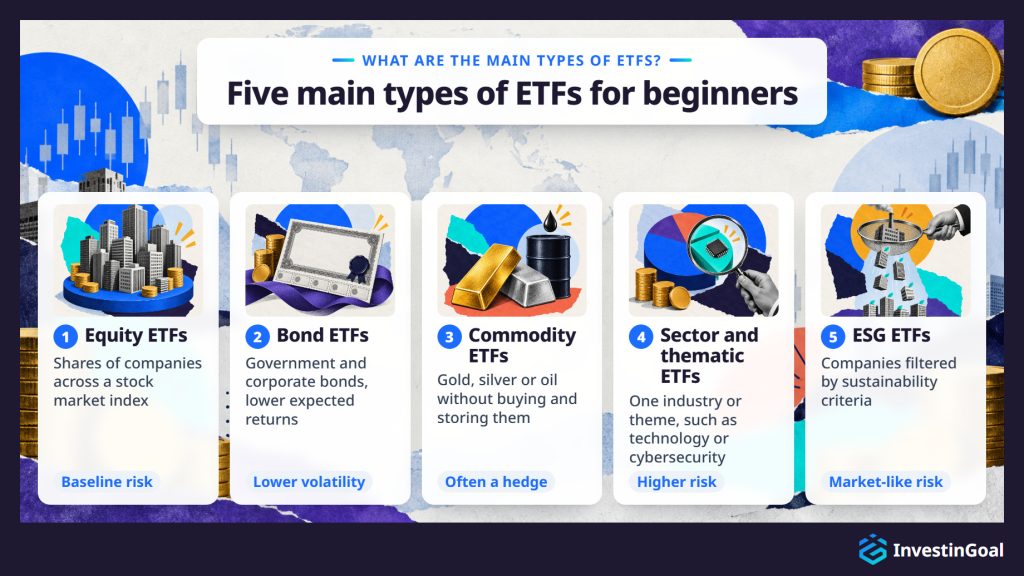
An accumulating ETF reinvests dividends in the fund, which raises the share price over time, while a distributing ETF pays dividends out to the investor as cash at regular intervals. The difference matters most for EU and UK investors, who can usually choose between both versions of the same fund. The two versions are called share classes, and their tax treatment depends on the account that holds them.
Continue reading
The difference changes how your returns compound. With an accumulating ETF, the fund reinvests the dividends automatically. You do not receive cash payouts, but the value of each share grows over time because the fund adds the dividends to its holdings. This is generally simpler if you are focused on long-term growth, because it avoids the need to reinvest small dividend payments by hand.
With a distributing ETF, the fund pays the dividends to your brokerage account, typically every quarter or every six months. You then decide whether to reinvest those dividends or spend them. This structure suits those who want regular income from their portfolio.
The choice between accumulating and distributing is especially visible among UCITS ETFs, the European funds that follow a common EU rulebook, where most major funds offer both share classes under the same fund name, often marked “Acc” or “Dist” in the fund title. EU and UK investors meet this choice whenever they select an ETF on a European exchange. US-listed ETFs almost always distribute dividends, so the choice matters less for US investors.
The tax treatment of accumulating and distributing ETFs varies by country and account type.
Why are ETFs a good investment for beginners?
ETFs are a good investment for beginners because they combine broad diversification, low annual fees and simple trading in a single product that requires neither stock-picking expertise nor a large starting capital.
Diversification comes with the first purchase, because a broad-market ETF spreads your money across hundreds or thousands of companies. A single ETF does it instantly, whether it tracks the S&P 500, the MSCI World or the FTSE 100. This removes the risk that one company’s poor performance destroys the portfolio, which is the main danger of buying individual stocks.
Low expense ratios make this diversification cheap. Broad-market index ETFs typically charge between 0.03% and 0.20% per year, so an investor with ₦15,000,000 in a low-cost ETF pays between ₦4,500 and ₦30,000 a year in fund fees. By comparison, actively managed funds frequently charge 0.50% to 1.50%. According to the SPIVA U.S. Scorecard of S&P Dow Jones Indices, 79% of actively managed US large-cap funds did worse than the S&P 500 in 2025. Over the 15 years to December 2024, no category of US equity funds had a majority of active managers beating its benchmark.
Simplicity comes from buying an ETF in the same way as a single stock. You place an order through a brokerage platform, and the trade executes in seconds. There is no need to research individual companies, read earnings reports or time the market.
Transparency is built in, because ETFs publish their full list of holdings every day. You always know exactly what you own.
Liquidity comes from the stock exchange, where you can buy and sell ETFs at any time the market is open. There is no lock-up period and no redemption delay.
These advantages make ETFs the default starting point for beginners in most developed markets. They do not remove the risk of losses, because the whole market can fall.
Which ETF advantage matters most to you?
Choose one and see how your answer compares with other readers.
What is the minimum amount needed to invest in ETFs?
The minimum amount needed to invest in ETFs is the price of a single share, from about ₦13,500 to hundreds of thousands of naira depending on the fund, and many platforms now offer fractional shares or automatic savings plans from €1 or £25 per month.
Continue reading
In the US, most online brokers let investors buy fractional shares of ETFs, which means you can invest $5 or $10 in an ETF with a full share price of $400. US brokers often ask for $0 to open an account, and many charge no commission on ETF trades.
In the EU, Trade Republic and Scalable Capital offer ETF savings plans from €1 per month. Both are neobrokers, online brokers that work mainly through a mobile app. A savings plan invests a fixed amount in a chosen ETF at regular intervals, so the investor does not need to time purchases or save up a lump sum first.
In the UK, many platforms offer regular investing from £25 per month through a Stocks and Shares ISA or a general investment account. The minimum deposit to open an account varies by platform but is often between £0 and £100.
Fractional shares, zero-commission trading and automatic savings plans have brought the entry barrier down to single digits in the US, the EU and the UK.
How much does it cost to invest in ETFs?
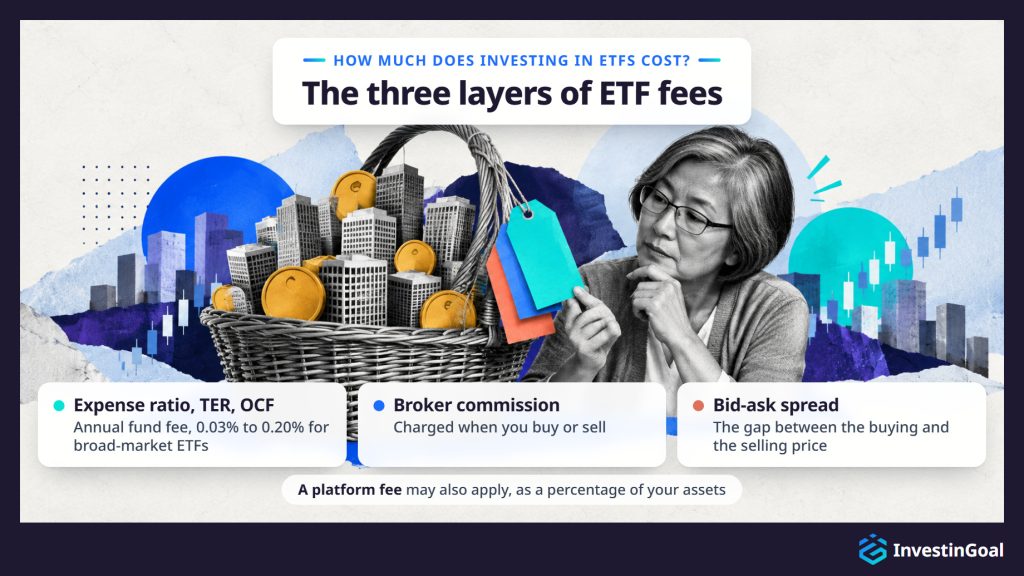
The cost of investing in ETFs has three layers: the fund’s annual expense ratio (typically 0.03% to 0.20% for broad-market ETFs, or ₦450 to ₦3,000 per year for every ₦1,500,000 invested), the broker’s commission when you buy or sell, and the bid-ask spread at the moment of the trade. The same annual cost of the fund is called the expense ratio in the US and the TER (total expense ratio) or the OCF (ongoing charges figure) in Europe and the UK. The three names mean the same cost.
The expense ratio is the most important cost to understand. The fund takes it automatically from its assets, so you never see a separate bill. It reduces the fund’s return by a small amount each year. An ETF with a 0.07% expense ratio costs ₦1,050 per year for every ₦1,500,000 invested, while an actively managed fund charging 1.00% costs ₦15,000 for the same amount. Over decades, compound interest widens that gap.
Broker commissions are the second layer. Since late 2019, when Charles Schwab, Fidelity and TD Ameritrade dropped commissions on US-listed ETF trades, commission-free trading has become the standard among major US online brokers. In Europe, neobrokers often charge €0 to €1 per transaction, while traditional banks may charge €5 to €15. In the UK, platforms like Trading 212 and InvestEngine offer commission-free ETF investing, while Hargreaves Lansdown charges £6.95 per online trade and Interactive Investor £3.99, and both offer regular monthly investing with no dealing charge. A platform fee may also apply, particularly in the UK, and it is a percentage of the assets you hold on the platform.
The bid-ask spread is the third layer. It is the difference between the price at which you can buy an ETF and the price at which you can sell it at any given moment. For large, liquid ETFs tracking major indices, the spread is usually a few cents per share and has little impact. For smaller or less liquid ETFs, the spread can be wider.
ETFs cost far less than actively managed funds. Low expense ratios, falling commissions and tight spreads make ETFs one of the cheapest investments available to retail investors. Together with the platform fee, these three layers make up the ETF fees a beginner pays, and the table below compares them in the US, the EU and the UK.
| Cost layer | US | EU | UK |
|---|---|---|---|
| Annual fund fee | Expense ratio: 0.03%–0.20% | TER: 0.03%–0.20% | OCF: 0.03%–0.20% |
| Broker commission | $0 at most major brokers (since 2019) | €0–€1 at neobrokers; €5–€15 at traditional banks | £0 at Trading 212, InvestEngine; £3.99–£6.95 at others |
| Platform fee | Uncommon | Varies; some neobrokers charge none | Common (percentage of assets or flat annual charge) |
| Bid-ask spread | A few cents per share for large, liquid ETFs in all jurisdictions; wider for smaller or less liquid ETFs | ||
How are ETFs taxed?
ETFs are taxed according to the investor’s country of residence and the type of account that holds them, and Nigeria has no tax-advantaged account that reduces the tax on ETFs.
Continue reading
In Nigeria, from January 2026 capital gains are taxed at the income tax rates, with an exemption below ₦150 million of proceeds and ₦10 million of gain, and 10% is withheld on ETF dividends. The platform that holds the account also matters, because the investor declares and pays the tax, also with a foreign broker, and 10% is withheld on ETF dividends.
Tax rules change from country to country and over time. Nigeria has no tax-advantaged account for ETFs, so the same tax rules apply to every ETF account.
What are the risks of investing in ETFs?
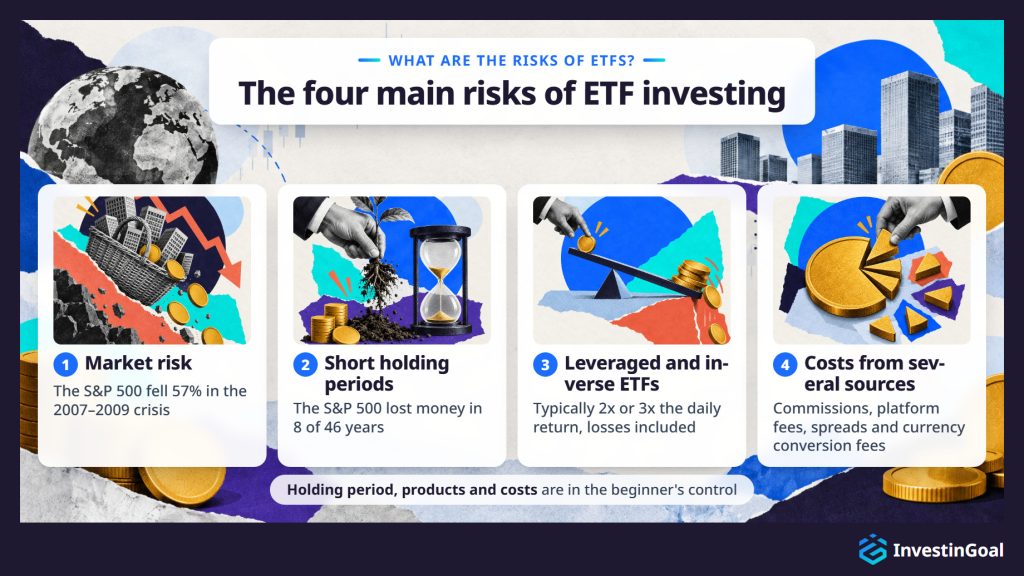
The main risks of investing in ETFs are market risk, short holding periods, leveraged and inverse ETFs, and costs from several sources. The whole index can fall, and broad-market falls of 30–50% have happened in the past. A short holding period makes a loss more likely, leveraged and inverse ETFs amplify losses and do not suit beginners, and fees that nobody monitors can take a large share of returns.
- Market risk is the most fundamental, because an ETF that tracks the S&P 500 or the MSCI World falls when those markets fall. Diversification reduces the impact of any single company’s decline, but it does not protect against broad market downturns. During the 2007–2009 financial crisis, the S&P 500 fell 57% from its October 2007 peak to its March 2009 trough, according to Federal Reserve data. During the COVID-19 crash, the S&P 500 fell 34% between 19 February and 23 March 2020, a decline that took just 23 trading days.
- Short holding periods raise the probability of a loss. From 1980 to 2025, the S&P 500 lost money in 8 of 46 calendar years with dividends included, roughly one year in six. Over longer periods the probability of a loss drops sharply, but it does not reach zero. Anarkulova, Cederburg and O’Doherty studied stock market data from 39 developed countries between 1841 and 2019, in a paper published in the Journal of Financial Economics. They found that even over 30 years an investor has about a 12% probability of a negative real return. This is why ETFs are fundamentally a long-term investment, and why beginners should not invest money they may need in the short term.
- Leveraged and inverse ETFs are products that beginners should avoid entirely. Leveraged ETFs use derivatives to multiply the daily return of an index, typically by 2x or 3x, which also multiplies losses. Inverse ETFs aim to profit when an index falls, and they lose value when the index rises. Both are short-term trading instruments, not long-term investments, and because their return resets every day, they can lose money even when the index ends a period where it started.
- Costs from several sources add up. Individual ETF expense ratios are low, but the total cost of investing also includes broker commissions, platform fees, spreads and currency conversion fees. An investor who does not know these layers can lose more of the return than expected, especially with frequent small purchases.
Broad-market index ETFs held over long periods have delivered strong returns in the past, but past performance does not guarantee future results. A beginner can control three of the four ETF risks: the holding period, the choice of products and the costs.
Before reading this section, were you aware that a broad-market ETF can lose 50%+ in a crash?
Choose one and see how your answer compares with other readers.
How do beginners start investing in ETFs?
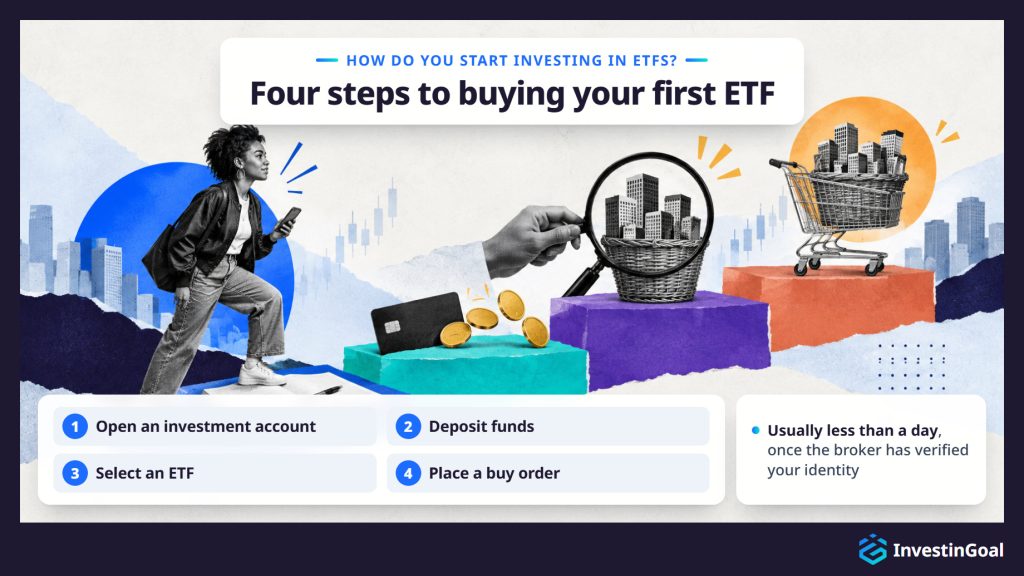
Beginners start investing in ETFs by opening an account with a regulated broker, depositing money, selecting an ETF and placing a buy order, which usually takes less than a day once the broker has verified their identity.
- Open an investment account. Choose a regulated platform in your country and register, which means sending identity documents so that the platform can verify your account, as anti-money-laundering rules require. In Nigeria the type of account is a standard brokerage account, because Nigeria has no tax-advantaged account for ETFs.
- Deposit funds. Once the broker has verified your account, transfer money from your bank account. Most platforms credit deposits within one business day, and some offer instant deposits by debit card or instant bank transfer.
- Select an ETF. Search for the ETF by the fund’s name, its ticker symbol or its ISIN code, with the search function that every platform has. If you have not yet decided which ETF to buy, make that decision before placing an order.
- Place a buy order. Enter the number of shares, or the amount of money if the platform offers fractional shares, and choose an order type. A market order buys at the current market price immediately. A limit order sets a maximum price you are willing to pay and executes only if the market reaches that price. For liquid broad-market ETFs, a market order during normal trading hours is usually enough.
These four steps are the same in every country. The type of account, the rules and the platforms change from one country to another, and they shape how beginners start investing in ETFs in Nigeria.
The simplest ETF setup needs two decisions, one broad-market global fund and one platform. After that, an automatic monthly purchase does the work, with no rebalancing and no changes to the allocation.
 Filippo UcchinoCo-Founder, CEO and Editor-in-Chief of InvestinGoal
How do beginners invest in ETFs in Nigeria?
In Nigeria, beginners invest in ETFs by opening an account with a platform such as Afrinvest, Bamboo or Trove, and they buy about 12 ETFs listed on the NGX, such as Vetiva Griffin 30, and global ETFs through platforms authorised by the SEC Nigeria.
Continue reading
Nigeria has no tax-advantaged account for ETFs, so beginners hold ETFs in a standard brokerage account.
Platforms authorised in Nigeria are supervised by the Securities and Exchange Commission of Nigeria (SEC Nigeria). If a platform authorised in Nigeria fails and cannot return the investor’s assets, the Investors' Protection Fund of the Nigerian Exchange (NGX) pays up to ₦500,000 per claim. The Investors' Protection Fund does not pay for losses caused by falling markets.
The ETFs available to investors in Nigeria are about 12 ETFs listed on the NGX, such as Vetiva Griffin 30, and global ETFs through platforms authorised by the SEC Nigeria.
Can Nigerian investors buy US ETFs?
Yes. Nigerian investors can buy US-listed ETFs through platforms authorised by the Securities and Exchange Commission of Nigeria (SEC Nigeria).
Popular US-listed ETFs include VOO (Vanguard S&P 500), SPY (the SPDR S&P 500 ETF, managed by State Street Global Advisors) and VTI (Vanguard Total Stock Market), which American investing guides mention often.
No ETF listed in Nigeria tracks the main US indices, so a US-listed fund is the direct way to follow them.
The US collects a withholding tax at source on the dividends that US companies and US-listed funds pay to investors abroad. The rate for residents of Nigeria is the full 30%, because Nigeria has no tax treaty with the US. Many UCITS ETFs are domiciled in Ireland, whose tax treaty with the US reduces the tax on the dividends the fund receives to 15%.
If a US guide recommends an ETF by its US ticker, an investor in Nigeria can buy that fund directly.
How do beginners choose their first ETF?
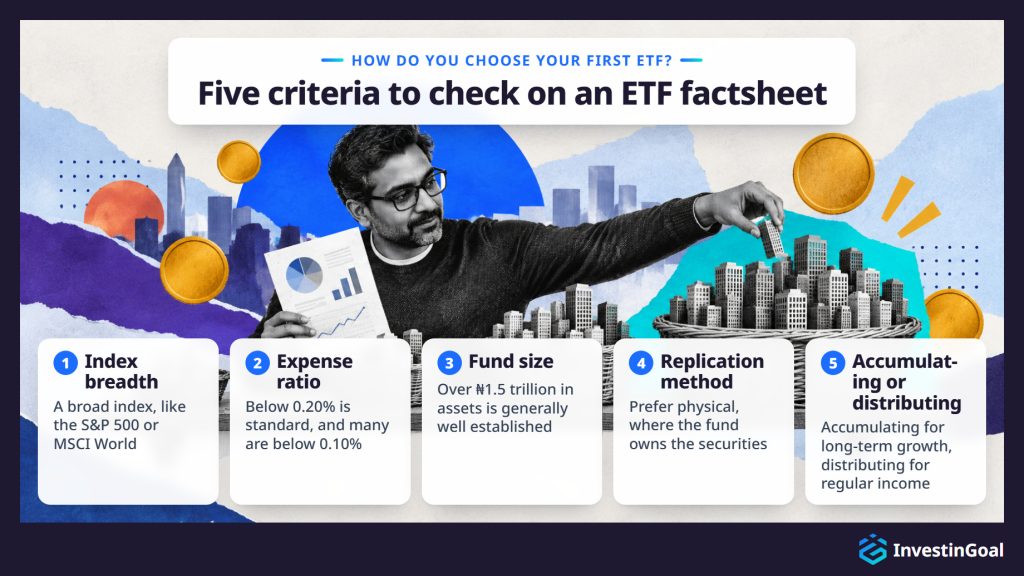
Beginners choose their first ETF by starting with a broad-market, low-cost index tracker and checking it against five criteria: the index it tracks, its annual expense ratio, its fund size and liquidity, its replication method (physical or synthetic), and whether it accumulates or distributes dividends.
Index breadth is the first criterion, and a first ETF should track a broad, well-diversified index rather than a narrow sector or theme. The three most common starting points are the S&P 500 (the 500 largest US companies), the MSCI World (developed markets only) and a global index of developed and emerging markets, such as the MSCI ACWI (All Country World Index) or the FTSE All-World. The broader the index, the more diversified the investment.
Expense ratio is the second criterion, because among funds tracking the same index, the one with the lower expense ratio delivers slightly higher net returns over time, all else being equal. For broad-market ETFs, expense ratios below 0.20% are standard, and many are below 0.10%.
Fund size is the third criterion, and it affects liquidity and how long a fund lasts. Larger funds tend to have tighter bid-ask spreads, a lower tracking difference and a lower risk of closure. A fund with over ₦1.5 trillion in assets under management is generally well established. Funds under ₦150 billion may carry higher trading costs and are more likely to close.
Replication method is the fourth criterion, and most new investors should prefer physically replicated ETFs, where the fund owns the underlying securities, over synthetic ETFs, which use swap contracts. Physical replication is simpler to understand and carries no counterparty risk from swap agreements.
Accumulating vs. distributing is the fifth criterion, and the choice depends on your goals and tax situation. Accumulating ETFs tend to be simpler for long-term growth. Distributing ETFs suit those who want regular income.
Applied together, these five criteria narrow the choice to a short list of funds. Every ETF’s factsheet shows all five, so a beginner can choose an ETF by comparing a few factsheets side by side.
How do you choose the right platform to invest in ETFs?
You choose the right platform to invest in ETFs by checking four factors: the range of ETFs available, the total cost structure (transaction fees, platform fees and any custody charges), whether the platform is regulated in your country, and whether it offers the account type you need.
ETF range is the first factor, because a platform is only useful if it lists the ETFs you want to buy. Some platforms offer access to thousands of ETFs across multiple exchanges, while others offer a smaller selection. For broad-market index ETFs, most major platforms have adequate coverage, but if you are interested in specific thematic or regional ETFs, check that the platform lists them before opening an account.
Cost structure is the second factor, and the total cost of using a platform includes per-trade commissions, ongoing platform fees (a percentage of assets or a flat monthly or annual charge), custody charges and any fees for currency conversion when you buy ETFs in a foreign currency. A platform with zero commissions but a high annual platform fee may cost more over time than one with a small per-trade fee and no platform charge. The comparison should look at the total cost for your expected trading frequency and portfolio size.
Regulation is the third factor, and it rules out any platform that fails it, whatever its costs or range. In Nigeria, the platform should be authorised by a recognised financial authority, such as the SEC Nigeria. Regulation requires the platform to keep client assets separate from its own money and gives you access to a compensation scheme if the platform fails. For a platform authorised in Nigeria, the scheme is the Investors' Protection Fund.
Account type is the fourth factor. In Nigeria a standard brokerage account is enough, because Nigeria has neither a tax-advantaged account for ETFs nor a platform that offers ETF savings plans. If the platform does not offer the account type you need, the other three factors do not matter.
Applied together, the four factors narrow the choice to two or three platforms. A beginner can then compare those ETF platforms side by side, on the website or in the ETF apps that most of them offer.
Is it possible to trade ETFs instead of investing in them?
Yes, investors can trade ETFs instead of investing in them, in the short term or through CFDs, but this approach carries much higher risk and cost than long-term investing and does not suit beginners building their first portfolio.
Continue reading
ETF trading in the short-term sense means buying and selling ETFs over days, weeks or months to profit from price movements, instead of holding them for years to capture the long-term growth of the index. This approach requires accurate timing decisions again and again. Brad Barber and Terrance Odean reviewed the research on individual investors in the Handbook of the Economics of Finance, and they found that individual investors do worse than standard benchmarks such as low-cost index funds, with the most frequent traders earning the lowest net returns.
CFD (contract for difference) trading on ETFs lets investors speculate on ETF prices with leverage, which means controlling a larger position than their capital would normally allow. Leverage amplifies both gains and losses, and it is possible to lose more than the initial investment. CFDs are not available to retail investors in the US, but they are available in the UK and the EU under strict rules, including leverage limits and negative balance protection set by the FCA in the UK and by national regulators in the EU.
Long-term investing in ETFs is a strategy built on diversification, compound interest and low costs. Short-term trading is a different activity, with a different risk profile, higher costs and a much lower probability of success for inexperienced participants. Time horizon, cost and risk tolerance are what separate trading from investing.