Risk tolerance in investing is the size of the fall in value an investor is willing to hold without selling, in exchange for a higher expected long-term return. Risk tolerance mainly decides the share of money in stocks, the investment type that falls furthest, against the steadier bonds and cash. For a beginner, the clearest measure of risk tolerance is a loss in naira on the amount actually planned, not a percentage. The largest naira loss an investor would hold points to a starting mix of stocks, bonds and cash whose worst year stays within that loss.
Willingness is only one half of the decision. The other half is risk capacity, the financial ability to absorb a loss without harming a goal, and the two can point in opposite directions for the same person. The prudent start is the lower of the two. On the common scale, that start falls on one of three levels, from conservative to aggressive, with a moderate level that holds growth and stability in balance. Where an investor lands depends on the time horizon, income, savings, debts and reliance on the money, which act mostly on capacity, and on experience and temperament, which act on willingness. Youth raises capacity most, because a young investor has decades to recover from a fall.
Capacity rests on facts, but willingness needs a measure. An investor measures it with a self-check that turns market falls into naira losses on the investor's own amount, such as ₦4,050,000 for a 30% fall on ₦13,500,000. A broker's questionnaire is then a cross-check, although in a rising market it tends to overstate risk tolerance. The naira figure leads to the mix. Stocks ask for more risk tolerance than bonds because they fall deeper and for longer, and in the returns since 1926 published by Vanguard, a large US fund manager, the worst calendar year ranges from about -10% for a conservative 20/80 mix to about -35% for an aggressive 80/20 mix. A written asset allocation and rebalancing keep the chosen mix at its level, and in a retirement account the money that usually stays there until retirement raises the capacity for risk in that pot.
A mix that doesn't match risk tolerance costs money in either direction. Too much risk leads to selling after a fall, which locks in the loss, and too little risk means slower growth and a goal reached later or missed. In Nigeria the question also comes with new accounts, because the rules of the Securities and Exchange Commission of Nigeria (SEC Nigeria) require firms that recommend investments to check that they suit the investor. A new investor answers it with no past fall to look back on, so the estimate rests on the naira self-check, starts one level lower when unsure, and meets its test in the first real market fall. When that level is too low for a goal, the investor closes the gap by saving more, extending the horizon or reshaping the goal, not with a riskier mix. Even a well-matched mix leaves two risks uncovered, a collapsing single holding and a forced sale, and broad funds and an emergency fund guard against them.
What is risk tolerance in investing?
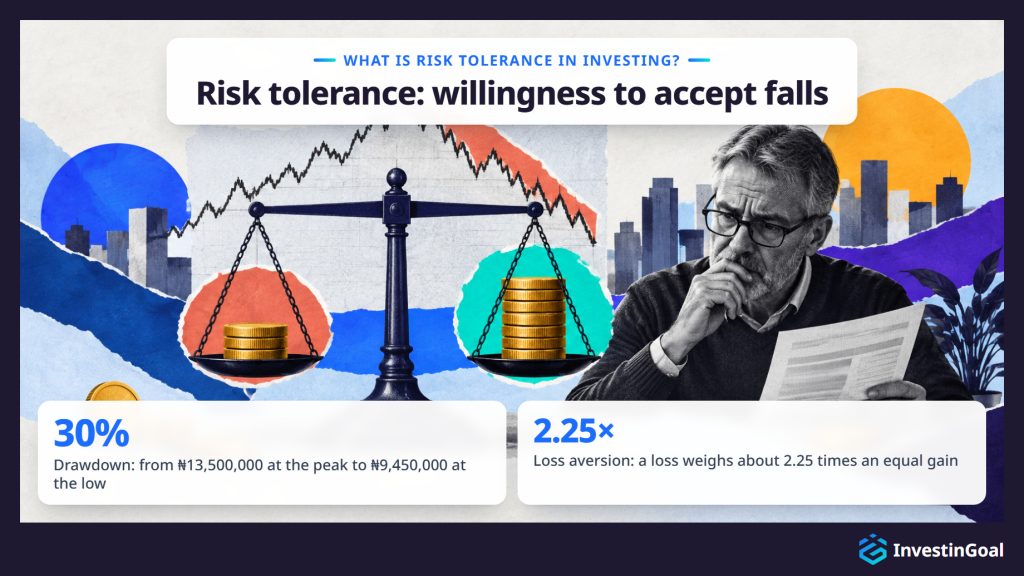
Risk tolerance in investing is an investor's willingness to accept falls in the value of their investments in exchange for a higher expected long-term return. Risk tolerance measures willingness, the emotional side of risk, and it decides how much of an investor's money can sit in assets that fall without being sold in a bad year. Risk tolerance leaves out the financial ability to absorb a loss, a separate quantity called risk capacity.
Keeping willingness apart from ability matters because the definitions in use disagree. The Financial Industry Regulatory Authority (FINRA) oversees US brokers, and its investor guide describes risk tolerance as "the amount of investment risk you're willing and able to accept", joining willingness and ability in one quantity. In this article risk tolerance means the willingness alone, and risk capacity means the ability, because the two can point in opposite directions for the same person.
What risk tolerance accepts has two names. Volatility is the size of the fluctuations in an investment's value from month to month and year to year. Drawdown is the fall from a peak to the lowest point before a new high. A portfolio worth ₦13,500,000 at its peak and ₦9,450,000 at its low is in a 30% drawdown. The drawdown is the figure that shows on your statement.
Risk tolerance is an emotional quantity because losses hurt more than equal gains please. The psychologists Daniel Kahneman and Amos Tversky described this asymmetry, called loss aversion, in prospect theory, their 1979 model of how people choose when the outcome is uncertain. In 1992 they estimated that a loss weighs about 2.25 times as much as a gain of the same size. A ₦1,350,000 fall weighs on an investor roughly as much as a ₦3,037,500 gain pleases them, which is why a fall that looks small on paper can feel large in your own account.
Risk tolerance is also not the same as risk perception, the momentary view of how risky the stock market looks. Risk perception moves from week to week with headlines and recent crashes, and it is why a stated risk tolerance often looks higher after a long rise and lower after a crash. A 2011 study by Rui Yao and A. Curl followed the same people over several years and found that stated risk tolerance tends to rise when market returns rise and to fall when they fall.
The qualifier "in investing" sets this sense apart from two others. In cybersecurity and in enterprise risk management, risk tolerance describes how much risk an organisation accepts in its systems or its business. In investing, risk tolerance belongs to one person and one portfolio, comes in levels from low to high, and shows in the answers to questions about how you would react to a fall.
Of all investment decisions, risk tolerance shapes one above all: the share of your money that goes into assets that fall, such as stocks, against the share in steadier assets. A share set at your risk tolerance is a share you hold through a bad year instead of selling at the bottom, and getting that share right is one of the first decisions in investing for beginners.
An example of risk tolerance is Jordan, 27, who is about to invest ₦10,800,000 for the first time. On that amount a 15% fall is a loss of ₦1,620,000, a 30% fall is a loss of ₦3,240,000 and a 50% fall is a loss of ₦5,400,000. Jordan would hold through the first two falls and sell at the third, so Jordan's risk tolerance lies between a ₦3,240,000 and a ₦5,400,000 fall on ₦10,800,000.
The example qualifies because it measures only Jordan's willingness to bear a fall in value. Whether Jordan can afford a ₦5,400,000 fall, with rent to pay and savings behind the ₦10,800,000, is a different question, and risk capacity answers it. A colleague with the same salary and the same ₦10,800,000 could draw the line at ₦1,620,000, and both answers would be honest.
You read risk tolerance in naira, on your own amount. It is the largest fall you would hold without selling. A percentage on its own hides that line, because "30%" sounds abstract until it becomes ₦3,240,000 of Jordan's own money.
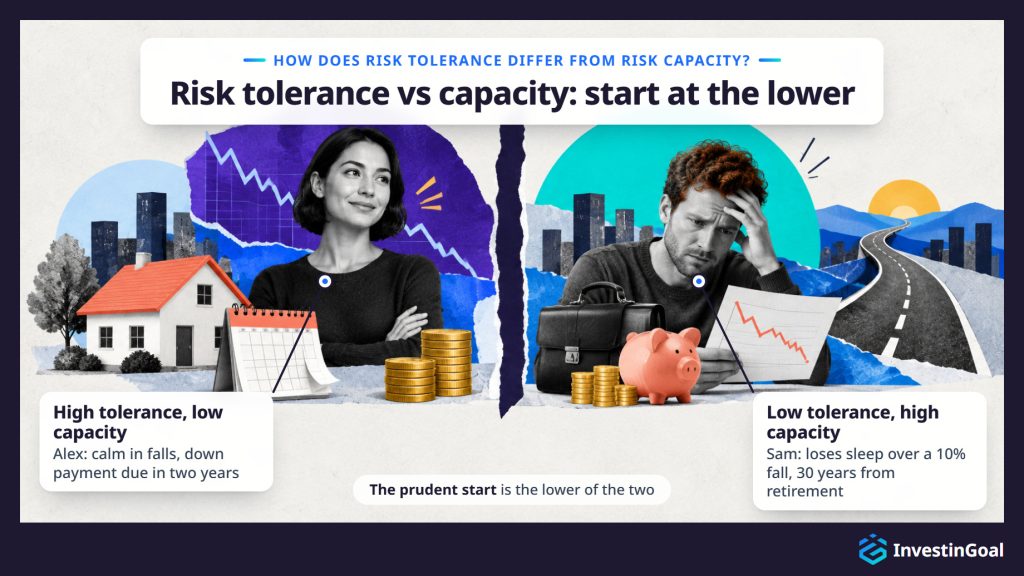
Risk tolerance is the willingness to bear a fall in value, while risk capacity is the financial ability to absorb a loss without harming a goal. The two can give opposite answers for the same investor, and the prudent starting point is the lower of the two.
Risk capacity is made of facts about your money rather than feelings about it: the time horizon before you need the money, the size and stability of your income, your savings and emergency fund, your debts, and how much you rely on the invested money. Each of these facts is something a questionnaire can ask about.
Alex stays calm when markets fall, but Alex's money is a home down payment due in two years: high risk tolerance, low risk capacity. Sam loses sleep over a 10% fall, but Sam is 30 years from retirement, with a steady job and an emergency fund: low risk tolerance, high risk capacity. A test of willingness alone would put Alex's down payment in stocks two years before Alex needs it. A test of ability alone would put Sam in a mix Sam would sell in the first bad month.
The lower of the two is the prudent start because each one sets a limit the other cannot lift. Money needed within a few years, and money with no emergency cushion behind it, stays out of volatile assets whatever a questionnaire says. Beyond these two, some planners add a third dimension, risk required, the return a goal demands, which matters when the lower of the two is too cautious to reach the goal.
In personal investing, risk appetite is the risk an investor seeks in pursuit of a goal, while risk tolerance is the loss the investor can bear without distress or selling. Risk appetite looks forward to the gain, and risk tolerance looks at the fall on the way.
Risk appetite can run ahead of risk tolerance. An investor drawn to high-growth technology stocks after a year of strong returns has a large risk appetite, and if the same investor sells in the first 20% fall, the risk tolerance was smaller than the appetite.
In enterprise risk management, risk appetite has another meaning: a statement by a company's board of the amount of risk the organisation accepts in pursuit of its strategy. The corporate sense belongs to organisations and is left aside here.
What are the different levels of risk tolerance?
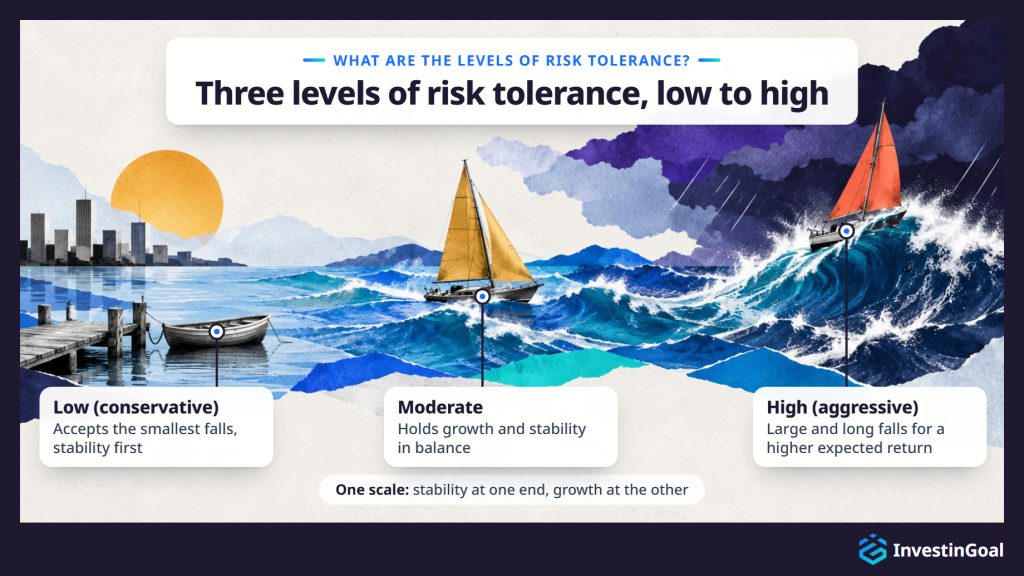
The three levels of risk tolerance are low (conservative), moderate and high (aggressive). A low risk tolerance accepts only the smallest falls and puts stability first, a moderate one holds growth and stability in balance, and a high one accepts large and long falls for a higher expected long-run return.
The number of levels is a convention of whoever builds the questionnaire, not a standard. Most guides use three levels: conservative, moderate and aggressive. Some use five, from very conservative to very aggressive, and some robo-advisors, online services that build and run a portfolio automatically from a client's answers, replace the levels with a numerical score. Every version runs along the same line, from stability bought with less growth at one end to growth bought with less stability at the other. This article uses three levels, and each level has a sample mix in the table of the section on stocks and bonds. Below are the three levels on the common scale, ordered by how much fall each one accepts in exchange for growth.
A low risk tolerance is the level of the scale that accepts the smallest falls, giving priority to stability and to capital preservation over growth. Falls cause the investor distress and the urge to sell. This level is also called conservative.
On the scale of risk tolerance, the low level sits where the investor accepts the least fall in exchange for growth. An investor at the low level feels any fall as a threat to money that should be safe, so even a modest fall brings the urge to sell. The attitude at this end of the scale is called risk aversion. A risk-averse investor prefers a certain outcome to a risky one with an equal or higher expected value, such as ₦1,350,000 for sure over an even chance of ₦0 or ₦2,970,000.
What the low level gives up is growth. Low risk is not no risk, though. Inflation erodes cash, and bond prices fall when interest rates rise, so a conservative investor trades deep falls for slower and quieter risks. Trading growth for stability is the main idea of how to invest conservatively, and the trade holds as long as the slower growth still reaches the goal.
A moderate risk tolerance is the middle level of the scale, which holds growth and stability in balance. The investor holds noticeable yearly falls in exchange for growth, but not the deepest ones.
On the scale of risk tolerance, the moderate level sits between the low and the high level. An investor at the moderate level accepts that a year can end in a loss in exchange for growth over time, but would sell in the deepest falls, the kind that take years to recover. Growth and stability each get a meaningful share of the money.
A moderate portfolio still has bad years. It falls when markets fall, only less far than an aggressive one, and the 60/40 row of the table in the section on stocks and bonds shows how far the moderate sample mix fell in its worst year.
A high risk tolerance is the level of the scale that accepts large and long falls in exchange for a higher expected long-run return. This level is also called aggressive.
On the scale of risk tolerance, the high level sits where the investor accepts the most fall in exchange for growth. An investor at the high level can watch a large part of the portfolio's value disappear for months or years and keep holding, because the expected return over decades is the point. A high risk tolerance is common among investors with long horizons, but it is not reserved to them. What makes it high is the willingness, not the age.
High risk is not a guarantee of higher returns. The higher return is expected over long periods, and the falls on the way are deeper. A high risk tolerance is never a reason to take more risk than risk capacity allows, because the starting point is the lower of the two. Within the limit that risk capacity sets, the trade of stability for growth is the basis of how to invest aggressively.
What are the factors that influence risk tolerance?
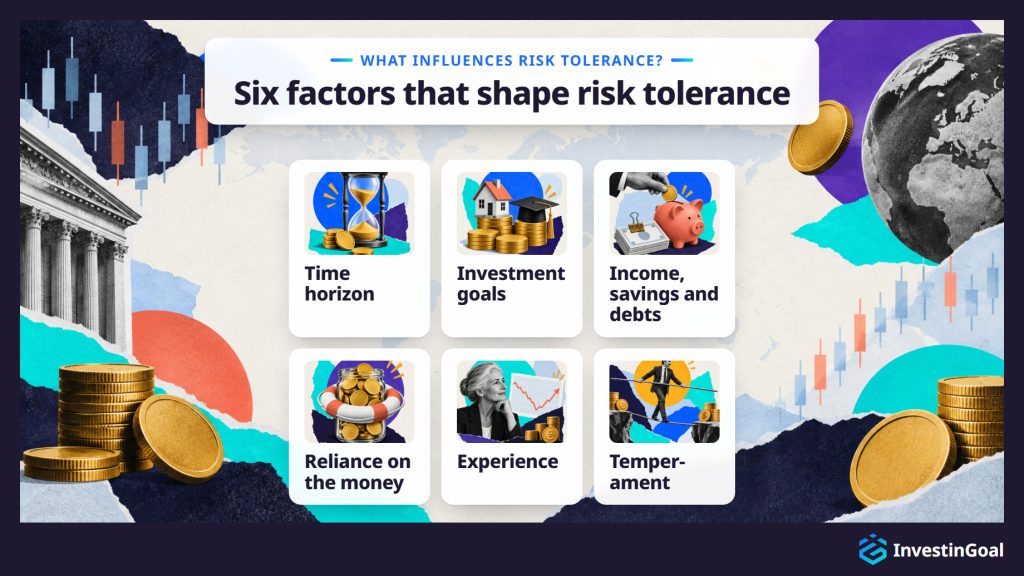
Six factors influence risk tolerance, four financial and two personal, and they are listed below.
- Time horizon: the number of years before you need the money. A goal 25 years away leaves time to recover from several falls, while a goal two years away leaves none. Recovery time is the reason why time horizon matters, and a longer horizon raises risk capacity more than willingness.
- Investment goals: the financial goals the money is for, such as a home, a child's education or retirement. A goal with a fixed date and a fixed amount leaves less room for a fall than a goal that can wait or shrink.
- Income, savings and debts: the size and stability of income, the savings already built, and what is owed. Savings and debts together set net worth, what is owned minus what is owed, and a higher net worth with a steadier income absorbs a loss more easily.
- Reliance on the money: how much you depend on the invested money for living costs or emergencies. FINRA's investor guide on risk tolerance lists reliance on the invested funds among the factors behind it. An emergency fund held apart in cash, and few liquidity needs, lower that reliance.
- Experience: knowledge of how markets work and time spent watching market cycles. An investor who has seen a fall and a recovery knows what a fall feels like and how long a recovery can take.
- Temperament: whether you are a cautious person or a risk-taker by nature. Temperament moves willingness most directly, and it shows in how you handle uncertainty outside investing too.
The first four factors act mostly on risk capacity, the financial ability to absorb a loss, and the last two act on willingness, which is risk tolerance. Beyond these six, the factor named most often is age, because it moves the time horizon and the financial factors together.
Investment risk tolerance is typically highest early in life, when an investor is young, far from the goal, has few obligations and has decades to recover from a fall. What youth raises is mostly risk capacity, the time to recover, and not temperament. A young beginner can be anxious and an older investor calm.
The usual answer rests on time. At 25, money for retirement has about 40 years to recover from any fall, and a young investor often has no dependents and no mortgage. Each of those facts raises the ability to absorb a loss, which is risk capacity, while willingness depends on the person.
Take a 25-year-old and a 60-year-old who both hold mostly stocks when the market falls 40%. The 25-year-old has four decades for prices to recover and years of new contributions that buy at lower prices. The 60-year-old may need the money within five years, and a 40% fall can delay retirement.
A young investor who is anxious about falls starts at that investor's own risk tolerance, not at the level the age suggests. An investor sells a mix that age allows but nerves cannot hold in the first bad year, and loses the time advantage of youth with the sale.
How is risk tolerance measured?
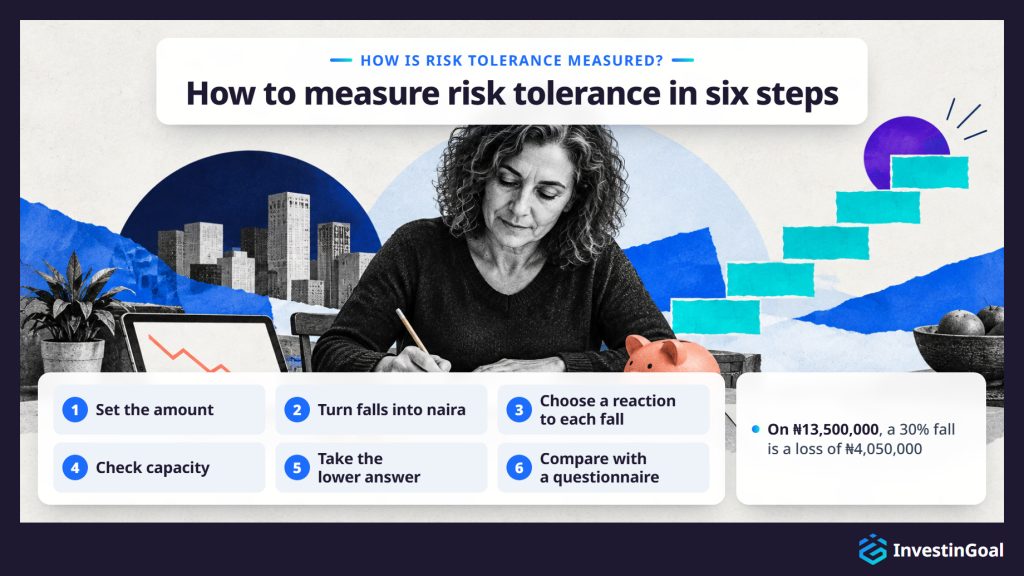
Risk tolerance is measured with a self-check of six steps, run on your own amount in naira and listed below in the order the task imposes.
- Set the amount: write down the sum you actually plan to invest, not a hypothetical portfolio. The examples below use ₦13,500,000. Replace it with your own figure.
- Turn falls into naira: apply the falls that risk questionnaires use (15% in a year, 20 to 30% in a year, a sum down 30%) and a severe 50% to your amount. On ₦13,500,000, a 15% fall is a loss of ₦2,025,000, a 30% fall is a loss of ₦4,050,000 and a 50% fall is a loss of ₦6,750,000. The naira figure is the number that reveals your real risk tolerance, because a percentage feels abstract until it is your own money.
- Choose a reaction to each fall: for each naira loss, decide whether you would sell, hold or buy more. If you have lived through a real fall with your own money, what you actually did counts more than what you predict now. The largest loss you would hold without selling is your risk tolerance in naira.
- Check capacity: answer three questions about the money itself: when you need it, whether an emergency cushion sits behind it, and how much you rely on it. Money needed within a few years, or money with no cushion behind it, points to a low risk capacity whatever step 3 said.
- Take the lower answer: match the largest loss you would hold to a level by comparing it with the worst years of the three sample mixes in the table of the section on stocks and bonds, then start from the lower of that level and your risk capacity. A high risk tolerance with a low risk capacity starts at the low level, and so does a low risk tolerance with a high risk capacity.
- Compare with a questionnaire: take the risk tolerance questionnaire of your own broker or of a robo-advisor, and compare its result with yours. A questionnaire gives an estimate built from its own questions. The estimate differs from one provider to the next, it is not advice, and taken in a calm or rising market it tends to overstate risk tolerance, because a rising market cannot tell whether you are comfortable with investment risk or only with rising prices. A financial advisor adds probing questions and spots mismatches, such as an aggressive answer next to a short horizon.
Keep a note of the naira loss you accepted in step 3. You will measure a real fall against that figure later.
Risk tolerance changes over a lifetime, and the six occasions that call for reevaluating it are listed below, from life events to changes in the market and the calendar.
- Family changes: marriage, divorce or a child changes who depends on the money and how large a cushion the household needs.
- Career and income changes: a new job, a raise or a lost job changes the stability of income, and with it how large a loss the household can absorb.
- A windfall or a large expense: an inheritance or a bonus can raise risk capacity, and a home purchase or a large bill can lower it.
- Age and a nearer goal: each decade shortens the horizon to retirement. The gradual shift towards lower risk as the goal nears is the main rule of how to invest by age, and each step of the shift is a moment to rerun the estimate.
- A major market move: a crash or a long rise changes risk perception and distorts any estimate you take at that moment. Redo the estimate once the market has calmed, never in the middle of a fall.
- A yearly review: once a year, rerun the self-check on the current amount, even when nothing else has changed, because the naira figures grow with the portfolio.
How does risk tolerance shape the mix of investment types?
Risk tolerance shapes the mix of investment types by setting the share of money in stocks, the type that falls furthest, against the steadier bonds and cash. That share then sets the portfolio's expected long-run return and the depth of its falls.
The chain starts from your starting level: the lower of risk tolerance and risk capacity, found with the self-check. A low level puts a small share of the money in stocks, a high level puts a large share in stocks, and the moderate level sits between. The share in stocks then drives the rest: the more of the money in stocks, the higher the expected return over decades and the deeper the falls along the way.
Three investment types, or asset classes, carry the mix. Stocks are shares in companies, with the highest expected return and the deepest falls. Bonds are loans to governments, such as Federal Government of Nigeria (FGN) bonds, and to companies, with steadier prices and lower returns. Cash is the steadiest of the three and the one inflation erodes. Cash sits in a savings account or a money market fund, a fund of very short-term loans. A first mix needs only these three of the many types of investments, because together they already cover the trade between growth and stability that risk tolerance decides.
The table below gives the three investment types, compared on what each one is, what it offers and what it costs.
| Investment type | What it is | What it offers | What it costs |
|---|---|---|---|
| Stocks | Shares in companies | Highest expected return | Deepest falls |
| Bonds | Loans to governments and companies | Steadier prices | Lower returns |
| Cash | Savings account or money market fund | Steadiest of the three | Eroded by inflation |
Once you set the share in stocks, holding the mix is a choice between building it yourself, buying it ready-made and handing it to a service.
- A two-fund portfolio template: copy your level's sample mix with one broad stock index fund and one bond fund, bought at any broker. An index fund holds all the stocks or bonds of a market index, and many index funds come as ETFs (exchange-traded funds), which are bought and sold on the stock exchange like a single share. Two funds make the simplest of the beginner portfolio templates, and you keep the split yourself.
- One balanced or target-date fund: a balanced fund holds a fixed mix of stocks and bonds, and a target-date fund, where one is offered, holds a mix that grows more conservative as its date nears. Both funds rebalance themselves, so the split stays at its target without any action from you.
- A robo-advisor: a service of this kind asks its own questionnaire, builds the mix from your answers and runs it for you.
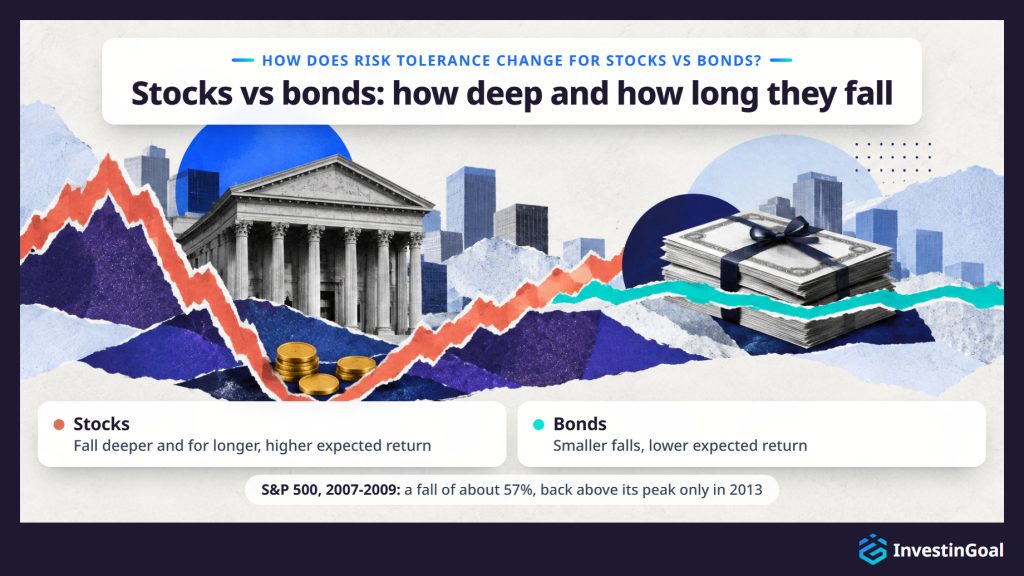
The risk tolerance an investment asks for changes between stocks and bonds with the depth and length of the falls each one brings. Stocks ask for more risk tolerance, because in exchange for a higher expected long-run return they fall deeper and for longer and can lose principal. Bonds ask for less, with a lower expected return and smaller falls.
The S&P 500 tracks 500 large US companies, and its price fell about 57% during the 2007-2009 global financial crisis, from a closing high of 1,565.15 on 9 October 2007, to a close of 676.53 on 9 March 2009. The index did not close above its 2007 peak until 28 March 2013, more than five years after the peak. On ₦13,500,000 in stocks, a 57% fall is a loss of about ₦7,695,000. The higher expected return of stocks comes with no guarantee.
Bonds ask for less risk tolerance because their prices move less, and the expected return is lower in exchange. Bonds are not risk-free, though, because bond prices fall when interest rates rise.
The decision follows from the depth of the falls. The more of the money in stocks, the more risk tolerance the mix asks for, so the lower the level, the larger the bond share. Choosing a split needs only that criterion, the result of comparing stocks and bonds on how deep and how long they fall. Which stocks or bonds to buy is a separate choice.
The table below gives the three sample mixes, one for each level of risk tolerance, compared on their split, their worst calendar year and that year in naira on ₦13,500,000.
| Level | Stocks | Bonds | Worst calendar year | Worst year on ₦13,500,000 |
|---|---|---|---|---|
| Conservative | 20% | 80% | About -10% (1931) | About -₦1,350,000 |
| Moderate | 60% | 40% | About -27% (1931) | About -₦3,645,000 |
| Aggressive | 80% | 20% | About -35% (1931) | About -₦4,725,000 |
Mixes and worst calendar years: model portfolio allocations of Vanguard, a large US fund manager, and their published history of annual returns since 1926. The three mixes are illustrations, not recommendations, and past performance does not guarantee future results.
Each step up in the stock share deepens the worst year: from about ₦1,350,000 to about ₦4,725,000 on ₦13,500,000 between the conservative and the aggressive mix, more than three times as much. The mix to start with is the one whose worst year, in naira on your own amount, is a loss you would hold.
Three practices keep a portfolio in line with risk tolerance over time, and they are listed below with the drift each one prevents.
- Asset allocation: the split among stocks, bonds and cash set for your level, as in the sample mixes of the table above. A written split prevents the drift of a portfolio built by impulse, one purchase at a time. Keeping the split as a written target is the main part of what asset allocation involves. New money goes in at the same split, and the split changes when the estimate of risk tolerance or risk capacity changes, not when the market moves.
- Diversification: each investment type spread over many holdings through broad index funds. Diversification prevents the drift of a portfolio whose risk comes to ride on a few companies. A broad fund delivers the textbook definition of diversification in a single purchase, although diversification does not guarantee a profit or protect against loss.
- Rebalancing: bringing the split back to its target after markets move it. Start at 60/40 with ₦8,100,000 in stocks and ₦5,400,000 in bonds. After a year in which stocks rise 30% and bonds stay flat, the portfolio holds ₦10,530,000 in stocks and ₦5,400,000 in bonds, about 66/34, a riskier mix than the one chosen. Selling part of what rose and buying what fell restores the level, once a year or whenever a type moves past a set band, such as five percentage points.
The table below gives the three practices, compared on what each one is, the drift it prevents and how it is applied.
| Practice | What it is | Drift it prevents | How it is applied |
|---|---|---|---|
| Asset allocation | Stock, bond and cash split set for your level | A portfolio built by impulse | Written target; new money at the same split |
| Diversification | Each type spread over many holdings | Risk riding on a few companies | Broad index funds |
| Rebalancing | Bringing the split back to its target | A riskier mix after markets move | Once a year or past a set band |
The SEC (Securities and Exchange Commission) is the federal regulator of the US securities markets. It treats the three practices as one routine in its investor guide Beginners' Guide to Asset Allocation, Diversification, and Rebalancing, published on investor.gov. All three practices also fit inside a single balanced fund or, where one is offered, a target-date fund, which rebalances itself as markets move.
Risk tolerance is applied in retirement accounts through each account's own rules. In a retirement plan an employer offers its staff, where such plans exist, you often choose from the plan's funds or investment lines, and a default investment usually takes the money of anyone who does not choose. In a retirement account you open yourself with a broker or another provider, you pick the mix, or one of the investment lines the provider offers. Because the money in either account is meant to stay there until retirement, often with a cost or a tax for early withdrawals, the capacity for risk in that pot is higher.
An employer's plan narrows the choice to the funds or lines the plan offers. The default investment, where the plan has one, is the fund your contributions go into if you choose nothing. In the United States, Vanguard, a large fund manager, found in its How America Saves 2024 report that 98% of the plans it administers that enrol employees automatically used a target-date fund as that default, and a target-date fund set to your expected retirement year already holds a mix that grows more conservative over time. Where the employer adds money on top of your contributions, that money usually goes into the same mix you choose.
A retirement account you open yourself leaves more of the choice to you. Depending on what the provider allows, you can buy the two funds of your level's sample mix, a single balanced fund or, where one is offered, a target-date fund, choose the investment line closest to your level, or hand the account to a robo-advisor.
The long wait before the money can be spent is what raises risk capacity. For an investor decades from retirement, money that the investor cannot easily spend until then has the long horizon that lets it recover from falls. One investor can therefore hold different levels in different pots: an aggressive mix in a retirement account that stays untouched for 30 years, and the money for a home down payment due in three years kept out of volatile assets altogether. Setting the level pot by pot is how risk tolerance enters the wider question of how to invest for retirement.
What happens if a portfolio doesn't match an investor's risk tolerance?
If a portfolio doesn't match an investor's risk tolerance, the investor pays for the mismatch in either direction. Too much risk leads to selling after a fall, which locks in the loss and is the costliest consequence. Too little risk means slower growth, a goal reached later or missed, and cash losing ground to inflation.
Too much risk shows up in the first deep fall. An investor whose mix falls further than that investor can bear sells, and selling after a fall turns a loss on paper into a permanent one, often before the recovery that the investor no longer owns. The Mind the Gap study by Morningstar, a US firm that researches and rates investment funds, found that the average dollar invested in US funds earned about 1.1 percentage points a year less than the funds themselves over the ten years to 2023, because investors bought and sold at the wrong moments.
The cost of too little risk is harder to see. A mix more cautious than the investor's level grows more slowly, so the investor reaches a goal later or misses it, and money held in cash loses buying power to inflation every year.
A mix you can hold through a bad year avoids both costs, because it is cautious enough not to be sold and growing enough to reach the goal.
Why is risk tolerance asked when opening an account on an investing platform?
Risk tolerance is asked when opening an account on an investing platform because the rules of Nigeria require a firm to check that the investments it recommends suit you. The rules of SEC Nigeria require a firm that recommends investments or manages a portfolio to check that they suit the client, and the risk tolerance question is how most platforms gather part of that information.
The question usually comes in one of two forms. Some account forms ask you to pick a profile, from conservative to aggressive. Others ask for an investment objective, such as income, growth or speculation. The same question often appears when you join an employer's retirement plan or open a retirement account yourself.
What your answer does depends on the platform. At a robo-advisor, the answers set the allocation the service will run. A cautious answer produces a bond-heavy portfolio, and an aggressive answer a stock-heavy one. At a self-directed broker, you choose your own investments, and the answer becomes the profile behind any recommendation the broker makes. The answer can also bear on trading permissions, such as approval to trade options, contracts that give the right to buy or sell an asset at a set price before a set date. Overstating risk tolerance to look like an experienced investor exposes you to products and losses you did not knowingly choose. A robo-advisor acts on your answer every day, while a self-directed broker keeps it on file and leaves the choices to you, and the contrast is the first test in the question of which investing platform is best for a beginner.
How does evaluating risk tolerance change for a new investor?
Evaluating risk tolerance changes for a new investor because a new investor cannot yet use the past-behaviour step of the self-check. With no market fall to look back on, a new investor estimates the level with the naira self-check on the amount actually planned. The estimate starts from the lower of risk tolerance and risk capacity, and from the level below when the investor is unsure.
The past-behaviour method relies on memory: how you reacted the last time markets fell. A new investor has no such memory, so the reactions in the self-check are choices made in advance, on the naira losses of the amount actually planned, and nothing yet confirms them.
Starting one level below when unsure costs little. A mix one level too cautious grows a little more slowly for a year, while the investor can sell a mix one level too aggressive in its first fall. A questionnaire taken in a calm market tends to overstate risk tolerance, and a new investor has no past fall to correct it with, which is one more reason to start low.
Paper trading means investing with virtual money on a demo account. It shows how a portfolio moves but not how losing your own money feels. The feeling is what risk tolerance measures, and only real money produces it.
The first year with real money is the measurement that confirms or corrects the estimate, and its first real fall is the test. A cautious estimate can also leave a goal out of reach, and even a well-matched mix leaves risks that the match does not cover.
Risk tolerance is tested by a first market fall when the fall in naira meets the figure the investor accepted in the self-check. Holding through a fall inside that figure confirms the estimate. A fall that proves unbearable inside it shows that the investor overstated risk tolerance.
Losing money in a market downturn is normal at every level of risk tolerance. The conservative sample mix has had losing years too, and a first fall is the moment a new investor learns what a loss in naira feels like.
A loss becomes permanent only when the investor sells the investment. Until then it is a paper loss, and only holding recovers a paper loss. The S&P 500 needed years after its 2007-2009 fall to regain its peak, as the section on stocks and bonds shows, and the investors who held through those years were the ones who got the recovery.
Holding works best with the plan already in place. Regular contributions keep going in at the same split, so new money buys at lower prices, and rebalancing buys the type that fell, the opposite of a panic sale.
A fall that proves unbearable inside the figure you accepted shows that you overstated your risk tolerance. The answer is to lower the level for new money once the market has calmed, not to sell at the bottom, which would lock in the loss the self-check was meant to prevent.
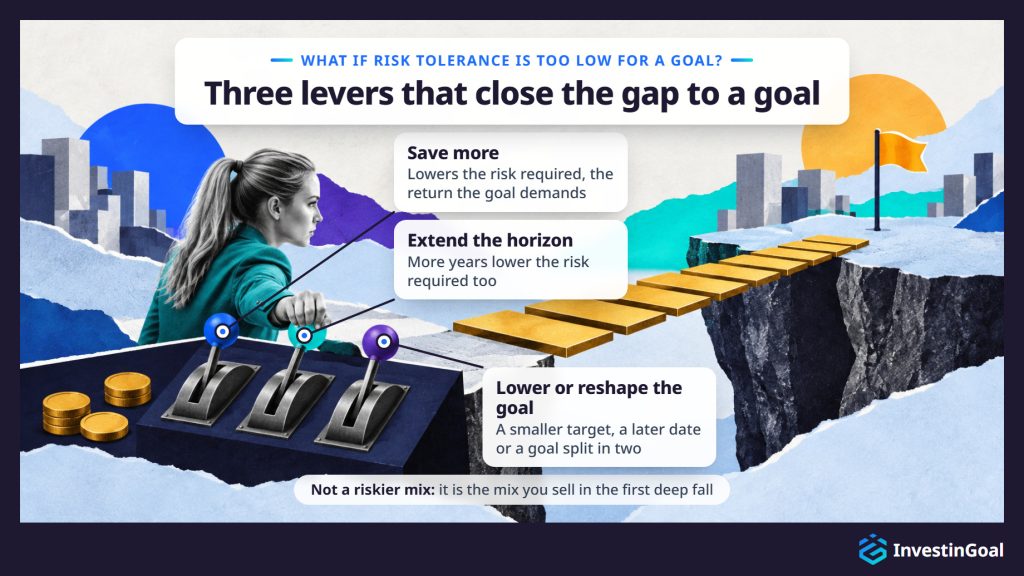
When risk tolerance is too low to reach an investment goal, the investor closes the gap by saving more, by extending the horizon, or by lowering or reshaping the goal, and not with a riskier mix that the investor would sell in the first fall. The gap opens when the goal demands a higher return than the mix of the investor's level can be expected to earn. That demanded return is called the risk required.
Reaching ₦135,000,000 in 15 years with ₦405,000 a month means ₦72,900,000 of contributions, and the rest has to come from returns: about 7.6% a year. When the mix of your level cannot be expected to earn that return, the goal is out of reach as it stands. These returns assume inflation close to 3% a year: in Nigeria, where prices have risen faster, the goal itself costs more each year, and the return it requires rises with prices.
A riskier mix looks like the obvious fix and is the wrong one. A mix above your level is the mix you sell in the first deep fall, and the sale locks in a loss that leaves the goal further away than before.
Three levers close the gap instead. Saving more lowers the risk required. ₦472,500 a month reaches the same ₦135,000,000 in 15 years at about 5.8% a year. Extending the horizon does the same. ₦405,000 a month over 20 years reaches ₦135,000,000 at about 3.2% a year. Lowering or reshaping the goal works from the other side. ₦405,000 a month for 15 years reaches ₦108,000,000 at about 5% a year.
The table below gives the starting plan and the three levers, compared on the monthly saving, the years, the target and the return required a year.
| Plan | Monthly saving | Years | Target | Return required a year |
|---|---|---|---|---|
| Starting plan | ₦405,000 | 15 | ₦135,000,000 | About 7.6% |
| Saving more | ₦472,500 | 15 | ₦135,000,000 | About 5.8% |
| Extending the horizon | ₦405,000 | 20 | ₦135,000,000 | About 3.2% |
| Lowering or reshaping the goal | ₦405,000 | 15 | ₦108,000,000 | About 5% |
Lowering or reshaping the goal means a smaller target, a later date or a goal split in two, each bringing the risk required within the reach of your level. Revisiting the goal itself is part of knowing how to set investment goals, and the investment plan is where the investor puts goals, horizon and risk tolerance together and checks them against each other.
A low risk tolerance still carries investment risks because the mix it points to trades deep falls for three other risks: inflation, which erodes the buying power of cash; interest-rate risk, which lowers bond prices when rates rise; and shortfall, a goal missed.
Inflation works on cash without a visible fall. At 3% inflation a year, ₦13,500,000 held in cash that earns nothing buys after ten years what about ₦10,044,000 buys today, because 1 ÷ 1.03¹⁰ is about 0.74: about a quarter of the buying power is gone, although the balance never fell. In Nigeria, where consumer prices have risen by about 27.0% a year on average over the last three years, cash loses its buying power much faster than in this example.
Interest-rate risk works on bonds. When interest rates rise, new bonds pay more, so the price of existing bonds falls until their yield matches. In 2022, as rates rose quickly, the Bloomberg US Aggregate index of the broad US bond market lost about 13%, the worst calendar year in the index's history.
Shortfall is the third risk. A mix that falls little can also grow too little, so the goal is missed by the amount the cautious mix failed to earn. Inflation, interest rates and shortfall belong to the wider risks of investing that no mix escapes.
Matching risk tolerance is not enough to manage investment risk because the matched mix sets only how far the portfolio as a whole can fall. The matched mix does not protect against the collapse of a single holding, or against a cash need that forces a sale at the bottom of a fall.
The first gap is concentration. Money in a single stock or in a few can lose all its value whatever the investor's level. Lehman Brothers was one of the largest US investment banks when it filed for bankruptcy in September 2008, and its shares became almost worthless. The investor therefore holds the stock share through broad funds, the diversification among the practices that keep a portfolio in line with risk tolerance, so that no single company can sink it.
The second gap is forced selling. A job loss or a large bill during a fall can force a sale at the bottom, the very loss risk tolerance is meant to avoid. An emergency fund pays for the emergency instead, so the portfolio does not have to be sold. The usual guideline is three to six months of expenses, held in cash outside the mix. Broad funds and an emergency fund protect the investor where the match cannot, and both belong to the wider question of how to manage investment risk.