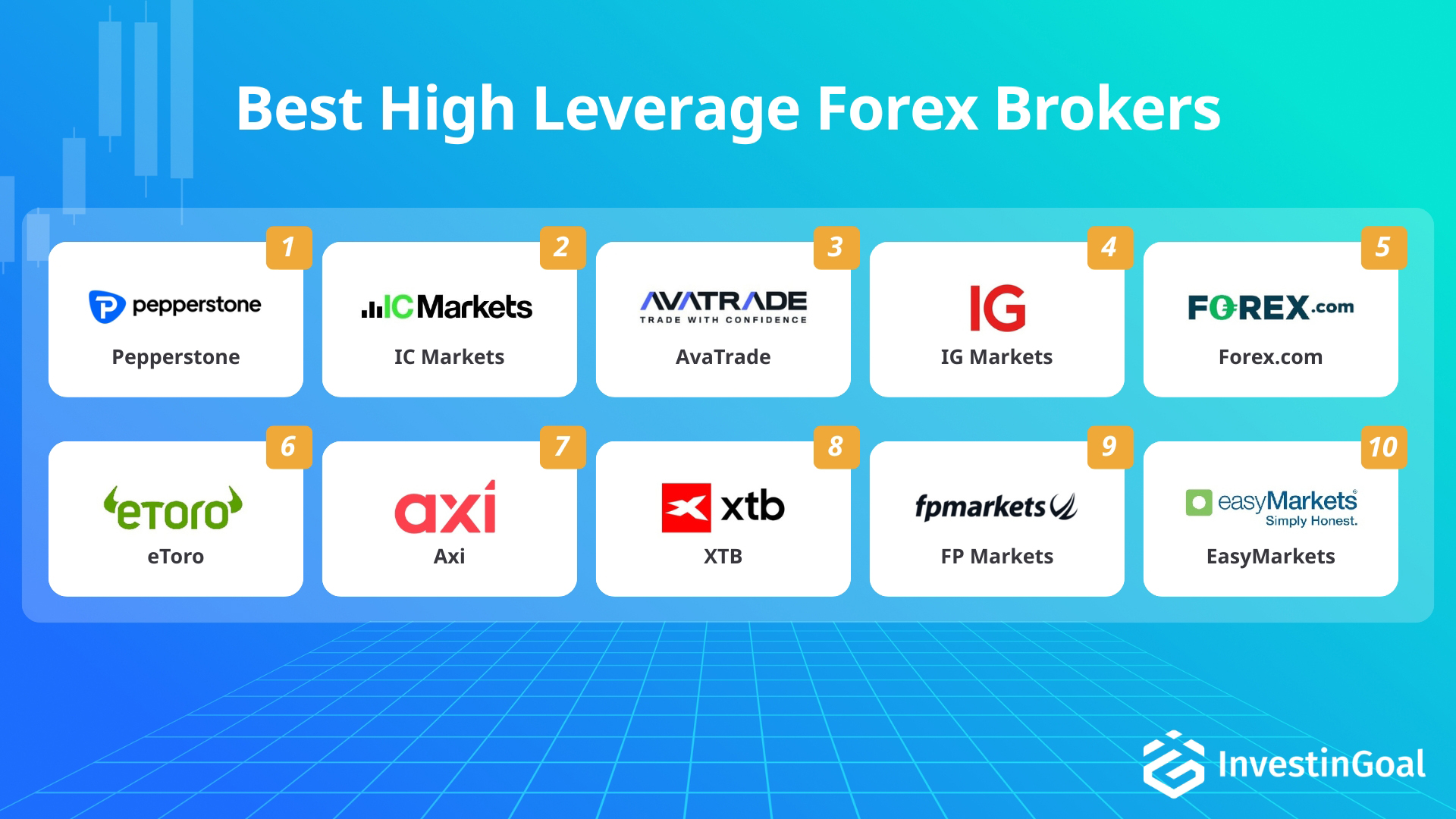
The best Forex brokers for maximizing leverage in the EU/UK are Pepperstone, IC Markets, AvaTrade and IG.
When choosing the best FX broker for maximizing leverage in the EU/UK, maximum leverage available (retail 30:1 vs elective professional up to roughly 200:1–500:1), regulatory strength and client protections (FCA/CySEC/CBI; negative balance protection; stop-out rules), all-in trading costs (typical EUR/USD spread plus commissions), and platforms and account features (MT4/MT5, cTrader/TradingView or proprietary platforms, minimum deposit, and tools) are the most important criteria.
Pepperstone is the best Forex broker for maximizing leverage in the EU/UK overall, thanks to the fact that it offers very high elective-professional leverage (up to 1:500 and even 1:1000 on some instruments) alongside ESMA-compliant 30:1 for retail, top-tier FCA/CySEC regulation with solid retail protections (negative balance protection and clear margin stop-out levels), tight all-in trading costs on EUR/USD via Razor raw spreads plus low commissions, and a wide range of advanced trading platforms and account features, including MT4/MT5, cTrader, and TradingView with no fixed minimum deposit requirement.
Next in line after Pepperstone, the best Forex brokers for maximizing leverage in the EU/UK in terms of maximum leverage, regulatory strength, pricing, and platform quality include IC Markets, AvaTrade, and IG. IC Markets provides EU-standard 30:1 retail leverage and up to 1:500 for professionals, industry-low Raw pricing (0.1 pip + $7/lot), and access to MT4/MT5/cTrader/TradingView with a typical $200 starting deposit. AvaTrade features 30:1 retail and up to 1:400 professional leverage on FX, roughly 0.9–1.2-pip EUR/USD spreads with no commission, strong Central Bank of Ireland regulation, and user-friendly WebTrader/AvaTradeGO alongside MT4/MT5 from about $100 minimum. IG offers ESMA-capped 30:1 retail leverage and around 1:222 on majors for professionals, tight EUR/USD spreads of 0.6–0.8 pips on its powerful proprietary web platform and MT4, plus top-tier FCA/BaFin oversight, with a commonly recommended first deposit of about £250.
Pepperstone, IC Markets, and IG are also widely regarded among the best Forex brokers in the world thanks to tight pricing, fast execution, robust platforms and tools, and responsive customer support.

Pepperstone
(Best high leverage Forex brokers overall)
Pepperstone is the best forex broker with high leverage thanks to professional leverage up to 1:500 (1:1000 on some instruments), and ESMA-compliant 1:30 for EU/UK retail with negative balance protection, and tight raw EUR/USD pricing (0.1 pip + $7/lot) on leading platforms such as MetaTrader 4, MetaTrader 5, and cTrader. Pepperstone is an exceptional option for experienced EU/UK traders pursuing Elective Professional status. It provides up to 1:500–1:1000 leverage and lowers stop-out (20% on MT4/MT5 for Pro), giving qualified traders the ability to open larger positions with less margin while still trading under FCA/CySEC oversight. The professional leverage of Pepperstone provides traders with materially lower margin requirements, helping them allocate capital more efficiently across multiple positions and hedging strategies.
-
Regulations:
-
Avg. EUR/USD Spread:
-
Platforms:
Pepperstone Features
The features of Pepperstone are listed below.
- Pepperstone caps retail leverage at 1:30 on major forex pairs under FCA and CySEC while Pepperstone offers up to 1:500 and in some cases 1:1000 to eligible professional clients.
- Pepperstone sets a 50 percent stop out for retail accounts and Pepperstone sets a 20 percent stop out for professional accounts on MT4 and MT5 with 50 percent on cTrader.
- Pepperstone provides negative balance protection for retail clients while Pepperstone requires professionals to waive some protections.
- Pepperstone supports MT4 MT5 cTrader and TradingView so Pepperstone covers both expert advisor trading and advanced charting.
- Pepperstone Razor account on EUR/USD shows raw spreads around 0.0 to 0.1 pips with a $7 per lot round turn commission while Pepperstone Standard averages about 1.1 to 1.3 pips with no commission.
- Pepperstone does not enforce a fixed minimum deposit and Pepperstone recommends about $200 as a practical starting balance.
Pepperstone Pros and Cons
Advantages of Pepperstone
The advantages of Pepperstone are listed below.
- Stable raw spreads (0,10 pips on EUR/USD on average)
- Caters for algorithmic trading
- Has won over 30 Forex industry awards
Disadvantages of Pepperstone
The disadvantages of Pepperstone are listed below.
- The demo account is not unlimited
About Pepperstone
Pepperstone is a global forex and CFD broker founded in 2010 in Melbourne, Australia. Pepperstone offers trading on currencies, commodities, indices, stocks, and cryptocurrencies through MetaTrader and cTrader platforms. Pepperstone is regulated by multiple authorities including ASIC, FCA, and CySEC. Pepperstone is known for competitive spreads, fast execution, and extensive educational resources. Pepperstone serves clients in over 160 countries worldwide. The Pepperstone CEO is Tamas Szabo.

IC Markets
(Best high leverage Forex brokers for algorithmic trading)
IC Markets is the second best high leverage forex broker due to professional leverage up to 1:500, ESMA-capped 1:30 for EU retail with negative balance protection and 50% stop-out, and ultra-low EUR/USD raw spreads (0.1 pip + $7/lot) across MT4/MT5/cTrader. IC Markets is an outstanding choice for algorithmic and high-volume traders because its deep liquidity and raw pricing help minimise spreads and slippage, so overall trading costs stay low even when you scale position sizes with professional leverage (up to 1:500). IC Markets’ professional leverage helps traders with reduced margin per lot, which in turn frees up capital to build more diversified portfolios or hold hedged positions at the same time.
-
Regulations:
-
Avg. EUR/USD Spread:
-
Platforms:
IC Markets Features
The features of IC Markets are listed below.
- IC Markets limits EU retail leverage to 1:30 on majors while IC Markets offers up to 1:500 for professional or offshore clients.
- IC Markets applies negative balance protection and a 50 percent stop out for retail while IC Markets allows professionals higher leverage with fewer protections.
- IC Markets provides MT4 MT5 cTrader and TradingView integration so IC Markets suits algorithmic and manual traders.
- IC Markets Raw account on EUR/USD averages about 0.1 pips plus $7 per lot round turn while IC Markets Standard averages roughly 1.1 to 1.3 pips with no commission.
- IC Markets requires a $200 minimum deposit for live accounts according to IC Markets documentation.
- IC Markets operates under CySEC and ASIC and international entities so IC Markets combines EU oversight with global access.
IC Markets Pros and Cons
Advantages of IC Markets
The advantages of IC Markets are listed below.
- Low-latency trading environment
- Institutional level liquidity
- MT4, MT5, cTrader platforms are all available
Disadvantages of IC Markets
The disadvantages of IC Markets are listed below.
- Small amount of educational tools for new traders
- Small range of tradable assets compared to other CFD/Forex brokers
About IC Markets
IC Markets is a global forex and CFD broker founded in 2007 and based in Sydney, Australia. IC Markets offers trading on over 2,250 instruments including currencies, commodities, indices, stocks, and cryptocurrencies. IC Markets provides MetaTrader 4, MetaTrader 5, and cTrader platforms. IC Markets is regulated by multiple authorities including ASIC and CySEC. IC Markets is known for its ECN execution model and low spreads. The IC Markets CEO is Andrew Budzinski.

AvaTrade
(Best high leverage Forex brokers for fixed spreads)
AvaTrade is the third best forex broker with high leverage because of Elective professional leverage up to 1:400 on FX majors, ESMA 1:30 retail limits with negative balance protection, and stable 1.0-pip EUR/USD spreads with fixed-spread options. AvaTrade is an excellent option for EU traders seeking higher leverage with guardrails. Pro status raises FX leverage to 1:400, while AvaProtect and guaranteed stops on its proprietary platforms help limit downside by capping potential losses on individual trades during volatile periods. AvaTrade’s professional leverage allows traders to open larger positions with the same amount of capital, and helps them manage their trading strategy more efficiently by freeing up capital for scaling into trades, diversifying instruments, or adding hedges.
-
Regulations:
-
Avg. EUR/USD Spread:
-
Platforms:
AvaTrade Features
The features of AvaTrade are listed below.
- AvaTrade sets EU retail leverage at 1:30 on major forex while AvaTrade allows up to 1:400 for professional traders.
- AvaTrade offers WebTrader and AvaTradeGO alongside MT4 and MT5 so AvaTrade covers proprietary and MetaTrader users.
- AvaTrade typically quotes about 0.9 to 1.2 pips on EUR/USD with AvaTrade charging no commission on forex.
- AvaTrade sets a minimum deposit of $100 or 100 euros for standard accounts according to AvaTrade.
- AvaTrade is regulated by the Central Bank of Ireland and by CySEC and ASIC so AvaTrade serves EU clients under strong oversight.
- AvaTrade provides a 21-day demo with a large virtual balance so AvaTrade supports practice before funding.
AvaTrade Pros and Cons
Advantages of AvaTrade
The advantages of AvaTrade are listed below.
- Tight fixed spreads from 0.6 pips (0.9 pips for retail traders)
- The mobile apps are well designed
- Can be connected to ZuluTrade and Duplitrade
Disadvantages of AvaTrade
The disadvantages of AvaTrade are listed below.
- High inactivity fees
- The demo account is limited to 30 days
About AvaTrade
AvaTrade is a global forex and CFD broker founded in 2006 and headquartered in Dublin, Ireland. AvaTrade offers trading on currencies, commodities, indices, stocks, bonds, ETFs, and cryptocurrencies. AvaTrade provides proprietary platforms alongside MetaTrader 4 and 5. AvaTrade is regulated by multiple authorities including CySEC, ASIC, and FSA. AvaTrade serves over 300,000 clients worldwide. AvaTrade is known for competitive spreads and extensive educational resources. The AvaTrade CEO is David Dryzin since 2016.

IG Markets
(Best high leverage Forex brokers for DMA access)
IG is the fourth best forex broker with high leverage through an Elective Professional programme delivering 0.45% margin on majors (1:222), ESMA-capped 1:30 for retail, and tight standard EUR/USD spreads from 0.6–0.8 pips (no commission). IG is a great choice for UK/EU professionals as its pro margins, 90% lower than retail (0.45% on majors), allow active traders to deploy higher effective leverage, whether they trade via Forex Direct (DMA) or standard CFDs. IG’s professional leverage helps traders by reducing the capital required for each trade and making it feasible to run several strategies or hold multiple positions in correlated markets without exhausting available margin.
-
Regulations:
-
Avg. EUR/USD Spread:
-
Platforms:
IG Markets Features
The features of IG Markets are listed below.
- IG sets EU and UK retail leverage at 1:30 on major forex while IG offers about 1:222 leverage for professional clients on majors.
- IG reduces margin for professionals to about 0.45 percent on majors so IG materially lowers capital requirements for pros.
- IG delivers an advanced web platform and MT4 with optional ProRealTime so IG caters to both proprietary and MetaTrader workflows.
- IG typical EUR/USD spread is around 0.6 to 0.8 pips with IG charging no commission on standard forex trades.
- IG recommends a first deposit of around $250 so IG enables quick account activation.
- IG is FCA regulated in the UK and operates IG Europe under BaFin so IG provides top tier protection across Europe.
IG Markets Pros and Cons
Advantages of IG Markets
The advantages of IG Markets are listed below.
- Low spreads from 0.6 pips on Forex
- Wide range of financial instruments
- 40 years of experience in the Forex industry
Disadvantages of IG Markets
The disadvantages of IG Markets are listed below.
- No copy trading features
- No social trading features
About IG Markets
IG Markets is a global online trading provider founded in 1974, offering access to over 17,000 financial markets including forex, stocks, indices, commodities, and cryptocurrencies. IG Markets provides proprietary trading platforms alongside MetaTrader 4 and ProRealTime. IG Markets is regulated by multiple top-tier authorities worldwide, including the FCA and ASIC. IG Markets is known for competitive spreads, extensive educational resources, and innovative features like weekend trading. The IG Markets’ parent company “IG Group” CEO is Breon Corcoran.

Forex.com
(Best high leverage Forex brokers for platform variety)
FOREX.com is the fifth best high leverage forex broker thanks to professional leverage up to 1:400, ESMA-limited 1:30 for retail under FCA/CySEC, and choice of RAW pricing (0.2 pip + $7/lot) or Standard (1.2–1.4 pips) on EUR/USD. FOREX.com is a strong option for EU/UK traders who want high leverage within a trusted and well-regulated company. The pro account offers 400:1 leverage, and StoneX’s infrastructure and access to platforms like TradingView, MetaTrader 4, and MetaTrader 5 provide the tools and stability needed to monitor risk and execute quickly at higher gearing. FOREX.com’s professional leverage provides traders with lower margin requirements, making it easier to spread capital across several currency pairs or trading approaches without repeatedly hitting margin constraints.
-
Regulations:
-
Avg. EUR/USD Spread:
-
Platforms:
Forex.com Features
The features of Forex.com are listed below.
- Forex.com caps EU retail leverage at 1:30 while FOREX.com offers up to 1:400 for professional clients in Europe.
- Forex.com provides a proprietary web and mobile platform plus MT4 and MT5 with TradingView integration so FOREX.com supports flexible execution.
- Forex.com Standard EUR/USD averages about 1.2 to 1.4 pips and FOREX.com RAW pricing often shows 0.0 to 0.2 pips plus $7 per lot round turn.
- Forex.com sets a $100 minimum deposit which makes FOREX.com accessible to beginners.
- Forex.com operates under FCA and EU regulators within the StoneX group so FOREX.com combines oversight with institutional backing.
- Forex.com offers a 90 day demo with sizable virtual funds so FOREX.com facilitates extended practice.
Forex.com Pros and Cons
Advantages of Forex.com
The advantages of Forex.com are listed below.
- Regulatory Assurance
- Low Forex Fees
- Comprehensive Educational Resources
Disadvantages of Forex.com
The disadvantages of Forex.com are listed below.
- Limited Product Portfolio
- Higher Spreads on Standard Accounts
- No Guaranteed Stop-Loss Orders for U.S. Clients
About Forex.com
FOREX.com is a global forex and CFD broker founded in 2001, offering trading on currencies, commodities, indices, stocks, and cryptocurrencies. FOREX.com provides proprietary platforms alongside MetaTrader 4 and 5. FOREX.com is regulated by multiple top-tier authorities including FCA, ASIC, and CFTC. FOREX.com is known for competitive spreads, fast execution, and extensive educational resources. FOREX.com serves over 450,000 clients worldwide. The FOREX.com’s parent company “StoneX Group Inc.” CEO is Sean O’Connor.

eToro
(Best high leverage Forex brokers for copy trading)
eToro is the sixth best high leverage forex broker due to professional leverage up to 1:400 for eligible clients, ESMA-capped 1:30 retail multipliers on CFDs, and an intuitive proprietary platform with fixed leverage steps and 1.0-pip EUR/USD spreads. The professional leverage up to 1:400 of eToro positions it as one of the great options for EU/UK traders seeking higher gearing alongside copy trading. Pro status unlocks 400:1 leverage, while CopyTrader and platform risk controls help structure position sizing by setting clear limits on per-trade and per-strategy risk so higher gearing remains controlled. The professional leverage of eToro allows traders to manage capital more efficiently and to use the same account balance to support larger position sizes or multiple copied strategies at once.
-
Regulations:
-
Avg. EUR/USD Spread:
-
Platforms:
eToro Features
The features of eToro are listed below.
- eToro limits EU retail leverage to 1:30 while eToro offers up to 1:400 to approved professional clients.
- eToro uses a proprietary web and mobile platform with social and copy trading so eToro does not support MT4 or MT5 for CFDs.
- eToro typically prices EUR/USD around 1.0 pip with eToro charging no extra commission on forex CFDs.
- eToro accepts a first deposit from $50 in many European countries so eToro lowers the entry barrier.
- eToro is regulated by CySEC and the FCA and ASIC among others so eToro operates under multi region supervision.
- eToro provides an unlimited demo with $100,000 virtual funds so eToro lets users practice indefinitely.
eToro Pros and Cons
Advantages of eToro
The advantages of eToro are listed below.
- Great copy trading and social trading features
- Wide range of asset classes
- It allows to buy fractional stocks from $10
Disadvantages of eToro
The disadvantages of eToro are listed below.
- The eToro spreads can be high
- Offers only USD accounts
- Transferring cryptocurrencies to other platforms can be hard
About eToro
eToro is a global multi-asset investment platform founded in 2007, offering trading on stocks, ETFs, Crypto CFDs, commodities, and forex. eToro provides a proprietary web and mobile platform with social trading features. eToro is regulated by multiple authorities including FCA, ASIC, and CySEC. eToro is known for its user-friendly interface, copy trading functionality, and commission-free stock trading. eToro serves over 30 million users worldwide. The eToro CEO and co-founder is Yoni Assia.

Axi
(Best high leverage Forex brokers for MT4 specialists)
Axi is the seventh best forex broker with high leverage for access to high leverage via its international entity (up to 1:500–1:1000), ESMA-capped 1:30 for UK/EU retail under FCA/CySEC, and raw EUR/USD pricing on Pro (0.0–0.2 pip + $7/lot) on MT4. Axi’s high-leverage access offers traders increased position size flexibility, while reducing margin per lot so complex algorithmic or hedged strategies can be run without locking up excessive capital. Axi is a strong choice for expert traders who need maximum leverage since qualifying clients can onboard to the offshore or Elite setup (500:1–1000:1) while still using familiar MT4 execution, VPS hosting, and EA automation tools.
-
Regulations:
-
Avg. EUR/USD Spread:
-
Platforms:
Axi Features
The features of Axi are listed below.
- Axi sets EU retail leverage at 1:30 while Axi offers up to 1:500 and up to 1:1000 through its international or elite setups.
- Axi focuses on MT4 with add ons VPS and copy trading so Axi targets expert advisor users.
- Axi Pro account on EUR/USD averages 0.0 to 0.2 pips plus $7 per lot round turn while Axi Standard averages about 1.2 pips with no commission.
- Axi imposes effectively no fixed minimum deposit for EU and UK with Axi activation possible from about $5.
- Axi is regulated by ASIC the FCA and CySEC with additional registrations so Axi balances safety and flexibility.
- Axi provides negative balance protection for EU and UK retail clients while Axi limits protections for offshore and professional users.
Axi Pros and Cons
Advantages of Axi
The advantages of Axi are listed below.
- Low Forex Fees
- No Deposit/Withdrawal Fees
- Regulatory Assurance
Disadvantages of Axi
The disadvantages of Axi are listed below.
- Limited Platform Options
- Lack of Advanced Educational Resources
About Axi
Axi, formerly known as AxiTrader, is a global forex and CFD broker founded in 2007 and headquartered in Sydney, Australia. Axi offers trading on currencies, commodities, indices, cryptocurrencies, and stocks through MetaTrader 4 and proprietary platforms. Axi is regulated by multiple authorities including ASIC, FCA, and DFSA. Axi is known for competitive spreads, fast execution, and extensive educational resources. Axi serves clients in over 100 countries worldwide. The Axi CEO is Rajesh Yohannan.

XTB
(Best high leverage Forex brokers for proprietary platforms)
XTB is the eighth best forex broker with high leverage Forex broker due to professional leverage up to 1:200 on majors, retention of negative balance protection for pros, and 0.9-pip typical EUR/USD spreads on xStation (xStation 5 and xStation Mobile, no commission). XTB is a solid option for EU professionals because its 200:1 leverage and continued negative balance protection help manage risk when taking larger positions on its reliable proprietary platform, giving traders a buffer against extreme market moves. XTB’s professional leverage helps traders with lower margin needs, so they can add to winning positions or run multiple trades simultaneously before hitting close-out thresholds.
-
Regulations:
-
Avg. EUR/USD Spread:
-
Platforms:
XTB Features
The features of XTB are listed below.
- XTB sets EU retail leverage at 1:30 and XTB offers up to 1:200 for professional clients with higher limits offshore.
- XTB uses the proprietary xStation 5 platform and XTB does not generally offer MT4 to new EU clients.
- XTB Standard EUR/USD typically averages about 0.9 pips with no commission while XTB Pro can offer about 0.1 pips plus $7 per lot.
- XTB does not enforce a fixed minimum deposit although XTB often suggests about $250 for practicality.
- XTB is regulated by KNF CySEC and the FCA and XTB is listed on the Warsaw Stock Exchange.
- XTB maintains negative balance protection for retail clients and XTB extends higher leverage only to approved professionals.
XTB Pros and Cons
Advantages of XTB
The advantages of XTB are listed below.
- No minimum deposit
- Wide selection of assets
- Competitive trading costs
Disadvantages of XTB
The disadvantages of XTB are listed below.
- Small withdrawal fee
- No social or copy trading
- XTB demo account is limited to 30 days
About XTB
XTB is a global forex and CFD broker founded in 2002 and headquartered in Poland. XTB offers trading on over 2,000 instruments including currencies, stocks, indices, commodities, and cryptocurrencies. XTB provides the proprietary xStation platform and is regulated by multiple authorities including FCA, CySEC, and KNF. XTB is listed on the Warsaw Stock Exchange and serves over 897,500 clients worldwide. The XTB CEO is Omar Arnaout since March 2017.

FP Markets
(Best high leverage Forex brokers for low costs)
FP Markets is the ninth best high leverage forex broker because of access to up to 1:500 leverage via its international entity for qualified clients, ESMA-capped 1:30 for EU retail under CySEC, and very tight RAW pricing on EUR/USD (0.0–0.1 pip + $6/lot). The access to up to 1:500 leverage via its international entity at FP Markets places it among the very good choices for cost-focused traders. Its RAW pricing keeps all-in EUR/USD costs 0.7–0.8 pips, allowing you to define precise risk per trade even when you scale up leverage. The high-leverage option of FP Markets offers traders increased capital efficiency, making it easier to spread positions across multiple currency pairs or asset classes without quickly exhausting available margin.
-
Regulations:
-
Avg. EUR/USD Spread:
-
Platforms:
FP Markets Features
The features of FP Markets are listed below.
- FP Markets caps EU retail leverage at 1:30 via its CySEC entity while FP Markets offers up to 1:500 through its international arm.
- FP Markets Raw account on EUR/USD often shows 0.0 to 0.1 pips plus $6 dollars per lot round turn while FP Markets Standard starts from about 1.0 pips with no commission.
- FP Markets supports MT4 and MT5 and TradingView connectivity so FP Markets serves both automated and chart traders.
- FP Markets sets a $100 minimum deposit for standard MT4 or MT5 accounts according to FP Markets.
- FP Markets holds ASIC and CySEC regulation with an offshore entity for higher leverage so FP Markets offers both safety and flexibility.
- FP Markets provides negative balance protection for EU retail clients while FP Markets limits protections for offshore users.
FP Markets Pros and Cons
Advantages of FP Markets
The advantages of FP Markets are listed below.
- Broad Instrument Offering
- Competitive Spreads
- Multiple Trading Platforms
Disadvantages of FP Markets
The disadvantages of FP Markets are listed below.
- High Fees for International Withdrawals
- Outdated Platform Design
About FP Markets
FP Markets is an Australian-based global forex and CFD broker founded in 2005. FP Markets offers trading on over 10,000 instruments including forex, stocks, indices, commodities, and cryptocurrencies. FP Markets provides MetaTrader 4, MetaTrader 5, and proprietary platforms. FP Markets is regulated by multiple authorities including ASIC, CySEC, and FSA. FP Markets is known for tight spreads, fast execution, and extensive educational resources. The FP Markets CEO is Craig Allison.

EasyMarkets
(Best high leverage Forex brokers for guaranteed stop-losses)
easyMarkets is the tenth best forex broker with high leverage Forex broker due to professional leverage up to 1:400 (and up to 1:500 via certain international entities), ESMA-capped 1:30 for EU/UK retail, and fixed-spread EUR/USD pricing around 1.8 pips with guaranteed stop-loss on its web platform. easyMarkets is a good option for traders who value risk controls at higher leverage because its guaranteed stops and dealCancellation features can cap downside by defining a maximum loss on each trade even as position size increases under pro terms. easyMarkets’ professional leverage provides traders with higher exposure on trades from the same capital, while the platform’s built-in guarantees, such as fixed spreads and guaranteed stops, help protect against sharp adverse price gaps.
-
Regulations:
-
Avg. EUR/USD Spread:
-
Platforms:
EasyMarkets Features
The features of EasyMarkets are listed below.
- easyMarkets limits EU retail leverage to 1:30 while easyMarkets provides up to 1:400 to professional clients and up to 1:500 in some international entities.
- easyMarkets offers a proprietary web and app platform with guaranteed stop loss and fixed spreads while easyMarkets also supports MT4 and MT5.
- easyMarkets typically fixes EUR/USD around 1.8 pips on the web platform with easyMarkets charging no commission.
- easyMarkets sets a $100 or 100 euros minimum deposit for standard accounts according to easyMarkets materials.
- easyMarkets is regulated by CySEC and ASIC and Seychelles FSA so easyMarkets serves EU clients under established oversight.
- easyMarkets includes unique tools such as dealCancellation and Freeze Rate which easyMarkets positions as added risk control.
EasyMarkets Pros and Cons
Advantages of EasyMarkets
The advantages of EasyMarkets are listed below.
- Innovative Risk Management Tools
- User-Friendly Platform
- Regulatory Trust
Disadvantages of EasyMarkets
The disadvantages of EasyMarkets are listed below.
- Limited Tradeable Symbols
- Higher Spreads on Some Accounts
- Outdated User Experience
About EasyMarkets
EasyMarkets is a global forex and CFD broker founded in 2001, offering trading on currencies, commodities, indices, cryptocurrencies, and stocks. EasyMarkets provides proprietary web and mobile platforms alongside MetaTrader 4 and 5. EasyMarkets is regulated by multiple authorities including CySEC and ASIC. EasyMarkets is known for innovative features like dealCancellation and fixed spreads. EasyMarkets serves clients worldwide and has received numerous industry awards. The EasyMarkets CEO is Nikos Antoniades.
Comparison of the best best forex brokers with high leverage
The table that compares the best best forex brokers with high leverage is shown below.
| Broker | High-leverage regulatory jurisdictions | Maximum forex leverage on major pairs | Minimum deposit to access high-leverage account | Average EUR/USD spread on standard account (pips) | Negative balance protection on high-leverage accounts |
|---|---|---|---|---|---|
| Pepperstone | SCB Bahamas | 1:500 | $0 | 1.2 | No on pro/offshore |
| IC Markets | FSA Seychelles | 1:500 | $200 | 1.2 | No on pro/offshore |
| AvaTrade | BVI FSC | 1:400 | $100 | 0.9 | No on pro/offshore |
| IG | FCA (UK) – Elective Professional | 1:222 | $250 | 0.7 | No on pro/offshore |
| FOREX.com | FCA (UK) – Professional | 1:400 | $100 | 1.3 | No on pro/offshore |
| eToro | CySEC (EU) – Professional | 1:400 | $50 | 1.0 | No on pro/offshore |
| Axi | SVG FSA | 1:1000 | N/A | 1.2 | No on pro/offshore |
| XTB | IFSC Belize | 1:500 | $0 | 0.9 | N/A |
| FP Markets | SVG FSA | 1:500 | $100 | 1.1 | No on pro/offshore |
| easyMarkets | FSA Seychelles | 1:500 | $100 | 1.8 | No on pro/offshore |
Warning
CFDs are complex instruments and come with a high risk of losing money rapidly due to leverage. Between 74-89% of retail investor accounts lose money when trading CFDs. You should consider whether you can afford to take the high risk of losing your money.
The best high leverage Forex broker with bonus is OctaFX. OctaFX offers a permanent 50% deposit bonus on every top-up to expand usable margin, a Trade & Win rewards program converting trading volume into prizes, and monthly demo contests with cash rewards for testing higher-risk approaches. These ongoing deposit bonuses, loyalty rewards and contest incentives provided by OctaFX give high-leverage traders extra margin headroom, additional perks for active trading, and risk-free ways to trial more aggressive strategies.
In the bonus segment, the most attractive high-leverage brokers tend to provide sizeable deposit promotions, low entry requirements and extra reward schemes that complement leveraged trading. FXTM is a solid alternative to OctaFX thanks to its Welcome Bonus system that turns traded lots into up to $500 in bonus credits, a Cent account with just a $10 minimum deposit and micro-lot sizing for more controlled leveraged trading, and extra rewards through refer-a-friend offers and regional deposit promotions that position it among the best Forex brokers with Bonuses for traders seeking added incentives. Axi is another viable alternative to OctaFX, as it combines access to high leverage through its international entities (up to 1:500–1:1000) with a Pro MT4 account featuring raw EUR/USD spreads of 0.0–0.2 pips plus a $7-per-lot commission, and an MT4 + VPS setup optimised for EA-driven high-leverage strategies.
The best high leverage Forex broker with low minimum deposit is Pepperstone. Pepperstone has a $0 minimum deposit with fee-free instant card, PayPal, Skrill and Neteller funding, offers professional leverage up to 1:500 (and up to 1:1000 on some instruments), and provides Razor accounts with raw EUR/USD spreads from 0.0–0.1 pips plus a $7-per-lot commission on MT4/MT5/cTrader. This mix of no minimum funding requirement, substantial available leverage and ultra-tight Razor pricing from Pepperstone makes it easy for traders to start small while still accessing institutional-style conditions.
For traders seeking high leverage with a small starting capital, the top brokers usually feature very low or zero minimum deposits, strong leverage options and competitive spreads on user-friendly platforms. XTB is a strong alternative to Pepperstone because it also has a $0 minimum deposit (you can begin with even $1) and instant card/e-wallet funding without deposit fees, making it one of the most accessible low deposit Forex brokers for new traders, and supports professional leverage up to 1:200 on majors while keeping negative balance protection, and offers the xStation 5 platform with roughly 0.9-pip EUR/USD spreads and integrated education. eToro is another alternative to Pepperstone, since it combines a low first deposit starting from $50 in many regions with instant card and PayPal funding, professional leverage up to 1:400 on FX alongside ESMA 1:30 limits for retail, and a social-copy platform that uses fixed leverage steps plus CopyTrader risk controls.
The best high leverage Forex broker for ECN trading is FP Markets. FP Markets provides a Raw ECN account with 0.0–0.1-pip EUR/USD spreads and a $6 round-turn commission, access to up to 1:500 leverage via its international entity, and low-latency execution with multi-platform access across MT4/MT5, cTrader and TradingView. These genuine ECN raw spreads with low commissions, high-leverage options and fast multi-platform connectivity from FP Markets are ideal for day traders who want institutional-style routing and pricing.
In the ECN space, the strongest high-leverage brokers generally offer raw interbank-style pricing, substantial leverage caps and high-speed execution suited to active or algorithmic strategies. IC Markets is a powerful alternative to FP Markets because it delivers ECN-style raw EUR/USD pricing around 0.1 pip with a $6 round-turn commission, professional leverage up to 1:500, and deep aggregated interbank liquidity plus low-latency MT4/MT5/cTrader setups geared to algorithmic ECN trading. Pepperstone is likewise a noteworthy alternative to FP Markets, and is considered among the best ECN Forex brokers thanks to its Razor ECN account with raw spreads from 0.0 pips and a $7 round-turn commission, professional leverage up to 1:500 (and 1:1000 on some products), and no-dealing-desk routing to multi-bank liquidity on MT4/MT5/cTrader.
The best high leverage Forex broker for scalping is IC Markets. IC Markets offers Raw accounts with about 0.1-pip EUR/USD spreads plus a $7 round-turn commission for tight scalping costs, professional leverage up to 1:500 to support high-frequency strategies, and deep liquidity with NDD execution on MT4/MT5/cTrader to minimise slippage on rapid entries and exits. Such low-spread raw pricing, generous leverage and fast, no-dealing-desk execution from IC Markets give scalpers the cost structure and fill quality they need to trade frequently over short timeframes.
For scalping, the best high-leverage brokers usually combine ultra-competitive spreads, sizeable leverage and execution conditions that allow rapid order placement without restrictions. AvaTrade serves as a good alternative to IC Markets because it provides professional leverage up to 1:400 on major FX pairs, floating EUR/USD spreads around 0.9 pips with optional fixed spreads between 1.3–1.6 pips to keep costs predictable during volatile news, and full MT4/MT5 EA support where scalping is permitted. FP Markets is another strong alternative to IC Markets, as it features a RAW account with 0.0–0.1-pip spreads and a competitive $6 round-turn commission compared to other scalping Forex brokers, high leverage up to 1:500 for qualified traders, and no restrictions on scalping or trade duration backed by low-latency ECN/STP execution.
High leverage forex brokers provide amplified market exposure but require careful evaluation of multiple trading factors. Leverage ratios reach 1:3000 with certain offshore brokers, while regulatory constraints limit European traders to 1:30 maximum leverage.
The criteria on how to choose the best high leverage forex brokers are listed below.
- Regulatory jurisdiction: Evaluate the broker’s licensing authority and compliance framework, as offshore regulators like IFSC and FSA allow leverage up to 1:3000, while European CySEC entities restrict leverage to 1:30 for retail clients and 1:500 for professional traders.
- Maximum leverage ratios: Compare the highest leverage multipliers available across major currency pairs, such as FBS offering 1:3000 leverage and HFM providing 1:2000 leverage under specific regulatory umbrellas.
- Minimum deposit thresholds: Assess capital requirements to access high leverage accounts, ranging from $0 with HFM to $100 with JustForex and RoboForex to ensure alignment with your available trading capital.
- Trading platform compatibility: Verify platform availability for high leverage execution, with most brokers supporting MetaTrader 4 and MetaTrader 5 for leverage trading across desktop and mobile interfaces.
- Minimum position sizing: Examine lot size flexibility and micro lot availability, as brokers like FBS and OctaFX allow 0.01 standard lots to enable precise position control with high leverage ratios.
- Margin calculation methods: Understand how brokers calculate required margin and maintenance levels, particularly when leverage decreases with larger position volumes on platforms like FXTM.
- Spread structures and commissions: Analyze trading costs relative to leverage benefits, considering that high leverage brokers often maintain competitive fx spreads starting from 0.2 pips on major currency pairs.
High-leverage Forex brokers should be compared by first identifying their jurisdiction and regulatory license. Forex regulatory entities determine your maximum leverage, margin protections, and dispute rights when you trade with brokers regulated by the FCA in the UK, NFA/CFTC in the US, ASIC in Australia, or ESMA-area regulators (like CySEC) in the EU.
Your trading strategy dictates which broker features matter most for high-leverage Forex brokers. Scalpers need tight spreads and fast execution. News traders need reliable fills during volatility. Swing traders need competitive swap rates. Grid or martingale systems need favorable stop-out percentages. High-leverage Forex brokers must be verified on official registers before you commit funds. You should record each broker’s maximum leverage by asset, margin call threshold (the warning level), stop-out level (the automatic close level), and negative balance protection status. The typical spread plus commission on major pairs matters if you trade frequently with high-leverage Forex brokers, especially when applying the best trading strategies that rely on tight execution and cost efficiency. Finally, consider performing a small live test to reveal how high-leverage Forex brokers handle real withdrawals. You should fund a small account, execute trades, then withdraw before scaling up your capital.
When choosing a high-leverage Forex broker, look for brokers that set their margin call at 100% or higher and their stop-out at 50% or lower. This separation gives you time to add funds or reduce positions before automatic liquidation occurs.
A margin call happens when your equity falls below a threshold relative to required margin. A stop-out instead automatically closes your positions at a specific margin level, which is calculated as Equity ÷ Used Margin × 100. Brokers in the EU and UK, under ESMA and FCA rules, must close retail CFD accounts at 50% of the minimum required margin.
Forex brokers with offshore entities, like FBS, sometimes offer lower stop-outs between 20% and 50%. These levels create more breathing room during drawdowns but without knowing what is margin in trading they lead to deeper losses if volatility gaps through your positions.
Negative balance protection (NBP) matters as much as margin levels when you choose a high-leverage broker. NBP prevents you from owing more than your deposits, which is mandatory for retail clients under ESMA and UK regulations. Offshore entities may not provide this protection by default.
Forex brokers offer leverage ranging from 20:1 to unlimited, depending on the regulatory jurisdiction. Major regulators in the EU, UK, Australia, and the US cap leverage at 25:1 to 50:1 for retail clients. The U.S. allows 50:1 on major currency pairs through CFTC/NFA rules. The EU, UK, and Australia restrict Forex brokers to 30:1 on major pairs under ESMA, FCA, and ASIC regulations. Japan limits leverage to 25:1 through JFSA/FFAJ requirements.
Offshore Forex brokers advertise much higher leverage ratios for clients outside major regulatory zones. FBS markets leverage up to 1:3000 on certain accounts. RoboForex promotes ratios up to 1:2000 with specific program conditions. Exness claims “unlimited” leverage, though this applies under strict conditions, such as low equity thresholds and trading history requirements.
Standard retail clients in highly regulated jurisdictions cannot access these offshore leverage levels. Local rules in the EU, UK, US, Japan, and Australia prohibit such ratios, depending on how each authority structures the definition of leverage and its role in retail trading. Some traders attempt to reclassify as “professional” clients in the UK or EU to bypass caps, but this removes protections such as negative balance protection (NBP) and the 50% margin close-out rule that Forex brokers must provide to retail clients under ESMA/FCA regulations.
Offshore brokers with high leverage expose you to significant risks because they operate outside your country’s regulatory protections. You lose access to compensation schemes when offshore brokers fail. The Financial Services Compensation Scheme (FSCS) in the UK covers up to £85,000 per person when authorized firms fail, but offshore entities don’t provide this backstop.
Offshore brokers frequently generate complaints about blocked withdrawals and manipulated pricing. The CFTC (Commodity Futures Trading Commission) warns that unregistered offshore dealers make it difficult to recover funds even when enforcement action is taken. It is advisable to check the CFTC’s RED list (or that of any other regulatory body worldwide) before depositing funds.
Negative balance protection (NBP) is often absent with offshore brokers. NBP prevents you from owing more than your deposits if markets gap against your positions. Regulators in the EU, UK, and Australia mandate NBP for retail clients, but offshore brokers treat it as optional. Margin call and stop-out levels become discretionary rather than standardized.
You must test small withdrawals before committing large capital with offshore brokers. Review bonus terms that lock funds, examine execution policies for hidden re-quotes, verify client-money segregation practices, and confirm weekend margin policies. Brokers with offshore entities, like FBS or RoboForex, offer leverage up to 1:2000, but these ratios come without the recourse mechanisms that brokers like Pepperstone provide under FCA or ASIC oversight.
Forex regulation sets the minimum protections and standards when you choose a high-leverage broker. The regulatory framework determines what happens when trades go wrong.
Regulation provides loss-containment rules. Negative balance protection (NBP) prevents you from owing money beyond your deposits. The 50% margin close-out rule automatically closes positions before your account zeroes out. These measures limit tail risk in jurisdictions under ESMA (European Securities and Markets Authority) regulations and the FCA (Financial Conduct Authority) in the UK.
Leverage caps reduce the chance of account blow-ups. Major regulators like ESMA, the FCA, CFTC (Commodity Futures Trading Commission), ASIC (Australian Securities and Investments Commission), and JFSA (Japan Financial Services Agency) impose maximum leverage ratios. These range from 25:1 in Japan to 50:1 for major currency pairs in the United States.
Compensation schemes and dispute resolution exist only with authorized firms. The FSCS (Financial Services Compensation Scheme) in the UK covers up to £85,000 per person if a regulated firm fails. Offshore brokers typically offer no such protection because they rely on looser Forex regulations such as the FSC in Belize.
The standards of conduct prevent abusive sales practices. Regulatory authorities enforce marketing restrictions and standardized risk warnings. These rules protect retail traders from predatory practices by brokers.