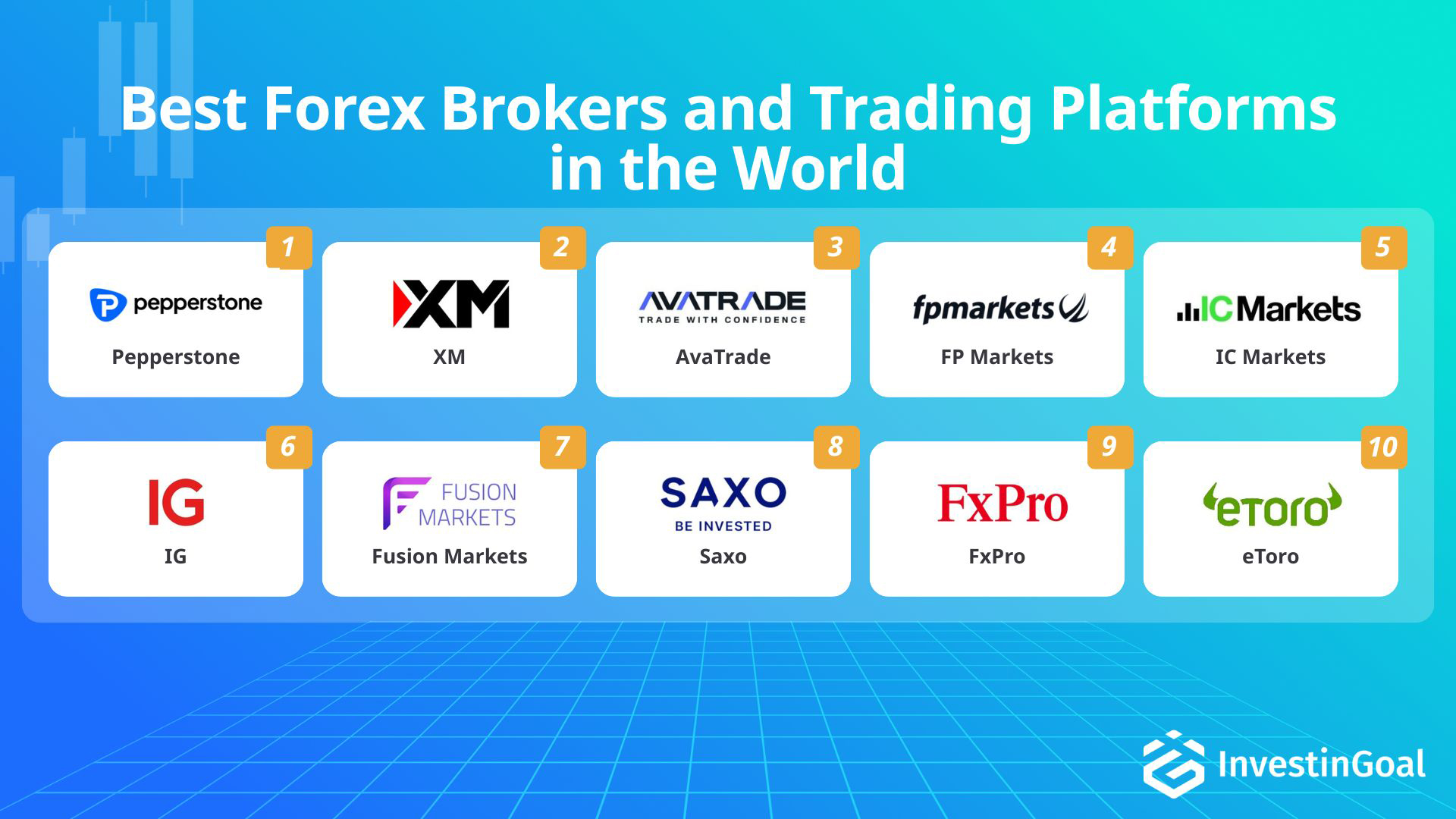
The best Forex brokers in the world are Pepperstone, XM, AvaTrade, and FP Markets.
To choose the best Forex broker to trade in the world, trading costs (spreads and commissions), platform and tools, execution speed, minimum deposit, and customer support are the most important criteria.
Pepperstone is the best Forex broker overall in the world for spreads (0.1 pips on EUR/USD), fast execution (average 60ms), comprehensive platforms (MetaTrader, TradingView, cTrader and Proprietary Platform), minimum deposit ($0) and active customer support (24/5 availability).
XM, AvaTrade and FP Markets follow Pepperstone as the best Forex brokers in the world with platform and tools (MT4, MT5 and Proprietary Platform), minimum deposit ( $5 for XM and $100 for AvaTrade and FP Markets) and customer support (24/5 availability via phone, email, and chat). XM offers trading costs with spread from 0.1 pips on EUR/USD with an execution speed less than 1 second approximately.AvaTrade offers trading costs with fixed spreads of 0.9 pips on EUR/USD with an execution speed of 145 ms approximately. FP Markets offers trading costs with spreads from 0.1 pips along a commission of $6 per lot round turn on EUR/USD with an execution speed of 40 ms approximately.

Pepperstone
(Best Forex Broker Overall)
Pepperstone is the best Forex broker overall thanks to its 0.1-pip average EUR/USD spreads, 60-millisecond execution speed, and multi-platform access including MT4, MT5, cTrader, and TradingView. Pepperstone is the best Forex broker in the world thanks to its ECN model, which delivers unmarked spreads with only a $3 commission per lot. This setup allows cost-conscious traders to maximize profitability on high-frequency strategies. Pepperstone’s raw spread pricing protects traders from hidden markup costs while offering volume-based rebates that reduce trading expenses for active participants.
-
Regulations:
-
Avg. EUR/USD Spread:
-
Platforms:
Pepperstone Features
The features of Pepperstone are listed below.
- Pepperstone is an Australian ECN broker that is popular with day traders and scalpers thanks to its very low spreads.
- Pepperstone offers unmarked spreads that average around 1 pips on EUR/USD and $3 commission per lot traded on its main ECN account.
- Pepperstone executes client orders with an average speed of about 60 ms, which is suitable for high-frequency and scalping strategies.
- Pepperstone provides professional traders with rebate programs that reward higher monthly trading volumes with reduced trading costs.
- Pepperstone supports multiple trading platforms including MetaTrader 4, MetaTrader 5, cTrader, and TradingView, plus its proprietary platform and DupliTrade for social trading.
- Pepperstone is regulated by several major authorities including FCA (684312), ASIC (414530), DFSA (F004356), CySEC (398429), SCB (SIA-F217), and CMA (128).
Pepperstone Pros and Cons
Advantages of Pepperstone
The advantages of Pepperstone are listed below.
- Stable raw spreads (0,10 pips on EUR/USD on average)
- Caters for algorithmic trading
- Has won over 30 Forex industry awards
Disadvantages of Pepperstone
The disadvantages of Pepperstone are listed below.
- The demo account is not unlimited
About Pepperstone
Pepperstone is a global forex and CFD broker founded in 2010 in Melbourne, Australia. Pepperstone offers trading on currencies, commodities, indices, stocks, and cryptocurrencies through MetaTrader and cTrader platforms. Pepperstone is regulated by multiple authorities including ASIC, FCA, and CySEC. Pepperstone is known for competitive spreads, fast execution, and extensive educational resources. Pepperstone serves clients in over 160 countries worldwide. The Pepperstone CEO is Tamas Szabo.

XM
(Best No-Requotes FX Environment)
XM is the second best FX broker due to its strict no-requotes policy, sub-one-second execution on 35% of orders, and zero-pip starting spreads. XM is an exceptional option for Forex traders seeking execution certainty as its policy ensures no price changes occur during order processing and thus eliminates the slippage that can turn profitable setups into losing trades. XM’s no-requotes commitment provides traders with guaranteed execution at requested prices, which ensures trading plans execute as intended without unexpected cost increases.
-
Regulations:
-
Avg. EUR/USD Spread:
-
Platforms:
XM Features
The features of XM are listed below.
- XM is a Cypriot broker that follows a strict no-requotes policy, with 35% of client orders executed in less than one second and no orders subject to price changes.
- XM allows traders to open a real trading account with a minimum deposit starting from just $5, while demo accounts remain free to use.
- XM offers forex spreads starting from 0.0 pips depending on the account type, which can appeal to cost-conscious and active traders.
- XM supports trading on MetaTrader 4 and MetaTrader 5, including manual and automated strategies.
- XM is regulated by multiple authorities including CySEC (120/10), DFSA (F003484), FSC (000261/397), and ASIC (443670).
XM Pros and Cons
Advantages of XM
The advantages of XM are listed below.
- There’s a wide range of account types
- The demo account at XM is unlimited
- Wide range of educational resources
Disadvantages of XM
The disadvantages of XM are listed below.
- No social trading features available
- The account availability changes depending on the location of the trader
- High minimum deposit to invest in securities ($10000 for the XM Shares account)
About XM
XM is a global forex and CFD broker founded in 2009, offering trading on currencies, commodities, indices, stocks, and cryptocurrencies. XM provides MetaTrader 4, MetaTrader 5, and proprietary platforms. XM is regulated by multiple authorities including CySEC, ASIC, and IFSC. XM is known for competitive spreads, extensive educational resources, and multilingual customer support. XM serves over 5 million clients from 196 countries. XM offers various account types and a no-requote policy.

AvaTrade
(Best for Fixed Spread Forex Trading)
AvaTrade is the third best Forex broker through its fixed 0.6-pip spreads, diverse mobile trading suite including AvaOptions, AvaTradeGO, and AvaSocial, and $100 minimum deposit requirement. AvaTrade is an exceptional choice for news traders since fixed spreads remain stable during high-volatility events and protect positions from the spread widening that typically occurs during economic announcements. The fixed-spread structure of AvaTrade offers traders predictable costs during NFP releases, central bank decisions, and other market-moving events when variable spreads can multiply transaction expenses.
-
Regulations:
-
Avg. EUR/USD Spread:
-
Platforms:
AvaTrade Features
The features of AvaTrade are listed below.
- AvaTrade is an Irish broker known among news traders for offering fixed forex spreads as low as 0.6 pips.
- AvaTrade provides a broad range of trading platforms including MetaTrader 4 and MetaTrader 5, alongside AvaOptions, AvaTradeGO, and AvaSocial.
- AvaTrade offers a demo account to all clients and allows opening a real account with a minimum deposit of $100.
- AvaTrade caters to traders who value platform choice and fixed-spread pricing, especially around news events and volatile market conditions.
- AvaTrade is regulated by the Central Bank of Ireland (C53877) and other bodies including ASIC (406684), FSCA (45984), CySEC (347/17), JFSA (1662), and FFAJ (1574).
AvaTrade Pros and Cons
Advantages of AvaTrade
The advantages of AvaTrade are listed below.
- Tight fixed spreads from 0.6 pips (0.9 pips for retail traders)
- The mobile apps are well designed
- Can be connected to ZuluTrade and Duplitrade
Disadvantages of AvaTrade
The disadvantages of AvaTrade are listed below.
- High inactivity fees
- The demo account is limited to 30 days
About AvaTrade
AvaTrade is a global forex and CFD broker founded in 2006 and headquartered in Dublin, Ireland. AvaTrade offers trading on currencies, commodities, indices, stocks, bonds, ETFs, and cryptocurrencies. AvaTrade provides proprietary platforms alongside MetaTrader 4 and 5. AvaTrade is regulated by multiple authorities including CySEC, ASIC, and FSA. AvaTrade serves over 300,000 clients worldwide. AvaTrade is known for competitive spreads and extensive educational resources. The AvaTrade CEO is David Dryzin since 2016.

FP Markets
(Best for Forex ECN Execution)
FP Markets is the fourth best FX broker for its 40-millisecond ECN execution, zero-pip starting spreads, and 1:500 leverage availability. FP Markets is best for precision-focused traders as its ultra-fast order processing minimizes latency-related slippage and enables scalpers and algorithmic traders to capture price movements with millisecond accuracy. FP Markets’ ECN infrastructure provides traders with direct access to interbank liquidity pools where institutional pricing improves fill quality on large orders.
-
Regulations:
-
Avg. EUR/USD Spread:
-
Platforms:
FP Markets Features
The features of FP Markets are listed below.
- FP Markets offers spreads starting from 0.0 pips and $6 commission per lot on its ECN-style accounts.
- FP Markets processes client orders with an average execution time of around 40 ms, which is attractive for scalpers and algorithmic traders.
- FP Markets supports MetaTrader 4 and MetaTrader 5, and allows traders to use EAs, custom indicators, and advanced charting tools.
- FP Markets provides leverage up to 1:500 depending on the client’s location and regulatory conditions.
- FP Markets is regulated by CySEC (371/18) and ASIC (286354) and is also registered in Saint Vincent and the Grenadines.
FP Markets Pros and Cons
Advantages of FP Markets
The advantages of FP Markets are listed below.
- Broad Instrument Offering
- Competitive Spreads
- Multiple Trading Platforms
Disadvantages of FP Markets
The disadvantages of FP Markets are listed below.
- High Fees for International Withdrawals
- Outdated Platform Design
About FP Markets
FP Markets is an Australian-based global forex and CFD broker founded in 2005. FP Markets offers trading on over 10,000 instruments including forex, stocks, indices, commodities, and cryptocurrencies. FP Markets provides MetaTrader 4, MetaTrader 5, and proprietary platforms. FP Markets is regulated by multiple authorities including ASIC, CySEC, and FSA. FP Markets is known for tight spreads, fast execution, and extensive educational resources. The FP Markets CEO is Craig Allison.

IC Markets
(Best for Forex Scalpers)
IC Markets is the fifth best Forex broker because of its 35-millisecond average execution speed, spread-free ECN pricing, and automated trading support across MT4, MT5, and cTrader. IC Markets is the best choice for Forex scalpers given that its sub-40-millisecond execution combined with no spread markups allows traders to profit from tiny price movements while maintaining tight control over transaction costs. IC Markets’ advanced execution technology improves traders’ ability to enter and exit positions at optimal prices, particularly in the context of small intraday movements where execution speed determines profitability.
-
Regulations:
-
Avg. EUR/USD Spread:
-
Platforms:
IC Markets Features
The features of IC Markets are listed below.
- IC Markets is an Australian ECN broker that covers the needs of a large number of traders, including day-traders, scalpers, high-volume traders and algo traders.
- Forex trading is offered with no mark-ups on spreads, and their advanced technology that executes orders in an average of 35ms.
- IC Markets offers three trading platforms (MT4, MT5 and cTrader), in which you can install robots for automated trading strategies.
- IC Markets also offers a great VPS service for more advanced traders, and also a demo account for beginners.
- The minimum deposit for a live account with IC Markets is kept low at $200.
- IC Markets is regulated by CySEC (362/18), ASIC (335692), SCB (SIA-F214) and the FSA (SD018).
IC Markets Pros and Cons
Advantages of IC Markets
The advantages of IC Markets are listed below.
- Low-latency trading environment
- Institutional level liquidity
- MT4, MT5, cTrader platforms are all available
Disadvantages of IC Markets
The disadvantages of IC Markets are listed below.
- Small amount of educational tools for new traders
- Small range of tradable assets compared to other CFD/Forex brokers
About IC Markets
IC Markets is a global forex and CFD broker founded in 2007 and based in Sydney, Australia. IC Markets offers trading on over 2,250 instruments including currencies, commodities, indices, stocks, and cryptocurrencies. IC Markets provides MetaTrader 4, MetaTrader 5, and cTrader platforms. IC Markets is regulated by multiple authorities including ASIC and CySEC. IC Markets is known for its ECN execution model and low spreads. The IC Markets CEO is Andrew Budzinski.

IG Markets
(Best for European Forex traders)
IG Markets is the sixth best FX broker through its 90+ currency pair selection, 17,000 total tradable instruments, and dual-platform offering with MT4 and L2 Trader. IG Markets is a top option for European Forex clients since its extensive instrument range provides diversification opportunities across forex, indices, and commodities, while its FCA and BaFIN regulation ensures account safety under strict European standards. The vast product selection of IG Markets offers traders access to major, minor, and exotic currency pairs alongside thousands of CFDs, which enables portfolio diversification from one multi-asset account.
-
Regulations:
-
Avg. EUR/USD Spread:
-
Platforms:
IG Markets Features
The features of IG Markets are listed below.
- IG markets offers a large number of exclusive services for European clients, including over 90 forex pairs and 17,000 tradable instruments in total.
- The forex spread with IG Markets starts at 0.6 pips.
- IG Markets offers two forex trading platforms (MT4 and L2 Trader), which include additional services and indicators to enhance the trading experience.
- IG markets offers a demo account, but to open a real account you need to deposit $300, although the final amount depends on your country of residence.
- IG Markets is regulated by ten different regulatory bodies, including BaFIN (148759), FCA (195355), ASIC (220440), NFA (509630).
IG Markets Pros and Cons
Advantages of IG Markets
The advantages of IG Markets are listed below.
- Low spreads from 0.6 pips on Forex
- Wide range of financial instruments
- 40 years of experience in the Forex industry
Disadvantages of IG Markets
The disadvantages of IG Markets are listed below.
- No copy trading features
- No social trading features
About IG Markets
IG Markets is a global online trading provider founded in 1974, offering access to over 17,000 financial markets including forex, stocks, indices, commodities, and cryptocurrencies. IG Markets provides proprietary trading platforms alongside MetaTrader 4 and ProRealTime. IG Markets is regulated by multiple top-tier authorities worldwide, including the FCA and ASIC. IG Markets is known for competitive spreads, extensive educational resources, and innovative features like weekend trading. The IG Markets’ parent company “IG Group” CEO is Breon Corcoran.

Fusion Markets
(Best for Low-Cost Forex Trading)
Fusion Markets is the seventh best Forex broker for its 0.0-pip spreads on major pairs, $2.25-per-side commission structure, and zero minimum deposit requirement. The zero minimum deposit requirement of Fusion Markets positions it as an excellent choice for cost-sensitive traders as its combination of raw spreads and low commissions creates one of the industry’s most competitive fee structures. This allows traders to retain more profit per trade. Fusion Markets’ elimination of deposit barriers provides traders with the ability to open accounts and begin trading with any amount, which removes financial obstacles that prevent market entry.
-
Regulations:
-
Avg. EUR/USD Spread:
-
Platforms:
Fusion Markets Features
The features of Fusion Markets are listed below.
- Fusion Markets is an Australian ECN broker that offers spreads from 0.0 pips on major forex pairs.
- Fusion Markets charges a $2.25 commission per side per standard lot on its RAW account and provides ultra-fast execution speeds.
- Fusion Markets clients can access MetaTrader 4 and MetaTrader 5 platforms with advanced charting and automation tools.
- Fusion Markets requires no minimum deposit for account opening, making it one of the most accessible brokers for new traders.
- Fusion Markets offers more than 90 forex pairs alongside commodities, indices, and cryptocurrencies.
- Fusion Markets is regulated by ASIC (001281614) and VFSC (40256).
Fusion Markets Pros and Cons
Advantages of Fusion Markets
The advantages of Fusion Markets are listed below.
- Low Trading Costs
- Zero Spread Accounts
- Excellent Customer Support
Disadvantages of Fusion Markets
The disadvantages of Fusion Markets are listed below.
- Limited Product Selection
- Basic Educational Resources
About Fusion Markets
Fusion Markets is an Australian-based forex and CFD broker founded in 2019. Fusion Markets offers trading on over 90 currency pairs, stocks, indices, commodities, and cryptocurrencies. Fusion Markets provides MetaTrader 4, MetaTrader 5, and cTrader platforms. Fusion Markets is regulated by ASIC and VFSC. Fusion Markets is known for low trading costs, no minimum deposit, and copy trading services. The Fusion Markets CEO is Phil Horner.

Saxo
(Best for Professional Forex Traders)
Saxo is the eighth best FX broker due to its SaxoStrats exclusive analysis service, 0.6-pip starting spreads, and professional-grade SaxoTraderPro platform. Saxo is an excellent option for professional Forex traders since SaxoStrats delivers institutional-quality market intelligence and expert analysis unavailable to retail clients at most brokers, which gives high-volume traders an informational edge. Saxo’s professional platform suite provides traders with advanced order types including iceberg orders and algorithmic execution tools that enable sophisticated position management for complex strategies.
-
Regulations:
-
Avg. EUR/USD Spread:
-
Platforms:
Saxo Features
The features of Saxo are listed below.
- Saxo is a Danish broker that serves a wide range of traders, with particular appeal to professional and high-net-worth clients.
- Saxo offers spreads from 0.6 pips on forex, with pricing tiers designed to reward higher trading volumes and larger account balances.
- Saxo provides premium research and analysis services such as SaxoStrats which deliver expert market insights to high-volume and high-equity clients.
- Saxo has no universal minimum deposit, as the required starting capital depends on the account type and client’s country of residence.
- Saxo supports proprietary platforms including SaxoTraderGO and SaxoTraderPRO for multi-device and advanced desktop trading.
- Saxo is regulated by multiple top-tier authorities including FCA (551422), ASIC (280372), MAS (200601141M), the UAE Central Bank, JFSA, and SFC.
Saxo Pros and Cons
Advantages of Saxo
The advantages of Saxo are listed below.
- Regulation and Trust
- Extensive Product Range
- Advanced Trading Platform
Disadvantages of Saxo
The disadvantages of Saxo are listed below.
- High Minimum Deposits for Premium Accounts
- Lack of Spread Betting Options
- Custody Fees in Certain Regions
About Saxo
Saxo is a Danish investment bank and online trading platform founded in 1992. Saxo offers trading in forex, stocks, CFDs, futures, options, and other financial instruments across global markets. Saxo provides proprietary trading platforms and white-label solutions for institutional clients. Saxo is regulated by multiple authorities including the Danish FSA and UK FCA. Saxo serves retail and institutional clients in over 170 countries. The Saxo CEO and co-founder is Kim Fournais.

FxPro
(Best for UK Forex Traders)
FxPro is the ninth best Forex broker thanks to its 14-millisecond NDD execution, 70+ international awards, and spread betting service for UK clients. FxPro is a great choice for UK Forex traders as its spread betting offering allows tax-advantaged forex trading under UK law, while its NDD policy ensures order execution without dealer intervention. The ultra-fast processing speed of FxPro helps traders capture short-lived price discrepancies that disappear within seconds and maximizes opportunities in fast-moving market conditions.
-
Regulations:
-
Avg. EUR/USD Spread:
-
Platforms:
FxPro Features
The features of FxPro are listed below.
- FxPro is a British broker that has received more than 70 international awards for its trading services.
- FxPro positions itself as a flexible broker catering to both novice traders and experienced algorithmic traders.
- FxPro uses an NDD (No Dealing Desk) execution model that processes client orders in less than 14 ms on average.
- FxPro on MetaTrader 4 offers both fixed and variable spreads, while on MetaTrader 5 and cTrader it provides variable spreads that can start from 0.0 pips.
- FxPro also offers forex spread betting services for UK clients who wish to trade under a tax-efficient structure where applicable.
FxPro Pros and Cons
Advantages of FxPro
The advantages of FxPro are listed below.
- Regulated and Trusted Forex broker
- Diverse Trading Platforms
- Wide Range of Instruments
Disadvantages of FxPro
The disadvantages of FxPro are listed below.
- Inactivity Fee
- Limited Educational Resources
- No Guaranteed Stop-Loss Orders
About FxPro
FxPro is a global online broker founded in 2006, offering trading on forex, CFDs, stocks, indices, commodities, and cryptocurrencies. FxPro provides multiple trading platforms including MetaTrader 4, MetaTrader 5, cTrader, and its proprietary FxPro Platform. FxPro is regulated by multiple authorities including FCA, CySEC, SCB, FSC and KNN. FxPro serves clients in over 170 countries and has won numerous industry awards. The FxPro CEO is Charalambos Psimolophitis.

eToro
(Best for Beginner FX Traders)
eToro is the tenth best FX broker through its copy-trading functionality, 1.0-pip starting spreads with zero commissions, and intuitive proprietary platform. eToro is a top option for beginner Forex traders since its social investing features allow newcomers to replicate the strategies of experienced traders automatically. eToro’s commission-free structure protects traders from calculating per-trade costs across different instruments and simplifies expense tracking when trading multiple asset classes.
-
Regulations:
-
Avg. EUR/USD Spread:
-
Platforms:
eToro Features
The features of eToro are listed below.
- eToro is a social trading broker with a proprietary platform designed for copy trading and social investing.
- eToro applies spreads starting from 1.0 pips with no commissions on major forex pairs.
- eToro executes trades with sufficient speed for most retail strategies, though its copy-trading focus may not suit scalping
- eToro’s proprietary platform offers intuitive navigation for social trading rather than technical automation through MT4 or MT5.
- eToro sets a minimum deposit of $100 in most countries, offering moderate accessibility for new traders.
- eToro provides access to forex, stocks, ETFs, indices, and cryptocurrencies across multiple asset classes.
- eToro is regulated by multiple financial authorities including FCA (583263), CySEC (109/10), and ASIC (491139).
eToro Pros and Cons
Advantages of eToro
The advantages of eToro are listed below.
- Great copy trading and social trading features
- Wide range of asset classes
- It allows to buy fractional stocks from $10
Disadvantages of eToro
The disadvantages of eToro are listed below.
- The eToro spreads can be high
- Offers only USD accounts
- Transferring cryptocurrencies to other platforms can be hard
About eToro
eToro is a global multi-asset investment platform founded in 2007, offering trading on stocks, ETFs, Crypto CFDs, commodities, and forex. eToro provides a proprietary web and mobile platform with social trading features. eToro is regulated by multiple authorities including FCA, ASIC, and CySEC. eToro is known for its user-friendly interface, copy trading functionality, and commission-free stock trading. eToro serves over 30 million users worldwide. The eToro CEO and co-founder is Yoni Assia.

Forex.com
(Best for US Forex Traders)
Forex.com is among the best Forex brokers for its NFA regulation in the United States, $100 standard account minimum, and $20,000 DMA account option for advanced execution. Forex.com is the best choice for American Forex traders as its NFA oversight and 25-year operational history provide the regulatory compliance and stability required by US-based forex participants. Forex.com’s DMA account offering provides traders with direct market access that bypasses dealing desk intervention and reduces requotes while improving fill quality on time-sensitive orders.
-
Regulations:
-
Avg. EUR/USD Spread:
-
Platforms:
Forex.com Features
The features of Forex.com are listed below.
- Forex.com is a US broker founded in 1999, is part of the StoneX financial group, and now is one of the most recognized Forex brokers among American traders.>
- Forex.com is licensed by multiple regulators across Europe, the UK, Japan, and Australia, and is authorized by the NFA (339826) in the United States.
- Forex.com allows traders to open a real account with a minimum deposit of $100, while advanced traders can choose a DMA account with a $20,000 minimum.
- Forex.com provides a free demo account for traders who want to test strategies and become familiar with the trading platform.
- Forex.com supports MetaTrader 4 as its main trading platform, suitable for both discretionary and automated trading.
Forex.com Pros and Cons
Advantages of Forex.com
The advantages of Forex.com are listed below.
- Regulatory Assurance
- Low Forex Fees
- Comprehensive Educational Resources
Disadvantages of Forex.com
The disadvantages of Forex.com are listed below.
- Limited Product Portfolio
- Higher Spreads on Standard Accounts
- No Guaranteed Stop-Loss Orders for U.S. Clients
About Forex.com
FOREX.com is a global forex and CFD broker founded in 2001, offering trading on currencies, commodities, indices, stocks, and cryptocurrencies. FOREX.com provides proprietary platforms alongside MetaTrader 4 and 5. FOREX.com is regulated by multiple top-tier authorities including FCA, ASIC, and CFTC. FOREX.com is known for competitive spreads, fast execution, and extensive educational resources. FOREX.com serves over 450,000 clients worldwide. The FOREX.com’s parent company “StoneX Group Inc.” CEO is Sean O’Connor.

Interactive Brokers
(Best for Institutional-Grade FX Access)
Interactive Brokers is one of the best brokers for Forex because of its 0.1-pip spreads, tiered commission model dropping to $2 per $100,000 traded, and proprietary Trader Workstation platform. Interactive Brokers is the best option for institutional-level Forex traders given that its smart order routing technology and volume-based pricing structure reward high-frequency and large-volume strategies with progressively lower transaction costs. The professional-grade TWS platform of Interactive Brokers offers traders real-time market depth visualization, advanced algorithmic order types, and multi-asset portfolio analysis tools designed for professional trading operations.
-
Regulations:
-
Avg. EUR/USD Spread:
-
Platforms:
Interactive Brokers Features
The features of Interactive Brokers are listed below.
- Interactive Brokers (IBKR) is a US-based broker that offers institutional-grade trading services with its proprietary TWS platform.
- Interactive Brokers uses a tiered commission model with costs as low as $2 per $100,000 traded, and offers spreads from 0.1 pips on major forex pairs via IBKR Pro.
- Interactive Brokers delivers ultra-fast execution supported by smart order routing technology that benefits institutional-level trading strategies.
- Interactive Brokers clients access the Trader Workstation (TWS) platform with professional-level market analysis tools.
- Interactive Brokers requires no minimum deposit for IBKR Lite accounts, while margin accounts require $100.
- Interactive Brokers supports forex trading across more than 100 currency pairs alongside thousands of instruments from global markets.
- Interactive Brokers is regulated by top-tier entities including SEC (8-47257), FCA (208159), and ASIC (453554).
Interactive Brokers Pros and Cons
Advantages of Interactive Brokers
The advantages of Interactive Brokers are listed below.
- Low Trading Fees
- Advanced Trading Tools
- Wide Market Access
Disadvantages of Interactive Brokers
The disadvantages of Interactive Brokers are listed below.
- Not user-friendly
- No MetaTrader Support
- Additional Fees
About Interactive Brokers
Interactive Brokers is a global electronic broker founded in 1978, offering trading in stocks, options, futures, forex, bonds, ETFs, and cryptocurrencies across 150 markets in 33 countries. Interactive Brokers provides advanced trading platforms, low commissions, and access to a wide range of financial instruments. Interactive Brokers is known for its sophisticated technology and serves both retail and institutional clients. Interactive Brokers is regulated by multiple top-tier authorities worldwide. The CEO of the Interactive Brokers Group is Milan Galik.

Admirals
(best Metatrader Forex broker)
Admirals is one of the leading FX brokers due to its six account type variations, 0-pip starting spreads with $6 commissions, and 4,000+ tradable instruments including 40 forex pairs. Admirals’ volume-based commission reduction improves traders’ cost efficiency as monthly trading volume increases, which drops per-lot fees from $6 to $3.60 for active participants. Admirals is the best choice for MetaTrader Forex traders since its comprehensive MT4 and MT5 implementation combined with multiple account structures allows traders to select accounts optimized for scalping, day trading, or swing trading depending on their approach.
-
Regulations:
-
Avg. EUR/USD Spread:
-
Platforms:
Admirals Features
The features of Admirals are listed below.
- Admirals is a versatile forex and CFD broker often ranked among the more flexible providers in the industry.
- Admirals allows traders to use MetaTrader 4 or MetaTrader 5 and offers six different trading account types to suit various strategies and experience levels.
- Admirals provides access to over 4,000 tradable instruments, including around 40 forex pairs for currency traders.
- Admirals offers forex spreads starting from 0.0 pips with a $6 commission per lot, which can drop to $3.60 per lot for active traders.
- Admirals is regulated by several well-known authorities including FCA (595450), CySEC (201/13), and ASIC (410681).
Admirals Pros and Cons
Advantages of Admirals
The advantages of Admirals are listed below.
- Extensive Forex Options
- Strong Regulatory Framework
- Advanced Educational Resources
Disadvantages of Admirals
The disadvantages of Admirals are listed below.
- Charges Inactivity Fee
- Mobile App Limitations
- Higher Average Spreads for Some Assets
About Admirals
Admirals, formerly Admiral Markets, is a global forex and CFD broker founded in 2001. Admirals offers trading on currencies, commodities, indices, stocks, and cryptocurrencies through MetaTrader platforms. Admirals is regulated by multiple authorities including CySEC and FCA. Admirals is known for competitive spreads and extensive educational resources. Admirals recently halted onboarding of new EU clients to comply with regulatory standards. The co-founder of Admirals and CEO of Admirals Group is Alexander Tsikhilov.

XTB
(Best multiasset FX broker)
XTB is one of the top FX brokers thanks to its proprietary xStation 5 platform, 0.1-pip PRO account spreads with $3.50 commissions, and zero minimum deposit policy. The proprietary xStation 5 platform of XTB establishes it as a solid option for multi-asset traders as it integrates forex, indices, commodities, and cryptocurrencies in a unified interface with advanced charting, which enables seamless cross-market analysis. XTB’s elimination of deposit requirements provides traders with the ability to start trading immediately without meeting minimum capital thresholds that delay account activation.
-
Regulations:
-
Avg. EUR/USD Spread:
-
Platforms:
XTB Features
The features of XTB are listed below.
- XTB is a Polish broker that operates its proprietary xStation 5 platform packed with tools for technical analysis.
- XTB offers spreads from 0.1 pips and a $3.50 commission per side per standard lot on its PRO account, while the Standard account is spread-only.
- XTB provides execution speeds that comfortably handle most retail trading strategies with consistency.
- XTB is appealing for traders who want to start with smaller capital because requires no minimum deposit.
- XTB gives access to more than 50 forex pairs alongside indices, commodities, and cryptocurrencies.
- XTB is regulated by major bodies including FCA (522157) and KNF in Poland.
XTB Pros and Cons
Advantages of XTB
The advantages of XTB are listed below.
- No minimum deposit
- Wide selection of assets
- Competitive trading costs
Disadvantages of XTB
The disadvantages of XTB are listed below.
- Small withdrawal fee
- No social or copy trading
- XTB demo account is limited to 30 days
About XTB
XTB is a global forex and CFD broker founded in 2002 and headquartered in Poland. XTB offers trading on over 2,000 instruments including currencies, stocks, indices, commodities, and cryptocurrencies. XTB provides the proprietary xStation platform and is regulated by multiple authorities including FCA, CySEC, and KNF. XTB is listed on the Warsaw Stock Exchange and serves over 897,500 clients worldwide. The XTB CEO is Omar Arnaout since March 2017.

FXTM
(Best for FX trading in Africa)
FXTM is one of the best Forex brokers for its 0.0-pip Advantage account spreads, $0.40-per-side commission structure, and $10 Micro account minimum deposit. FXTM is a great choice for African Forex traders since its low entry barriers and FSCA regulation provide accessible, compliant forex trading to a region where capital constraints often limit market participation. The micro-deposit option of FXTM offers traders the ability to access leveraged forex markets with minimal initial capital, which makes professional-grade trading accessible to smaller account holders.
-
Regulations:
-
Avg. EUR/USD Spread:
-
Platforms:
FXTM Features
The features of FXTM are listed below.
- FXTM is a Cypriot broker that provides spreads starting from 0.0 pips on its Advantage account designed for active traders.
- FXTM charges commissions starting at $0.40 per side per standard lot on the Advantage account, with fees scaled according to trading volume.
- FXTM ensures fast order execution through its market execution model and is suitable for most trading strategies.
- FXTM supports MetaTrader 4 and MetaTrader 5 which offer familiar interfaces for both manual trading and algorithmic systems.
- FXTM requires a minimum deposit of $10 for its Micro account.
- FXTM offers trading on more than 60 forex pairs as well as spot metals and CFDs on indices, stocks, and commodities.
- FXTM is regulated by several authorities including FCA (600475), CySEC (185/12), and FSCA (46614).
FXTM Pros and Cons
Advantages of FXTM
The advantages of FXTM are listed below.
- User-Friendly Platform
- Fast Customer Support
- Low Minimum Deposit
Disadvantages of FXTM
The disadvantages of FXTM are listed below.
- Withdrawal Fees
- Limited Product Range
- Inactivity Fees
About FXTM
FXTM, also known as ForexTime, is a global forex and CFD broker founded in 2011. FXTM offers trading on currencies, commodities, indices, stocks, and cryptocurrencies through MetaTrader 4, MetaTrader 5, and proprietary platforms. FXTM is regulated by multiple authorities including CySEC, FCA, and FSC Mauritius. FXTM is known for low spreads, fast execution, and extensive educational resources. FXTM serves over 2 million clients worldwide. The FXTM CEO is Nicholas Defteras.

CMC Markets
(Best for Forex CFD Variety)
CMC Markets is among the best FX brokers thanks to its 330+ forex pair selection, 0.7-pip spreads without commissions, and proprietary platform with advanced charting. CMC Markets is the best option for traders looking for a Forex broker with a wide CFD offering. The massive currency pair catalog of CMC Markets extends far beyond major and minor pairs and provides exposure to exotic crosses that enable unique trading opportunities. CMC Markets’ spread-only pricing protects traders from calculating separate commission charges on each trade and makes cost assessment immediate and straightforward.
-
Regulations:
-
Avg. EUR/USD Spread:
-
Platforms:
CMC Markets Features
The features of CMC Markets are listed below.
- CMC Markets is a UK broker that offers its proprietary trading platform with advanced charting and analysis
- CMC Markets provides spreads from 0.7 pips on major currency pairs through its spread-only pricing model with no commissions on forex trading.
- CMC Markets uses ultra-fast order execution that suits both retail and professional traders.
- CMC Markets requires no minimum deposit, making it easy to open and test an account.
- CMC Markets provides access to more than 330 forex pairs plus thousands of CFDs across multiple asset classes.
- CMC Markets is regulated by FCA (173730) and ASIC (238054).
CMC Markets Pros and Cons
Advantages of CMC Markets
The advantages of CMC Markets are listed below.
- Regulatory Trust
- Low Trading Costs
- Extensive Trading Platform
Disadvantages of CMC Markets
The disadvantages of CMC Markets are listed below.
- Complex Fee Structure
- Limited Funding Options
About CMC Markets
CMC Markets is a global online financial trading company founded in 1989 and headquartered in London. CMC Markets offers trading on forex, indices, commodities, cryptocurrencies, and shares through CFDs and spread betting. CMC Markets provides proprietary and MetaTrader platforms for desktop, web, and mobile. CMC Markets is regulated by multiple authorities including FCA, ASIC, and BaFin. CMC Markets is listed on the London Stock Exchange. The CMC Markets CEO is Lord Peter Cruddas.

Oanda
(Best for low-volume Forex traders)
Oanda is one of the best Forex brokers in the world due to its 0.1-pip core pricing spreads, $5 commission per $100,000 traded, and zero minimum deposit requirement. Oanda is a top choice for low-volume Forex traders since its flexible account structure allows position sizing without pressure to meet volume thresholds, while its institutional infrastructure ensures reliable execution regardless of trade size. Oanda’s elimination of deposit minimums provides traders with the freedom to allocate precisely the capital needed for their strategy without maintaining unused balance to meet broker requirements.
-
Regulations:
-
Avg. EUR/USD Spread:
-
Platforms:
Oanda Features
The features of Oanda are listed below.
- Oanda is a US-based broker with a long-standing presence in institutional markets that offers competitive trading conditions for retail clients.
- Oanda provides spreads starting from 0.1 pips and $5 per 100,000 units traded on core pricing accounts, while standard accounts are spread-only.
- Oanda delivers reliable execution speeds supported by institutional-grade trading infrastructure.
- Oanda supports MetaTrader 4 alongside its proprietary trading platform, which focuses on clean design and efficient manual trading tools.
- Oanda requires no minimum deposit, allowing traders to start with capital that matches their strategy and risk tolerance.
- Oanda offers trading in forex pairs along with indices, commodities, and bonds.
- Oanda is regulated by several financial authorities including CFTC (0325821), FCA (160548), and ASIC (412981).
Oanda Pros and Cons
Advantages of Oanda
The advantages of Oanda are listed below.
- Comprehensive Platforms
- Robust Education
- Highly Regulatory Trust
Disadvantages of Oanda
The disadvantages of Oanda are listed below.
- Higher Spreads
- Proprietary Platform Limitations
- Inactivity Fees
About Oanda
OANDA is a global multi-asset broker founded in 1996, offering trading on forex, CFDs, commodities, indices, and cryptocurrencies. OANDA provides proprietary platforms and API solutions. OANDA is regulated by multiple authorities including FCA, ASIC, and MAS. OANDA is known for competitive spreads, fast execution, and currency data services. OANDA serves both retail and institutional clients worldwide. The Oanda Chief Executive Officer is Gavin Bambury since August 2019.

Axi
(Best for Low Minimum Deposit FX Trading)
Axi is one of the top FX brokers through its 0.0-pip PRO account spreads, $3.50-per-side commissions, and Equinix server infrastructure for low-latency execution. Axi is a great option for FX traders looking for a low minimum deposit broker as its zero minimum deposit policy combined with competitive spreads allows traders to test strategies with actual capital without committing substantial funds upfront. The server infrastructure of Axi improves traders’ execution speeds by hosting trading servers in the same data centers as major liquidity providers and reduces network distance and latency.
-
Regulations:
-
Avg. EUR/USD Spread:
-
Platforms:
Axi Features
The features of Axi are listed below.
- Axi is an Australian broker that offers spreads from 0.0 pips on its PRO account for traders seeking tighter cost control.
- Axi charges a $3.50 commission per side per standard lot on its PRO account, in line with industry standards for ECN-style pricing.
- Axi provides low-latency execution using Equinix servers, which benefits time-sensitive and algorithmic trading strategies.
- Axi supports MetaTrader 4 across desktop, web, and mobile, giving traders a consistent trading environment on multiple devices.
- Axi requires no minimum deposit, lowering the barrier to entry for new traders.
- Axi offers more than 70 forex pairs in addition to CFDs on indices, commodities, and cryptocurrencies.
- Axi is regulated by ASIC (318232), FCA (466201), and DFSA (F003742).
Axi Pros and Cons
Advantages of Axi
The advantages of Axi are listed below.
- Low Forex Fees
- No Deposit/Withdrawal Fees
- Regulatory Assurance
Disadvantages of Axi
The disadvantages of Axi are listed below.
- Limited Platform Options
- Lack of Advanced Educational Resources
About Axi
Axi, formerly known as AxiTrader, is a global forex and CFD broker founded in 2007 and headquartered in Sydney, Australia. Axi offers trading on currencies, commodities, indices, cryptocurrencies, and stocks through MetaTrader 4 and proprietary platforms. Axi is regulated by multiple authorities including ASIC, FCA, and DFSA. Axi is known for competitive spreads, fast execution, and extensive educational resources. Axi serves clients in over 100 countries worldwide. The Axi CEO is Rajesh Yohannan.

EasyMarkets
(Best for Forex News Traders)
EasyMarkets is one of the leading Forex brokers for its 1.8-pip fixed spreads, commission-free spread-only pricing, and dealCancellation tool for trade reversals. EasyMarkets is a solid choice for Forex news traders since fixed spreads prevent the cost inflation that typically occurs during volatile economic releases and allow traders to execute strategies around announcements with predictable transaction costs. EasyMarkets’ fixed-spread model protects traders from the 5-10x spread widening that occurs during NFP, FOMC, and other high-impact releases when variable spreads can eliminate profit margins.
-
Regulations:
-
Avg. EUR/USD Spread:
-
Platforms:
EasyMarkets Features
The features of EasyMarkets are listed below.
- EasyMarkets is a Cypriot broker that offers fixed spreads starting from 1.8 pips for traders who value predictable pricing.
- EasyMarkets operates a spread-only pricing model with no additional commissions, simplifying the calculation of trading costs.
- EasyMarkets provides execution speeds that comfortably support most retail trading strategies.
- EasyMarkets supports MetaTrader 4 and its proprietary platform, which includes unique tools such as dealCancellation.
- EasyMarkets requires a very small initial investment with a minimum deposit of $25.
- EasyMarkets offers forex, indices, metals, and cryptocurrencies across a focused set of tradable instruments.
- EasyMarkets is overseen by several regulators including CySEC (079/07), ASIC (246566), and FSA (SD056).
EasyMarkets Pros and Cons
Advantages of EasyMarkets
The advantages of EasyMarkets are listed below.
- Innovative Risk Management Tools
- User-Friendly Platform
- Regulatory Trust
Disadvantages of EasyMarkets
The disadvantages of EasyMarkets are listed below.
- Limited Tradeable Symbols
- Higher Spreads on Some Accounts
- Outdated User Experience
About EasyMarkets
EasyMarkets is a global forex and CFD broker founded in 2001, offering trading on currencies, commodities, indices, cryptocurrencies, and stocks. EasyMarkets provides proprietary web and mobile platforms alongside MetaTrader 4 and 5. EasyMarkets is regulated by multiple authorities including CySEC and ASIC. EasyMarkets is known for innovative features like dealCancellation and fixed spreads. EasyMarkets serves clients worldwide and has received numerous industry awards. The EasyMarkets CEO is Nikos Antoniades.

FBS
(Best for Asian FX traders)
FBS is among the top FX brokers because of its 0.0-pip ECN spreads, $1 Cent account minimum deposit, and STP/ECN execution infrastructure. FBS is a great option for Asian Forex traders since its micro-deposit Cent account provides entry-level access suited to regions where traders prefer testing platforms with minimal capital commitment before scaling positions. The $1 minimum offering of FBS provides traders with the ability to evaluate platform functionality, execution quality, and customer service with negligible financial exposure before committing larger deposits.
-
Regulations:
-
Avg. EUR/USD Spread:
-
Platforms:
FBS Features
The features of FBS are listed below.
- FBS is a Cypriot broker that offers spreads from 0.0 pips on its ECN accounts, suited to aggressive and high-frequency trading styles.
- FBS applies commissions starting from $6 per lot round turn depending on the chosen account type.
- FBS supports fast order execution through its STP and ECN infrastructure.
- FBS offers trading on MetaTrader 4 and MetaTrader 5, which remain industry-standard platforms for forex trading and automation.
- FBS requires a minimum deposit starting from $1 on its Cent account.
- FBS supports trading in more than 35 currency pairs along with metals and cryptocurrencies.
- FBS is regulated by several authorities including CySEC (331/17), IFSC (60/230), and ASIC (426359).
FBS Pros and Cons
Advantages of FBS
The advantages of FBS are listed below.
- Low minimum deposit
- User-Friendly Platforms
- 90 international awards
Disadvantages of FBS
The disadvantages of FBS are listed below.
- Limited Financial Instruments
About FBS
FBS is a global forex and CFD broker founded in 2009, offering trading on currencies, commodities, indices, stocks, and cryptocurrencies. FBS provides MetaTrader 4, MetaTrader 5, and proprietary platforms. FBS is regulated by multiple authorities including CySEC, ASIC, and IFSC. FBS serves over 27 million clients in 150+ countries. FBS is known for low minimum deposits, extensive educational resources, and copy trading services.
How to choose the best Forex broker?
The most important criterias to choose the best Forex brokers are regulatory compliance, to make sure the broker is trustworthy, and trading costs, to lower the overall trading risk. Other criterias to choose the top Forex brokers involve assessments of trading platforms, range of offerings, account types, verification of customer service, and of risk management features.
The most important criteria to choose a Forex broker are listed below.
- Regulatory compliance: A trustworthy Forex broker must be regulated by reputable authorities such as CFTC (USA), FCA (UK), ASIC (Australia), or European regulators under MiFID II. A crucial criteria is verifying the broker’s license on official regulatory websites and checking for security measures like segregated accounts and cybersecurity policies.
- Trading Costs: Traders should consider spreads and commission models when choosing a Forex broker to ensure that lower spreads or fixed commissions align with their strategy. Reviewing non-trading fees such as inactivity fees, withdrawal fees, and overnight financing costs that accumulate over time is important to consider.
- Trading platforms: Many Forex traders rely on MetaTrader 4/5, while some brokers provide proprietary platforms with additional features. Among the critical criteria when selecting a Forex broker are execution speed, platform stability, and analytical tools. A valuable criteria is having a customizable platform with a high-quality mobile app for trading on the go.
- Range of offerings: Forex brokers commonly provide major, minor, and exotic currency pairs, but many also include commodities, indices, and cryptocurrencies. A notable criterion to select Forex brokers is having a diverse selection, which enables better risk management and trading opportunities beyond Forex.
- Account types: Account type options such as micro, standard, and VIP accounts cater to different traders. One important criterion is leverage options to balance potential gains and risks, as the amount of leverage offered vary by jurisdiction.
- Customer service: A broker should offer 24/7 support through phone, email, or live chat. An important criterion to choose a Forex broker is access to educational materials, such as trading guides, webinars, and demo accounts, which help traders refine their skills in a risk-free environment.
- Risk management tools: A broker should provide stop-loss orders, negative balance protection, and guaranteed stops to help limit losses in the Forex broker of your choice. Among the necessary criteria is understanding market risks, including leverage risks, interest rate fluctuations, and transaction risks, which impact trading performance.
Comprehensive broker evaluation requires systematic assessment across multiple criteria that affect trading success and account security. Professional traders benefit from detailed comparison processes that incorporate Forex broker tips for regulatory verification, cost analysis, and platform testing before committing significant capital. Due diligence reduces the likelihood of selecting unsuitable brokers that compromise trading objectives.
What are the most important criteria for Forex broker comparison? The most important criteria when comparing Forex brokers are stringent regulation and fund protection, tight transparent spreads and commissions, rapid and reliable trade execution, reasonable leverage terms, robust user‑friendly platforms, low‑cost funding options, responsive 24/5 support, and a broad range of tradable FX pairs.
Leverage conditions vary across Forex brokers due to different regulatory frameworks, as local authorities often impose leverage restrictions to safeguard beginner traders and ensure stability within the Forex trading industry. Forex brokers provide varying leverage options depending on account types, with higher leverage typically available for accounts requiring a lower minimum deposit and lower leverage for accounts needing larger capital investments.
Regulatory authorities impose strict leverage limits to protect retail traders from excessive losses. The European Securities and Markets Authority (ESMA) caps leverage to European traders at 30:1 for major currency pairs. Leverage restrictions on Forex of 30:1 apply in Australia under ASIC regulation and in the UK under FCA. Offshore jurisdictions like St. Vincent and the Grenadines or VFSC in Vanuatu allow Forex brokers regulated in the country to offer higher leverage (often exceeding 1:500) to all clients.
Leverage changes depending on the account type offered by the broker. Forex market brokers often categorize their accounts with different leverage levels based on trader experience and deposit size. Forex market brokers limit their leverage offering on FX up to 1:30 (or less) across all their account types in the countries where leverage is restricted, with the exception of professional Forex accounts that show higher leverage up to 1:400. Offshore Forex brokers vary the leverage offering across their account types. For example, Micro accounts require a very small minimum deposit (often below $10), and high leverage Forex brokers allow traders to use high leverage (sometimes up to 1:1000 when applicable) to increase market exposure. Trading accounts with higher minimum deposit like Standard accounts generally offer lower leverage below 1:400.
Leverage availability represents one dimension of broker differentiation. Understanding various broker execution models and operational structures becomes essential when evaluating how different provider types serve distinct Forex trading market requirements and regulatory compliance needs.
There are four types of Forex brokers to choose from. These are listed below.
- Market Maker brokers: Market makers create a market by setting bid and ask prices while taking the opposite side of trades (which is commonly referred to as B-Book model). Market makers match client orders internally to reduce risk, which has the positive side of ensuring liquidity at any moment even with little market activity. Forex market makers profit when traders lose and hedge positions with liquidity providers to manage exposure. Spread mark-ups provide the bulk of market making income, and most market maker FX brokers focus on maintaining a stable bid–ask difference rather than charging explicit commissions.
- ECN Brokers: Electronic Communication Network (ECN) Forex brokers receive live market data from the ECN, including buy and sell orders from market participants. ECN brokers relay real-time quotes and market depth to traders and hedge orders by taking an equivalent position in the Electronic Communication Network when a trade is placed. ECN pricing is the reason why expert traders choose ECN Forex brokers for improved transparency, lower market risk, and direct access to pooled interbank liquidity.
- DMA Brokers: Direct Market Access (DMA) brokers connect Forex traders directly to the interbank Forex market and provide the best bid and ask prices. Traders using DMA brokers access market depth (DOM) and real-time quotes for deep liquidity and fast execution. Forex DMA brokers hedge positions directly in the interbank market, to reduce counterparty risk and ensure transparency, which is why institutional desks frequently rely on DMA FX brokers when executing large-volume orders.
- STP brokers: Straight Through Processing (STP) brokers receive pricing from multiple liquidity providers and aggregate the best spreads. STP brokers mirror market price movements and hedge with a liquidity provider when traders open a position in the Forex market. The automation behind STP order routing delivers neutrality and swift execution while reducing broker-side risk under the A-Book model, features that make STP brokers particularly attractive to cost-sensitive retail traders.
The best Forex brokers for the lowest spreads are listed below.
- Pepperstone: Pepperstone is the premier choice for raw spreads. Pepperstone offers direct interbank pricing from 0.09 pips on EUR/USD plus a $7 per‑lot commission and provides lightning‑fast execution on MT4, MT5 and cTrader.
- IG Markets: IG Markets is renowned for minimal markup. IG delivers commission‑free trading with average EUR/USD spreads of 0.86 pips across IG WebTrader, MT4, ProRealTime and L2 Dealer.
- AvaTrade: AvaTrade is a trusted Forex broker with fixed spreads. Costs stay at 0.9 pips or 0.6 pips for professional clients on MT4 and MT5 regardless of volatility.
- IC Markets: IC Markets is popular with MetaTrader users who want low spreads. The Standard account starts at 0.8 pips. The Raw account accesses interbank prices with a $6 per‑lot commission and benefits from deep liquidity and fast execution.
- Fusion Markets: Fusion Markets is the standout cTrader choice for low spreads. The Zero account average is 0.03 pips on EUR/USD and the commission starts at $9 per lot on cTrader.
Cost-efficient Forex trading providers deliver substantial trading expense reductions through direct interbank access and institutional-grade liquidity aggregation across major currency pairs. Professional traders evaluating low spread FX brokers consistently prioritize commission transparency and execution quality alongside raw pip differentials when calculating total trading costs per standard lot. Raw spread accounts eliminate dealing desk markup while maintaining deep liquidity pools from prime banks and electronic communication networks.
The best Forex brokers for beginners are listed below.
- Oanda: Oanda is the best broker for beginners looking for a low minimum deposit. Oanda allows traders to open a trading account with no minimum deposit and supports flexible position sizing with nano lots.
- XM: XM is the best broker for beginners seeking free educational content. XM provides extensive free resources, including webinars, tutorials, and trading courses.
- eToro: eToro is the best broker for beginners wanting an unlimited demo account and copy trading features. eToro offers an unlimited demo environment which allows traders to practice Forex trading risk-free for as long as they need. eToro is great for beginners interested in copy/social trading as it enables users to copy strategies from expert traders, interact with them socially, and invest in pre-built portfolios.
- Pepperstone: Pepperstone is the best broker for beginners who value negative balance protection. Pepperstone ensures traders cannot lose more than their deposited funds and offers protection across all jurisdictions and account types.
Leading brokerage platforms implement shared beginner safeguards such as educational portals, low-risk account configurations, and responsive customer support teams. InvestinGoal reviewers highlight regulatory compliance, transparent fee structures, and demo account accessibility as the most important criteria to choose among the best FX brokers for beginners.
The best Forex brokers for scalping are listed below.
- Pepperstone: Pepperstone is the leading choice for fast execution in scalping. Pepperstone delivers an average 30 ms order speed, raw spreads from 0 pips, and a $6 per‑lot commission on MT4, MT5 and cTrader.
- IC Markets: IC Markets is the top broker in scalping for Depth of Market access. IC Markets provides full DOM and VWAP tools on MT5 and cTrader, deep liquidity pools, raw pricing, and rapid execution that suits tick‑level tactics.
- FP Markets: FP Markets is the preferred broker for one‑click scalping trading. FP Markets supports instant order entry on MT4 and MT5, offers competitive spreads, low commissions, and maintains stable execution during news releases.
- AvaTrade: AvaTrade is the go-to scalping broker for fixed spreads. AvaTrade keeps costs predictable at 0.9 pips for standard accounts and 0.6 pips for professional traders across its platform suite, a benefit in volatile sessions.
Scalping-focused brokers share institutional-grade market access through prime brokerage relationships and raw spread pricing models. Professional scalpers value latency-driven advantages when evaluating execution quality of scalping fx brokers. Direct market access eliminates dealing desk intervention that traditionally adds 2-3 pip markup costs to retail currency transactions.
The best Forex brokers for Islamic traders are listed below.
- XM: XM is the first choice for Islamic traders because it removes swap fees and hidden charges and maintains full Shariah compliance. XM provides native‑speaking staff and an Arabic website in addition to a UAE office.
- OctaFX: OctaFX is the best low‑deposit option as its Islamic account opens from just 25 USD and still excludes every swap fee.
- FBS: FBS is the ideal broker for Indonesian speakers because it supplies full local language service, localized payments, and swap‑free Islamic accounts.
Forex brokers with islamic account options maintain average spreads between 0.6 and 1.2 pips on major currency pairs, with leverage caps ranging from 30:1 to 500:1. A comprehensive comparison of FX brokers for islamic traders shows consistent account-opening procedures requiring identity verification and proof of residence.
The best Forex trading platforms for advanced traders are listed below.
- MetaTrader 4: MetaTrader 4 delivers algorithmic trading excellence through Expert Advisors to execute automated strategies, and provides over 30 native indicators for comprehensive price action analysis. The MT4 platform supports an extensive third-party marketplace offering custom tools such as specialized indicators, trading robots, and risk management utilities. Execution latency varies significantly depending on the broker, and professional MT4 Forex brokers deliver raw ECN spreads below 0.1 pips for high-frequency scalping strategies.
- MetaTrader 5: MetaTrader 5 provides multi-asset capability across Forex, commodities, and equities while displaying Depth-of-Market ladders that reveal order book liquidity alongside integrated economic calendars. Leading MT5 brokers activate hedging mode which allows multiple positions in the same instrument and extend backtesting windows beyond 10 years of historical data. The platform supports 21 advanced order-execution modes, a range that provides MT5 FX brokers with greater flexibility than MetaTrader 4’s six standard order types.
- cTrader: cTrader Platform provides true ECN routing that eliminates dealing desk interference, and displays Level II order books that reveal comprehensive market depth information. C# and cAlgo automation enables sophisticated algorithmic development through “.NET” framework integration that supports complex programming structures. Premium setups that combine microscopic commission schedules and detachable GUI workspaces for multi-monitor trading are exactly what many professional desks expect, and numerous cTrader Forex brokers meet premium demands with institutional-grade execution quality.
- TradingView: TradingView Platform operates through browser-based charts that eliminate software installation requirements. Pine Script custom coding allow the creation of indicators built by the community alongside proprietary indicators. Cloud-based efficiency increases because partnering TradingView brokers enable direct order execution from web dashboards without sacrificing desktop-grade analytical capabilities. Tradingview provides over 100 drawing tools and unlimited indicator overlays that exceed traditional platform customization options, and allows traders to trade through Tradingview brokers that partner with the platform.
The best Web‑based Forex trading platforms are listed below.
- Pepperstone: Pepperstone is the top choice for traders who want TradingView in a browser. Pepperstone offers free access with a Razor account and gives custom charts, custom indicators and real‑time data.
- IC Markets: IC Markets is the best web‑based MetaTrader platform. Traders can use MT4 or MT5 in a browser with markup spreads from 0.8 pips or raw pricing plus a 6 USD commission per lot.
- Fusion Markets: Fusion Markets is the leader for cTrader online. Fusion Markets shows average spreads of 0.03 pips on EUR/USD and charges a competitive 9 USD commission per lot.
- eToro: eToro is the standout proprietary web platform. eToro delivers a flexible user‑friendly interface and supports copy trading within a solid trading environment.
The best desktop Forex trading platforms are listed below.
- IC Markets: IC Markets is the best desktop MetaTrader choice. IC Markets provides fully customisable MT4 charts and automated strategies through Expert Advisors. MT5 adds extra order types, an integrated economic calendar, and access to more markets.
- Fusion Markets: Fusion Markets is the best desktop cTrader choice. Fusion Markets supplies advanced charting tools, one‑click order entry, and full depth‑of‑market data that suits active scalpers.
- Pepperstone: Pepperstone is the best desktop platform for macOS. Pepperstone natively supports MT4, MT5, and cTrader on Apple computers, so traders avoid emulators or work‑arounds.
- Saxo: Saxo is the best desktop platform for Windows. SaxoTraderGO fits everyday traders, while SaxoTraderPRO offers multi‑asset access, rapid execution, and rich research for professionals and institutions.
The best mobile Forex trading applications are listed below.
- IC Markets: IC Markets is the best MetaTrader app choice. The MT4 app supports custom charts and Expert Advisors, while MT5 adds advanced order options, extra indicators, and an economic calendar.
- Fusion Markets: Fusion Markets is the best cTrader app choice. The mobile platform offers intuitive charting, one‑tap orders, depth‑of‑market visibility, and trade history, with tight EUR/USD spreads from 0.03 pips.
- XTB: XTB is the best proprietary app choice. The XTB app delivers real‑time price alerts, advanced charts, robust risk controls, and broad market coverage within a clean interface.
- IG Markets: IG Markets is the best iOS app choice. Traders can switch between the IG Trading app for live markets, IG Academy for education, and ProRealTime for advanced charting, all on iPhone or iPad.
- eToro: eToro is the best Android app choice. The eToro app integrates a social network, copy‑trading functionality, live market feeds, and a simple interface that suits beginners and experienced users alike.
Mobile Forex applications dominate the trading landscape because they combine desktop-grade analytics with swipe-fast execution capabilities. Secure biometric log-ins and real-time synchronization are a priority for Forex trading apps because they ensure an extra layer of safety for traders.
The best Forex brokers for algo trading are listed below.
- RoboForex: RoboForex provides complimentary VPS hosting for traders who maintain minimum account balances of $300 and eliminates server rental costs that burden algorithmic operations. RoboForex virtual private servers reduce connection delays and ensure consistent expert advisor performance during volatile trading sessions.
- Interactive Brokers: Interactive Brokers delivers robust API access through multiple programming interfaces, such as Web API for REST and WebSocket support, FIX API for high-speed institutional connectivity, and TWS API for custom trading automation. Interactive Brokers’ direct market access capabilities enable sophisticated algorithmic strategies that require minimal execution delays.
- Pepperstone: Pepperstone offers complimentary TradingView subscriptions that enable traders to develop automated strategies using Pine Script programming language. Pepperstone’s integration allows seamless strategy execution from TradingView charts and supports algorithmic trading without additional platform costs.
- IC Markets: IC Markets supports Expert Advisor development through MetaQuotes Language on both MetaTrader platforms, including MQL4 for MT4 strategies and MQL5 for MT5 algorithms. IC Markets’ EA-friendly environment accommodates custom indicators and automated trading systems that operate across multiple currency pairs.
- Fusion Markets: Fusion Markets enables algorithmic strategy development through cAlgo programming language on the cTrader platform and supports automated trading with advanced order types. Fusion Markets’ cTrader integration allows traders to code custom algorithms and execute strategies with institutional-grade execution speeds.
Algorithmic trading success depends on sub-millisecond execution pathways that eliminate slippage during volatile market conditions. The evaluation of Forex brokers for automated trading should include criteria like latency metrics and VPS proximity rather than only spreads. Many traders focus on leading algo Forex trading brokers that publish independently their own automated trading perks to support high-frequency strategies.
The best Forex brokers for trading bonuses are listed below.
- FBS: FBS is the best broker with a deposit bonus. It provides a 100% bonus under IFSC regulation, so traders can instantly double their initial funding.
- XM: XM is the best broker with a no‑deposit bonus. It grants new accounts 50 USD of free trading credit under FSC regulation, which lets beginners start live trading without a personal deposit.
- HFM: HFM is the best broker with a welcome bonus. HFM rewards first deposits with an extra 50% under Seychelles regulation and gives new clients more usable margin from day one.
- RoboForex: RoboForex is the best broker with cashback. RoboForex returns up to 15% of trading costs under IFSC regulation, a structure that lowers expenses for active volume.
- FBS: FBS is the best broker for trading contests. FBS runs demo and live competitions under IFSC regulation, and winners receive cash prizes plus special promotions.
The best brokers for bonuses balance credible regulation with incentive structures that add deployable capital without hidden lock-ins. Traders should confirm that promotional credits do not hinder their trading experience when screening Forex brokers with bonuses, and no deposit bonuses in Forex must not impose withdrawal penalties during account closure processes.
There are 5 steps to follow to compare Forex brokers. These steps include evaluating regulatory compliance and security measures, analyzing trading costs and fee structures, assessing platform technology and execution capabilities, examining execution quality and order processing speeds, and reviewing additional service features such as customer support, research tools, and various funding payment options.
The first step is evaluating regulatory compliance as the primary comparison factor. Regulated brokers follow rules from authorities such as FCA, ASIC, CFTC, and CySEC, all of which impose stringent capital-adequacy and reporting standards. Regulated Forex brokers protect client funds through segregated accounts and negative balance protection, while unregulated providers increase risks such as fund mismanagement and withdrawal problems.
The second step is analyzing trading costs including spreads, commissions, swap fees, and withdrawal charges. Clear pricing structures help traders manage expenses and calculated trading costs, while hidden fees (such as inactivity fees, currency-conversion costs, and deposit fees) create unexpected losses that impact profitability.
The third step is assessing platform technology that determines execution quality and trading efficiency. Stable platforms such as MetaTrader 4, MetaTrader 5, and cTrader connect users to high-speed servers that reduce slippage and improve order execution. Professional traders demand direct connectivity to tools like TradingView, advanced desktops such as NinjaTrader, or customize their operativity through FIX API or proprietary HTML-5 web terminals.
The fourth step is examining execution models that affect speed and transparency. NDD brokers using ECN or STP models connect traders to liquidity providers with minimal slippage, while DD Forex brokers act as market makers.
The fifth step is reviewing additional service features including research tools and funding methods. Professional traders utilize comprehensive online broker comparison tools to identify providers meeting specific operational requirements or offering specific market analysis tools. Value-added extras that tilt the balance when two brokers appear otherwise similar are free VPS hosting, integrated copy-trading, multilingual 24-hour live chat, and tiered educational academies.
Choosing major Forex brokers provides superior safety, lower costs, faster execution, and access to larger trading communities. Major brokers operate under Tier 1 regulatory entities (such as FCA, ASIC, CFTC), secure tighter spreads from premium liquidity providers, and offer features such as negative balance protection.
Major Forex brokers operate under stringent regulatory frameworks from Tier-1 authorities such as FCA, ASIC, and CFTC. Other major regulatory bodies, like BaFin (Germany), FINMA (Switzerland), JFSA (Japan), MAS (Singapore), and the U.S. NFA, demand client-fund segregation at top-tier banks (like Barclays or UBS), publish audit findings, and back investor-compensation schemes (such as the UK’s FSCS). Tier-1 watchdogs demand substantial capital reserves, enforce rigorous reporting standards, and conduct frequent audits. Regulated major brokers offer enhanced financial transparency, which reduces exposure to broker-related risks, such as insolvency and price manipulation.
Large brokers secure superior pricing from institutional liquidity providers such as banks, hedge funds, and ECNs. Typical liquidity pools include Deutsche Bank, JPMorgan, XTX Markets, and electronic venues such as EBS, Currenex, and Integral, which quote raw-spread pairs from 0.0 pips upward. Major platforms offer tighter spreads, faster execution speeds, and reduced slippage due to higher trading volumes.
Established brokers maintain larger user communities that facilitate the exchange of ideas and strategy discussions. Major platforms host active trader forums, educational webinars, and social features that accelerate skill development. Many also integrate copy-trading hubs, such as ZuluTrade, Myfxbook AutoTrade, MetaTrader Signals, and TradingView Streams, turning community sentiment into actionable data.
Major brokers invest in proprietary technology infrastructure rather than relying on white-label solutions. Colocated engines inside Equinix LD4/NY4 data centers, cross-connected to AWS latency-shaving clusters, deliver sub-2 ms fills. Direct FIX API, REST endpoints, and advanced scripting in MQL5 or Python allow quants to back-test and deploy algos at scale. Custom platforms offer lower latency, enhanced customization options, and advanced tools for back-testing and automation, which smaller brokers cannot provide.
The largest Forex broker in the world, in terms of average daily trading volume (ADTV), is IC Markets. The ADVT of IC Markets is approximately $18.9 billion, or $6.89 trillion per year. IC Markets was established in 2007 and is recognized among high-frequency traders and scalpers for its deep interbank liquidity and true Forex ECN order execution.
Other major Forex brokers in the world for the highest ADVT include Forex.com ($15.5B), which is part of the StoneX financial group, XM ($13.4B), which is part of Trading Point Holdings, and Saxo ($12.3B), which is a Danish bank that offers Forex trading services internationally.
The most famous Forex broker in the world is eToro. eToro has a wide global reach with over 38 million registered users across 75 countries and approximately 3.2 million funded accounts, thanks to their solid social trading platform and their regulatory status, which gives them credibility among both new and experienced traders.
One of the biggest drivers behind eToro’s global popularity is the eToro Popular Investor Program, which features over 1,000 expert and professional traders whose portfolios and strategies can be followed or copied in real time. eToro popular investors are trading experts with higher than average yearly profits. In 2019 the top 50 most-copied Popular Investors at eToro managed to beat the market with an average annual profit of 29%.
There are five steps to follow to start trading with a Forex broker. These are understanding the Forex market, selecting a broker, opening a trading account, funding the account, and executing trades.
The first step to start trading with a Forex broker is understanding the Forex market. Basic Forex market concepts include exchange-rate reactions to economic indicators, central bank policies, and geopolitical events. Key releases such as U.S. Non-Farm Payrolls (NFP), CPI, and GDP, plus rate decisions from the Federal Reserve, European Central Bank (ECB), and Bank of Japan (BoJ), often drive volatility across the London, New York, and Tokyo sessions.
The second step is selecting a reputable Forex broker that ensures secure trading experiences. Forex traders should choose brokers regulated by Tier-1 authorities such as FCA, ASIC, or CFTC for fund protection and transparent pricing.
The third step is opening a trading account by submitting applications with personal and financial details. Forex brokers mandate identity verification through government-issued documents and address verification through bank statements. The Forex account verification process is called KYC (Know Your Customer) and it takes from 24 to 48 hours.
The fourth step is funding the trading account using payment methods such as bank transfers, credit cards, and e-wallets like PayPal or Skrill. Many brokers also support SEPA, ACH, Faster Payments, and crypto stablecoins such as USDT or USDC for instant settlement with zero deposit fees. Micro (Cent) accounts can start from as little as $10. Standard accounts typically require minimum deposits of $200.
The fifth step is executing the first trades through market analysis and risk control using fundamental and technical analysis methods. Most platforms (MT4, MT5, TradingView) let you place market, limit, and stop orders, attach stop-loss / take-profit exits, and cap leverage to ESMA’s 30:1 (EU) or NFA’s 50:1 (US). Popular indicators (RSI, MACD, moving averages) plus copy-trading feeds such as MetaTrader Signals or ZuluTrade help new traders test strategies while keeping per-trade risk to 1–2 % of equity.
The best Forex brokers for demo trading are listed below.
- eToro: eToro is the premier choice for unlimited demo use. eToro lets traders practise with endless virtual funds while exploring copy and social features inside a clear interface.
- IC Markets: IC Markets is ideal for customizable demos. Users can set virtual equity up to 5 000 000 USD and test strategies on MT4, MT5 or cTrader under live pricing.
- XM: XM is recommended for MetaTrader simulation. XM supplies MT4 and MT5 demos, Expert Advisor testing, and advanced chart tools with real‑time conditions.
- FxPro: FxPro is preferred for cTrader practice. The FxPro Forex demo shows full depth of market, algorithmic trading options, and price updates that match live environments.
Simulation realism and comprehensive learning tools have a significant impact on the quality of demo accounts, as traders require authentic market conditions to develop effective strategies. Practice environments that combine realistic execution speeds with educational resources enable novices to improve before risking capital, and established Forex demo account brokers provide controlled testing grounds that eliminate emotional pressure during strategy development. Smooth transition pathways to live accounts ensure continuity when traders achieve consistent practice results.
The Forex brokers with the lowest minimum deposit are listed below.
- Oanda: Oanda is the leading broker with no minimum deposit. Traders open accounts with any amount and trade nano lots for precise position sizing.
- Pepperstone: Pepperstone is the standout MT4 choice for low deposits. Accounts start with any capital and benefit from ultra‑low spreads, fast execution, and free TradingView integration.
- FBS: FBS is notable for MT5 access with small deposits. The FBS Cent account begins at just 10 USD and grants full MT5 functionality.
- Fusion Markets: Fusion Markets is the preferred cTrader option without a set minimum. Clients receive tight spreads, swift order fills, and algorithmic trading through cAlgo.
Choosing a Forex broker with low minimum deposit is important when capital constraints limit trading opportunities. Professional traders prioritize execution reliability and regulatory compliance over marketing headlines when evaluating Forex brokers with no minimum deposit, as successful trading ultimately depends on the quality of the infrastructure, regardless of account size. Fee-free funding methods and negative balance protection become especially valuable for managing smaller account balances.
The different types of small‑scale Forex trading accounts are listed below.
- Micro lot accounts: Micro lots represent positions of 0.01 standard lots, limiting risk to just a few cents per pip. Traders compare the best micro lot Forex brokers when sizing small trades to ensure spreads stay tight and execution remains reliable.
- Cent accounts: Cent accounts show balances and trades in cents instead of dollars to ease psychological pressure while preserving live‑market realism. New traders ready to scale their trading career often review the best cent account Forex brokers to find platforms to move from a demo environment to a live trading environment.
- Nano lot accounts: Nano lots shrink trader exposure to 0.00001 standard lots and make drawdowns very small during strategy testing. Accuracy and learning accelerate when working through a nano lot Forex brokers, where tick‑level pricing and quick fills still matter.
Small-scale accounts are famous for the accessibility, a better risk control and granular position sizing, but show wider spreads, slower fills and occasional withdrawal or instrument limits. Entry-level accounts let capital-constrained traders and beginners gain live-market mileage and graduate to standard lots with measured confidence before funding their standard trading account.
The list of payment methods accepted by Forex brokers are listed below.
- Bank deposit: A bank deposit moves funds straight from a current or savings account to the trading account. It is trusted for high limits and strong oversight, although processing often spans one to three business days. Fusion Markets handles multi‑currency bank wires without extra cost.
- Credit and debit card: Card funding lets traders add money through Visa, Mastercard, or similar networks in seconds. It offers speed, anti‑fraud protection, and clear statements, yet daily limits can apply. Pepperstone processes card payments instantly and does not charge deposit fees.
- eWallets: Digital wallets such as PayPal, Skrill, Neteller, and UnionPay enable near-instant deposits that keep bank details private. They suit active traders who need rapid top-ups and fast withdrawals. IC Markets supports several eWallets and is frequently highlighted among leading PayPal Forex brokers offering zero funding costs.
- Local Bank Transfer: Region-specific rails such as ACH (US), SEPA (EU) or POLi (Australia) settle deposits same-day at domestic cost. The availability of local bank transfers depends on the broker’s banking network and the presence of the broker in the country.
- Crypto Payment: Forex brokers accept cryptocurrencies like Bitcoin and stablecoins like USDT. Cryptocurrency payments are more common in offshore Forex brokers, and get processed within an hour. Crypto conversion spreads and on-chain fees apply on both deposits and withdrawals.
The shared virtues of a payment method for Forex brokers are speed, flexibility, tiered limits, counter-balanced by variable fees, region-locking and low withdrawal constraints. Traders increase their profit margins by aligning payment methods with trading cadence, account size and regulatory footprint. Forex brokers require documents to identify the trader whenever accepting and sending money to clients accounts.
The personal documents required to trade with a Forex broker are listed below.
- Passport or government-issued photo identification: Forex brokers require passports to verify full legal names, birth dates, and photographs that satisfy basic Know Your Customer compliance rules. Government-issued identification enables brokers to confirm trader identity and prevent fraudulent account creation during registration processes.
- Proof of residential address: Address verification documents demonstrate verifiable links to current residences and help brokers meet anti-money laundering regulatory directives. Utility bills, bank statements, and government correspondence serve as acceptable proof of address for compliance verification.
- Tax identification number: Tax identification numbers enable brokers to file mandatory FATCA, CRS, and local tax reports on trading activity that regulatory authorities require. TIN submission ensures compliance with international tax reporting obligations and prevents account closure penalties.
- Proof of payment method: Masked payment card images and recent bank statements confirm that funding sources belong to account holders and prevent unauthorized transaction processing. Payment method verification protects both traders and brokers from financial fraud and identity theft attempts.
- Source of funds evidence: Payslips, employment contracts, and bank statements document the origin of larger deposits and fulfill due diligence requirements that regulators impose. Source of funds verification becomes mandatory when deposit amounts exceed broker-defined thresholds or regulatory trigger points.
Reliable identity verification protects financial markets from fraudulent activities and secures trader funds against unauthorized access. Digital document preparation accelerates approval processes and reduces funding delays that compromise trading opportunities. Traders who prefer looser requirements explore alternative options like Forex brokers without KYC in order to avoid providing their personal details, or delay the account verification until they feel confident about the broker.
The best Forex brokers for resources to learn Forex trading are listed below.
- XM: XM is the leading broker for live webinars. XM provides free sessions led by professional traders. Topics include technical analysis, trading strategies, and risk management, and the service is available in several languages.
- Saxo: Saxo is renowned for rich market analysis. Saxo publishes daily research, expert commentary, and detailed free reports. Traders gain broad asset coverage and deep insights that help improve both short‑term and long‑term plans.
- eToro: eToro is the top broker for social trading education. The eToro platform lets users follow and copy experienced traders. Real‑time feeds reveal positions and commentary, allowing learners to observe decision making as it happens.
Educational resource availability accelerates skill development because comprehensive training materials reduce learning-curve duration and foster disciplined strategy construction. Brokers that prioritize educational infrastructure enable traders to develop systematic approaches to market analysis and risk management, a foundation that familiarizes them with essential Forex terminology and reduces costly decision-making errors during volatile trading periods. Investing in education-rich brokers represents a strategic commitment to long-term trading success rather than short-term profit maximization.
A Forex broker is crucial for trading-strategy success because it determines execution quality, spread competitiveness, and liquidity access. Opting for an ECN/STP broker such as Pepperstone or IC Markets, which sources quotes from tier-1 liquidity providers (like LMAX Limited, JPMorgan Chase and IS Prime Limited), reduces slippage, delays, and cost inefficiencies that distort trading performance. Scalping and day-trading strategies suffer most from execution delays and high transaction costs.
Trading-platform technology directly impacts strategy-implementation efficiency. Platforms offering real-time price feeds, customizable charting tools, and automated-trading capabilities support strategies requiring speed and data accuracy. Widely used suites such as MetaTrader 4 (MT4), MetaTrader 5 (MT5), cTrader, and TradingView provide rich APIs, VPS integration, and one-click trading that institutional-grade algorithms rely on. Technical-analysis traders need built-in indicators and drawing tools, while fundamental analysts require economic calendars and real-time news feeds.
Trading costs significantly affect overall profitability across different strategy timeframes. Scalpers and intraday traders require tight spreads and low commissions due to frequent position turnover. Zero-commission or raw-spread models, popularised by Interactive Brokers and IG Group, reduce cumulative fees, while swing and position traders face greater impact from swap rates and overnight holding costs that accumulate over extended periods.
Regulatory oversight quality influences trading outcomes substantially. Between 74% and 89% of retail accounts lose money trading Forex and CFDs, and brokers regulated by tier-1 authorities such as FCA and ASIC provide transparent pricing, superior execution standards, and enhanced client fund protections that benefit trading strategies which lower the overall trading risk. Additional major regulator, including the CFTC and NFA (United States), CySEC (European Union), and BaFin (Germany), further strengthen a firm’s credibility, giving strategies an extra margin of safety by lowering counter-party risk.
The best prop trading firms as alternatives to Forex brokers are listed below.
- FTMO: FTMO is the top choice for high‑profit splits. FTMO offers funded accounts up to $2 000 000 after a two‑phase evaluation, and traders keep as much as 90 % of their profits while respecting a 10% maximum drawdown across Forex, stocks, indices, commodities, and crypto.
- The 5%ers: The 5%ers is geared toward long‑term sustainability. The 5%ers lets traders scale funding to $4 000 000, share between 50 % and 100 % of gains, and benefit from a supportive community plus real‑time performance tracking that promotes steady growth and risk control.
- TopStep Trader: TopStep Trader is best for futures trading specialists. Traders keep their first $10 000 in profits, then receive an 80 % split thereafter, and the program combines a structured learning path, respected oversight, and cost‑effective fees.
- Axi Select: Axi Select is renowned for its scaling system. Axi Select unlocks up to $1 000 000 in buying power once a 5 % profit target is met on a $2 000 deposit, imposes no time limits, and caps losses at 10 % before a level downgrade.
Prop trading firms serve as viable alternatives when broker leverage restrictions or regulatory constraints limit traditional Forex access. Professional traders increasingly consider the best prop trading firms for substantial capital allocations without personal financial risk while offering profit-sharing arrangements that often exceed traditional brokerage commissions. Educational support and community resources accelerate skill development for traders transitioning from retail to proprietary environments.
Forex brokers technically connect traders to the Forex market through technology infrastructure that aggregates price feeds from liquidity providers and routes orders via standardized protocols. Brokers receive quotes from banks such as JPMorgan Chase, Citigroup, and Deutsche Bank, then process pricing through dedicated engines and transmit orders using FIX Protocol connections.
Market connectivity in Forex works through prime-brokerage partnerships, which provide institutional liquidity access and interbank execution capabilities. Prime brokers such as Deutsche Bank and Barclays establish credit limits and margin requirements while facilitating order routing to the interbank network. Pricing engines aggregate real-time currency feeds and calculate bid-ask spreads for distribution to trading platforms. Market data streams delivered by REST API, WebSocket APIs, or FIX API offer consolidated quotes that enable traders to analyze price movements and execute transactions across major currency pairs.
FIX Protocol standardizes communication between brokers and prime networks through structured message formatting. Financial Information eXchange Protocol governs trade requests, execution reports, and market data subscriptions in millisecond timeframes that support efficient operations in the FX market.
The role of a broker in Forex trading is to act as an intermediary by connecting retail, professional and institutional traders to the international currency interbank market. Forex brokers provide traders with the tools to execute trades, analyze the Forex market, and manage trading risk.
The full list of roles of Forex brokers in Forex trading is listed below.
- Provide market access: Retail traders need a middleman (a broker) like a financial institution such as banks and investment funds to access the Forex trading market. Forex brokers link traders to liquidity providers and the international Forex market through trading platforms such as MetaTrader or cTrader.
- Ensure liquidity: Forex brokers play a key role in maintaining stable market conditions by sourcing liquidity from multiple providers. Better liquidity smooths order execution with minimal slippage in every market condition.
- Execute orders: Brokers manage the execution of client trades by routing orders to liquidity providers or acting as counterparties. Execution quality determines important factors in trading, such as trade efficiency, accuracy, and order execution speed.
- Offer leverage: Brokers allow traders to borrow money in order to control larger positions using relatively small capital deposits. High-leverage options (like 1:400) are typically offered by brokers in lightly regulated regions such as Vietnam or Nigeria, while brokers in jurisdictions like the European Union apply leverage caps (like 1:30) to limit client exposure.
- Supply trading tools: Brokers integrate trading tools within their platforms to assist traders in forming analysis and automating strategies. Trading tools offered by Fx brokers include real-time price data, technical indicators such as moving averages, and macroeconomic event calendars.
- Support trader education: Brokers provide educational resources, including research materials, strategy guides, and trading signals. Education tools are designed to improve trader decision-making and market understanding.
Broker responsibilities include comprehensive service delivery that extends beyond basic market access, and understanding how Forex brokers differ from CFD providers becomes essential when evaluating specialized trading requirements and regulatory frameworks.
The differences between Forex brokers and CFD brokers lie in instrument specialization and market access scope. Forex brokers focus on currency markets through spot contracts, futures, and options. CFD brokers offer Contracts for Difference across multiple asset classes such as equities, indices, commodities, and currencies.
Forex brokers operate through various execution models such as ECN, STP, and Market Maker structures and provide access to foreign exchange markets via spot trading, futures contracts, and options. Most international Forex brokers, like eToro or IG Markets, function as CFD providers due to the leverage flexibility and margin requirements that CFD contracts enable. CFD brokers like Plus500 specialize in derivative contracts across diverse markets, including stocks, commodities, indices, and Forex pairs. CFD structures allow traders to speculate on price movements without owning underlying assets.
Regional regulations create distinct operational boundaries between broker types. The Commodity Futures Trading Commission prohibits CFD trading in the United States and forces American traders to use spot Forex, futures, or options exclusively. International markets allow CFD brokers to offer comprehensive multi-asset platforms with enhanced leverage options.
Forex brokers ensure the security of traders’ accounts through regulatory compliance, fund segregation, identity verification, and the use of encryption technologies. Regulatory authorities, such as the FCA, CySEC, and ASIC, impose strict capital requirements and audit procedures. Segregated client accounts protect trader deposits from the risk of broker insolvency.
Regulatory compliance requires brokers to meet standards established by financial watchdogs such as the Financial Conduct Authority (FCA), the Cyprus Securities Exchange Commission (CySEC), and the Australian Securities and Investments Commission (ASIC). Financial authorities mandate capital buffers, regular financial audits, and transparent reporting to safeguard client funds. Licensed brokers must maintain segregated bank accounts held with tier-1 banks (like Barclays or HSBC) that separate client deposits from operational capital, which increases overall traders’ account security.
Fx brokers apply identity-verification protocols to prevent unauthorized account access and fraudulent activities. Brokers implement Know Your Customer (KYC) procedures requiring official documentation such as passports, utility bills, and bank statements. The KYC process validates account ownership and blocks identity-theft attempts. Encryption technologies protect financial transactions and personal data from cyber threats. Brokers deploy SSL encryption, two-factor authentication, and intrusion detection systems to prevent hacking attempts and create multiple protection layers for Forex account holders.
There are three steps to follow to avoid Forex broker scams. These are verifying regulations to avoid fraudulent Forex brokers, checking security measures to make sure the Forex broker protects clients’ money, and assessing withdrawal policies to make sure the Forex broker pays regularly.
The different steps to avoid Forex broker scams are listed below.
First, verify regulations to avoid unlicensed or fraudulent Forex brokers. Scam brokers often register in loosely regulated jurisdictions like Saint Vincent and the Grenadines or the Seychelles. Choose a Forex broker supervised by a recognized financial authority such as the Financial Conduct Authority (for UK traders), the Australian Securities and Investments Commission (for Australian traders), or the European Securities and Markets Authority (for European traders). Always cross-check the license on the official website of the regulator to make sure the broker’s claims are officially registered in the regulatory database of the financial watchdog.
Second, verify the security measures to ensure that client funds and personal data are protected. A trustworthy broker uses SSL encryption, two-factor authentication (2FA), and segregated client accounts. Security measures reduce the chances of unauthorized access, data breaches, and fund misuse.
Third, assess the withdrawal policy to ensure easy access to deposited funds. Hidden fees, long processing times, and unnecessary paperwork are typical tactics of many Forex scams. A reliable broker clearly outlines withdrawal conditions and honors them without delay.